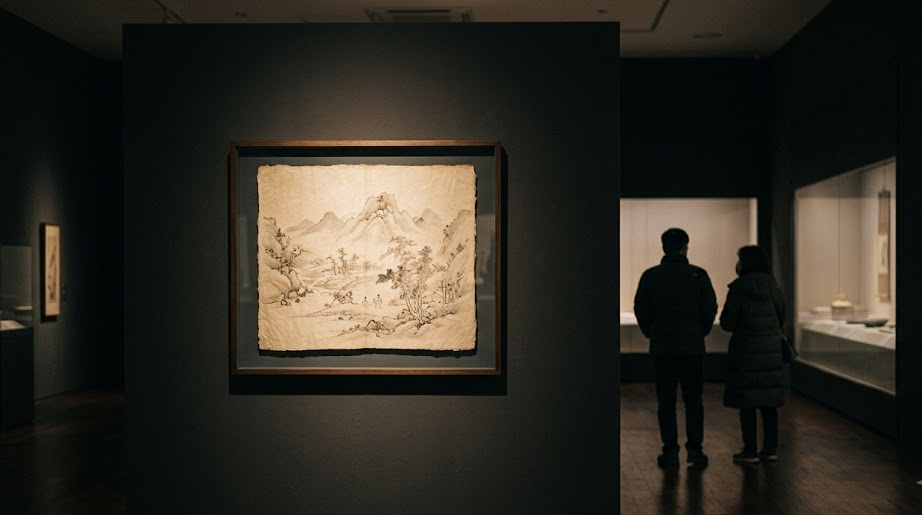
The National Museum of Korea opened the thematic exhibition "Danwon Kim Hong-do, Painting His Age" on the 4th in the painting and calligraphy gallery of the permanent exhibition hall. The gallery replaces all of its displayed works every three months, and Kim Hong-do (1745-1806 or later) has been hung as the face of this rotation. What has been put out comes to 96 pieces in 50 items, eight of them Treasures. It is the second thematic exhibition, following the rotation that dealt with the work of Gyeomjae Jeong Seon.
Paper swallows light when it ages. That is why the lighting in the painting and calligraphy gallery is low, and only after passing through a dim corridor and standing before the glass do visitors make out the shading of the ink and the faint apricot tint of the light color. Kim Hong-do's paintings give off sound in that darkness. The murmur of the wrestling ring, the beat of the dancing boy, the clink of cups that must have passed at the banquet table on Manwoldae leak out beyond the picture surface.
Painting Gallery 2 is the center of this exhibition. Of the Treasure "Danwon Genre Painting Album," only 11 of the total 25 pieces are out, among them "Dancing Boy" and "Wrestling." The rest are being spared because of the lifespan of the paper, so showing and preserving always push against each other even within a single album. The restraint of 11 pieces is the result of that push and pull.
What the eye lingers on longest is the brush of his sixties. "Girosaryeongyedo" depicts a gathering of elders held at Manwoldae in Gaeseong. The old men seated before the banquet tables number sixty-four, and the attendants and onlookers filling the space beside them are counted at two hundred and thirty-seven. That the picture surface is not cluttered even with this many people standing in it is probably because eyes that had looked into the marketplace all his life knew how to handle a crowd.
"Nomaedo," painted in the same sixties, is also out on loan from a private collection. It is a painting of the bent trunk of an old plum tree. "Chongseokjeongdo," painted at fifty-one, is a picture surface on which the stone pillars of the East Sea stand, and it is understood to be a work that has never been hung in an exhibition hall before. The one-slot name tag of genre painter comes loose at this point.
Painting Gallery 1 turns the gaze toward his teacher. It sheds light on his exchanges with Kang Se-hwang (1713-1791) and hangs Kim Hong-do's "Seowonajipdo," on whose surface the teacher's appraisal is written alongside. The way a teacher's writing was laid over a pupil's painting was an old habit by which the Joseon painting world joined one generation to the next. The range of Kim Hong-do, who handled landscape, bird-and-flower and figure painting alike as a court painter at the Dohwaseo, can also be gauged in this room.
Painting Gallery 3 holds court decorative color paintings and folk paintings. The wall paintings of Gyotaejeon Hall at Gyeongbokgung Palace (late 19th century), all three pieces of "Banquet of the Pyongyang Governor" in Kim Hong-do's style, and "Munbangdo," donated by the late chairman Lee Kun-hee, are reported to be out together. The calligraphy gallery shows the writing of master calligraphers in sequence from the early Joseon period to the modern era. If painting gives off sound, calligraphy is the side that shows breathing.
There is one more item being made public for the first time in this rotation. It is a letter in Yi Sun-sin's own hand. The museum explained that it was sent on July 8, 1598 to the chief supply officer in charge of provisioning, writing done four months before the Battle of Noryang. Beside a room that gathers a painter's late years, the late years of another man remain on paper.
The works in the painting and calligraphy gallery will change again after three months. The 11 genre paintings now hanging and the paintings of his sixties are within that cycle. Director Yoo Hong-jun will give a lecture on "The Life and Art of Danwon Kim Hong-do" on June 2 at the museum's Yong Theater. Counting the two hundred or so people at Manwoldae is allowed only to those who stand a long while before the picture surface, so it would be well to bring time enough not to hurry.