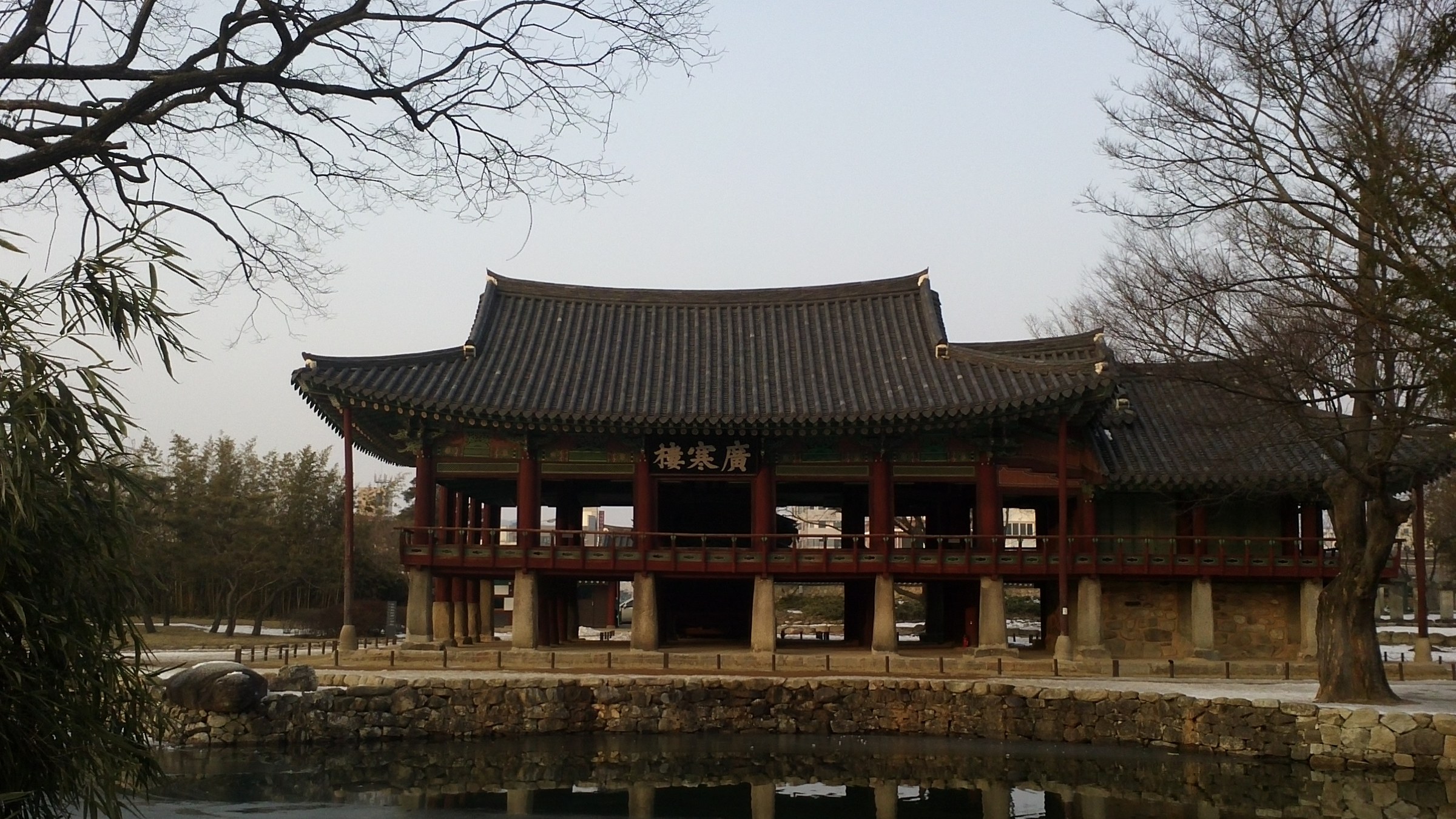
The Korea Heritage Service has announced its intent to designate "Namwon Gwanghallu" as a National Treasure among state-designated cultural heritage. It is the government pavilion that represented Honam in the late Joseon period, the wooden building long called "Honam jeilnu," the finest pavilion in Honam. The announcement was made on the 24th.
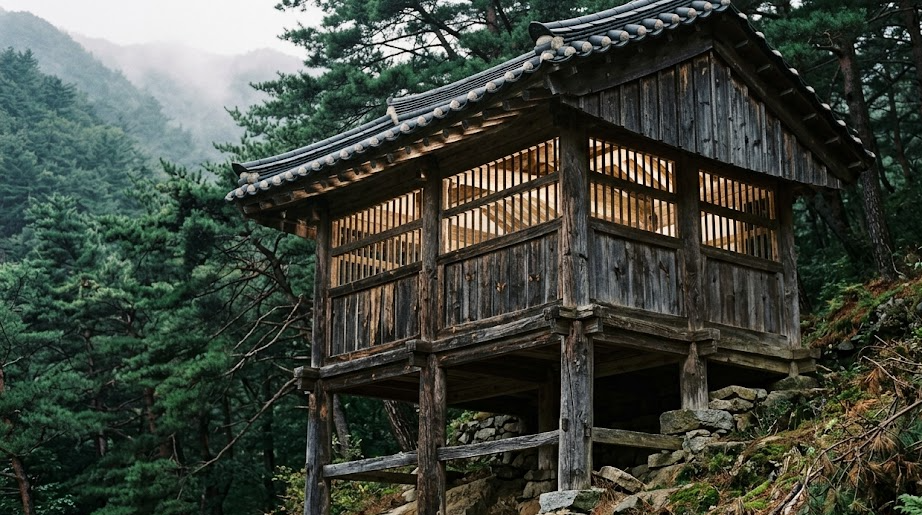
Gwanghallu's body is wood. Thick columns hold up the floor, and the floor opens toward the water at a height slightly above a person's feet. Climbing up in summer, the damp smell the wood has absorbed reaches the nose, and the floorboards creak low with each step. The sound of timber that has endured nearly 400 years can be confirmed only by the weight of a human body.
Its origin was a small pavilion named Gwangtongru. This building, said to have been erected when Hwang Hui was exiled to Namwon, later became Gwanghallu. After that, the place was used as a space where officials and literati gathered to hold banquets and exchange poetry and prose. The pavilion was a government facility and at the same time a stage where poems passed back and forth.
The scenery around the pavilion was also made by people. A lake was dug and three islands named Bongnae, Bangjang and Yeongju were set afloat on it, and the Ojakgyo bridge was laid across that water. It is said to have passed through the hands of Jeong Cheol and Jang Uiguk. This arrangement, which took the names of the three divine mountains where immortals are said to live and applied them directly, carried the intent of redrawing a garden on earth as the geography of heaven.
But the pavilion disappeared when the flames of the Jeongyu War swallowed Namwon in 1597. The one who rebuilt it was Sin Gam, the magistrate of Namwon. Rebuilt in 1626 at the same scale as today, this building is said to have kept its site since then without major changes in form. The floor we climb today rests on the frame assembled at that time.
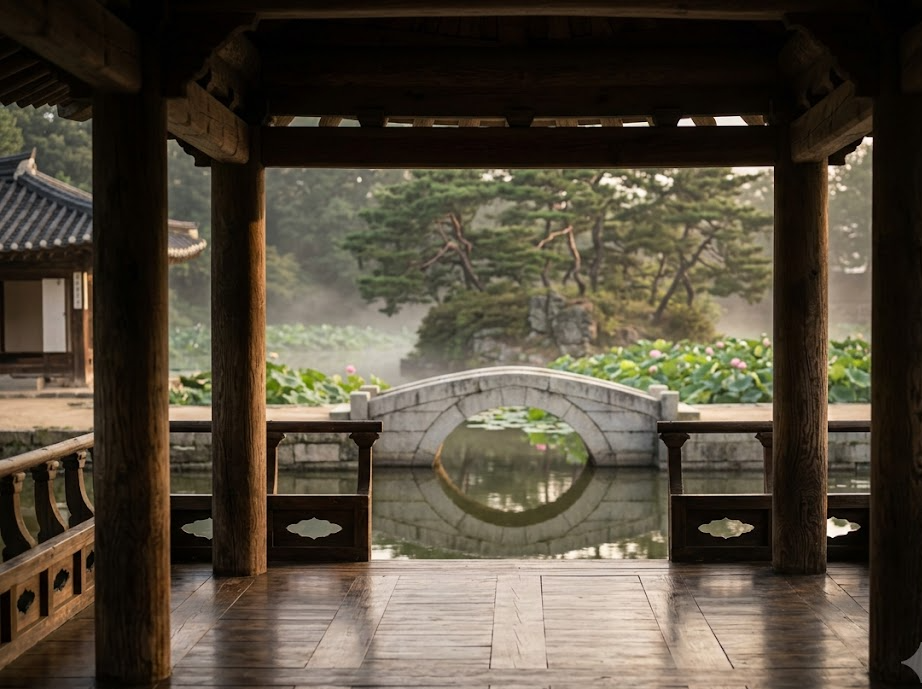
Gwanghallu became known beyond Namwon not only because of its architecture. The pansori and classical novel "Chunhyangjeon" took this pavilion as its stage. As this building was named the place where Yi Mongnyong and Seong Chunhyang first met each other's eyes, a single wooden pavilion came to carry an entire city's story. This is the starting point at which the place name Namwon came to travel alongside a narrative of love.
So the eyes that read Gwanghallu are divided in two. One sees the accomplishment of 17th-century wooden architecture, and the other sees the symbolism that legend has layered onto it. Its assessment as a case where garden and building do not run separately but form a single landscape is also the result of both eyes working together. The National Treasure announcement is closer to a procedure that officially recognizes the architectural accomplishment among these.
The tension arises here. The greater the power of the story, the more people gather, and the more people gather, the more the 400-year-old floorboards and columns wear down. The Korea Heritage Service said it will take the designation announcement as an occasion to work with local governments and continue systematic preservation and management. That a decision to raise its standing is not at once a decision to widen access is something this pavilion's age quietly tells us.
The point at which the National Treasure designation is confirmed remains open. A procedure remains that must pass through the announcement period and then a review. In the meantime the gates of Gwanghalluwon stay open, and the water of the pond changes color with each season.
Now, as spring draws to a close, it is worth climbing onto that floor in Namwon. Take off your shoes and stand on the wood, and there is a coolness that comes through the soles of your feet. It is a temperature made by the marks of countless feet that have passed over 400 years. Once you have felt that touch, the two words "National Treasure" turn from a grade on paper into something you can hold in your hand.