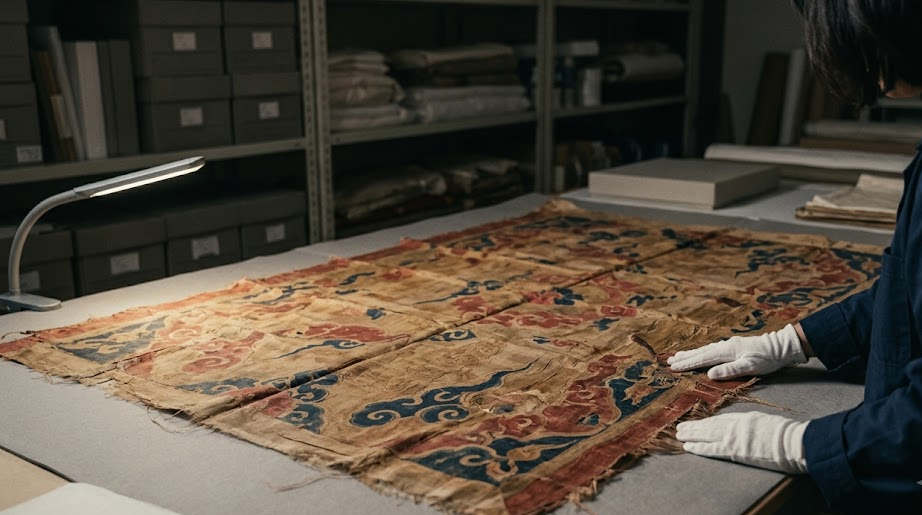
Five Joseon ceremonial flags that hung at the 1893 World's Columbian Exposition in Chicago will undergo conservation treatment in the United States. The National Palace Museum of Korea under the Korea Heritage Service and Riot Games announced the plan on the 13th. The flags include the hogi (虎旗), painted with a tiger, and the jujakgi (朱雀旗), painted with a red bird, banners used in royal processions and military rites. After treatment they will come to Korea on loan and meet visitors here for the first time at a special exhibition at the National Palace Museum of Korea in December.
The flags were both image and sound. The spotted beast of the hogi and the red bird of the jujakgi were painted in colored pigments on large cloths, and each time a procession moved, the cloth caught the wind and made a snapping sound. Lined up before and behind the king's procession, these flags were devices that announced direction and rank to the eye. It was in 1893 that objects used inside the palace first crossed the Pacific and hung on the wall of an unfamiliar exposition hall.
The exposition that year was the first world's fair in which Joseon officially took part. Joseon presented 27 pieces of cultural heritage, and five of them are the subject of this conservation work. After the exposition closed, these objects did not return to Joseon, and they remained in the collection of the University of Pennsylvania Museum of Archaeology and Anthropology, spending 133 years there. There is no settled account of how they came to stay in the United States.
The damage is severe, so the restoration process will be carried out locally before the flags are brought to Korea. With old textiles, the act of moving them easily becomes damage in itself. Fibers break along the fold lines, and the pigment layer crumbles under vibration. That is why the threads must be secured before the crossing of the Pacific.
Conservation and use do not always stand on the same side. The longer a piece stays spread out under exhibition lighting, the more its colors fade, and each time temperature and humidity change, the cloth expands and contracts slightly. Even so, if it is kept only inside a case, no one can see what the flag was made for. This project chose to stabilize the condition in the United States and then show the flags in Korea for a limited time, and the details of the loan terms are outside what has been disclosed.
The National Palace Museum of Korea signed an agreement in February with the University of Pennsylvania Museum of Archaeology and Anthropology and the National Trust for Cultural Heritage, laying the groundwork for this work. Riot Games, the sponsor, has taken part in the recovery of cultural heritage abroad seven times with the Korea Heritage Service since 2012. In 2022 it supported the conservation treatment of 15 nobu ceremonial objects of the Joseon royal court, and in 2024 the reproduction of three royal paintings and calligraphic works in the National Palace Museum of Korea's collection. Its cumulative sponsorship for Korean cultural heritage has passed 10 billion won.
As more cultural heritage returns, the question of who will bear the time after the return, and how, grows with it. Recovery does not end at the moment a contract is stamped. It is completed only through months of labor spent reattaching a single thread. These five flags show a path in which, rather than taking over ownership, the work begins by securing the damaged condition.
The special exhibition "World's Fair" is a working title, and while the schedule has been set for an opening on December 2, the name and the run may still be refined. In the exhibition hall of the National Palace Museum of Korea inside Gyeongbokgung Palace in Seoul, visitors will come face to face with the cloth that hung on a Chicago wall in 1893. One tiger and one red bird will meet the same air as the end of Joseon again after 133 years. Visitors entering the hall will first be struck anew by how large these flags are.