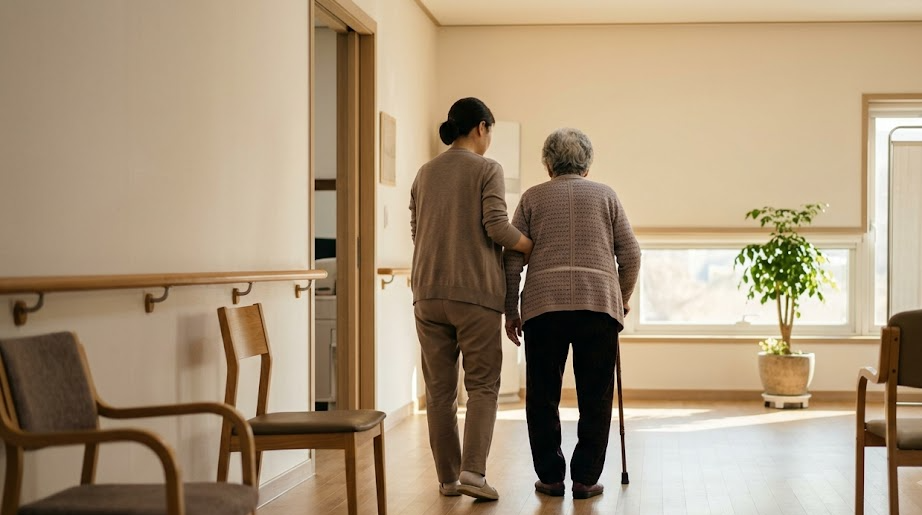

With the Act on Integrated Support for Community Care Including Medical and Long-Term Care taking effect, local governments across the country have started running their own integrated care. Jeju Special Self-Governing Province said on the 8th that the cumulative number of users of "Jeju Gachi Dolbom" (Jeju Value Care) had reached 17,349. Goryeong-gun in North Gyeongsang Province signed consignment contracts with two service providers, and Gimje in North Jeolla Province set out "a life carried on peacefully in the place where one has lived" as this year's policy vision. The design is to have people receive medical care, long-term care and housing together in the home they live in now, without moving to a facility or a hospital.
The rise in users in Jeju is clear. The service started in October 2023 and was used by 683 people that year, 3,775 in 2024 and 8,337 in 2025. As of March 2026 the figure was 4,554, up 116.9% from 2,100 in the same period a year earlier. The province has placed integrated care help desks in eup, myeon and dong offices to take consultations and applications, and announced a plan to connect discharged patients and others to daily living care services.
Gimje links public care such as long-term care insurance and customized care for older adults first, with home visits by doctors and hospital accompaniment as its axis. To that it added meal, transport and housework support, home environment improvement, emotional support and case management, and it grouped transport support, rehabilitation exercise and meal support separately as "Gimje-type specialized services." Goryeong-gun draws up an individual support plan and then connects services after review by an integrated support committee. The Goryeong Regional Self-Sufficiency Center handles accompanied transport support, meal support and home environment improvement, and the Dasan Sugyeong Senior Welfare Center handles housework support and bathing support.
Some places moved ahead of the law taking effect. Daedeok-gu in Daejeon created an ordinance in 2019 and began integrated care, and in 2023 it set up a six-person dedicated team first, with no budget. Of a population of about 165,000, 22.6% are 65 or older and 42.8% are single-person households. Of about 10,000 registered residents with disabilities, 54% are over 65, and over 10 years the population fell by 30,000 while the older population doubled.
Daedeok-gu runs a "prevention track" for healthy older people aged 65-75 and an "intensive care track" for older adults with severe conditions separately. There is also "Neulbomchae," care safety housing that ties housing, medical care and care together. It has signed agreements with 80 medical, long-term care and care institutions, and over three years from 2023 it provided 3,862 services to about 1,680 people. The project runs to about 1.4 billion won, filled by pulling together state funds, the regional extinction response fund and hometown love donations.
Scraping funds together from here and there also means there is no stable source of funding. The same point was raised at a forum on "seeking the role of social welfare under the Integrated Care Support Act," held by the Korea National Council on Social Welfare at the Korea Social Welfare Building in Gongdeok-dong, Mapo-gu, Seoul. At the forum, where Shin Chang-hwan, a professor at Kyungpook National University, gave the presentation and Chung Jong-hwa, a professor at Sahmyook University, served as chair, the weak manpower and financial base of local governments, the limits of centralized operation, and the shortage of dedicated staff and medical infrastructure in the field were cited as tasks. Nam Il-seong, a professor at Sungkonghoe University, Kim Yi-bae, an expert member of the Association of Mayors, County Governors and District Heads of Korea, and So Yeong-mi, secretary general of the Yeongwol-gun Council on Social Welfare, took part as discussants.
Saying that care is moved into the home can also mean the burden is handed back to families. In the Ministry of Health and Welfare's 2025 survey on dementia, 45.8% of the families of dementia patients reported an extreme care burden. The cost for one patient was put at an annual average of 17 million to 30 million won. If public services do not fill that gap, "in the place where you have lived" reads as "families sort it out themselves."
There are desks that can be used now. Dementia relief centers at public health centers nationwide provide customized case management, cognitive strengthening programs, treatment cost support, care supplies and family counseling free of charge. Jeju takes consultations and applications at eup, myeon and dong help desks, and Gimje and Goryeong connect services through designated providers. Whether someone is caring for a mother or living alone, it means one place to call today has appeared in each neighborhood.
The visions and contracts the local governments set for themselves are now out. What has to be checked next is how many staff are attached to those contracts and whether next year's budget is larger than this year's. The course by which Daedeok-gu started with a dedicated team without a budget and reached a scale of 1.4 billion won in seven years shows that this work does not end with a single declaration. How far the other local governments can shorten those seven years becomes the first year's report card.