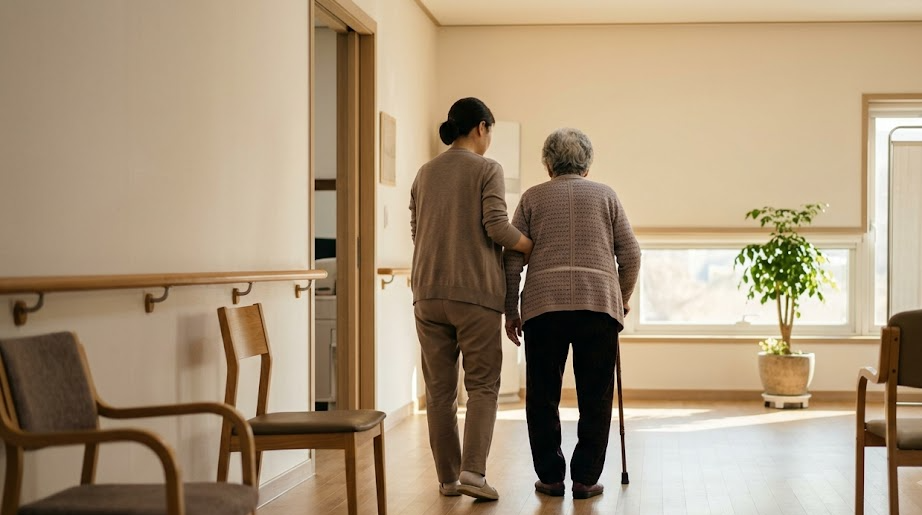
The Act on Integrated Support for Community Care Including Medical Care and Long-Term Care took effect on the 27th of last month. It is a system that ties medical care, long-term care and daily care together so that people who have difficulty with daily life because of frailty, disability, illness or accident can go on living in the homes where they have lived. A week after the law began to operate, the point being raised in a number of regions is aimed at the employment terms of the people who actually perform the services with their own hands rather than at the list of services.
The Incheon Social Service Agency directly operates comprehensive home care centers in three places: Michuhol, Bupyeong and Ganghwa. Bupyeong and Ganghwa switched care workers to full-time employment in 2022. Only Michuhol remains on an hourly wage system, and there, 9 of 15 care workers quit last year. The center opened in September 2024 and has not been running long.
Under the hourly system, wages are calculated only for the hours spent visiting users' homes. If a user is hospitalized or dies, that month's income drops immediately. When one older person's condition changes, the livelihood of the person caring for them shifts as well, so a relationship of staying beside someone for a long time is hard to build.
This is not the first time the issue has been raised. In December 2021, the Dagachi Union held a press conference demanding that the Incheon Social Service Agency introduce full-time employment, and on the 24th of last month a "press conference urging proper implementation of integrated care" was held again in front of Incheon City Hall. Lee Soon-hwa, head of the Incheon Social Service Agency branch of the Dagachi Union under the Korean Confederation of Trade Unions, spoke that day. The same demand has been repeated for more than four years.
Money weighs on this demand as well. The Incheon Social Service Agency requested about 8.1 billion won from the Incheon Metropolitan Government as its total institutional budget for 2026, but through consultation with the city's Health and Welfare Bureau the figure was cut to about 5.5 billion won. In Incheon, moreover, the department in charge of the Social Service Agency is the Welfare Policy Division of the Health and Welfare Bureau, while the department handling integrated care support is the Integrated Care Division of the Loneliness and Care Bureau.
While a law calling for the integration of care is being implemented, the hand holding its workforce and the hand holding its programs are different. The Incheon Social Service Agency began in 2019 as the Incheon Welfare Foundation and was expanded and reorganized into a social service agency the following year.
In other regions, experiments in connection are under way. Hanam City has signed agreements on a community linkage project for discharged patients with six medical institutions: five within the city, Haetsal Hospital, Bobath Hospital, Misa Riverside Convalescent Hospital, Life Convalescent Hospital and Gangdong Misa Korean Medicine Hospital, and the Veterans Health Service Medical Center outside the city. It targets older adults aged 65 and over and people with disabilities, and is an attempt to narrow the gap on the way home after discharge. Bucheon City, after being selected as a pilot project city by the Ministry of Health and Welfare in 2019, has built up a "Bucheon-style integrated care" that links medical care, long-term care, welfare, housing and daily support.
The "community health care leaders" of the Bucheon Medical Welfare Social Cooperative stand out among these. Residents receive training, watch over their neighbors' health conditions, and connect them to medical staff when needed. This route, in which a neighbor notices before the system reaches, is also the plainest form of what it means for care to take root in a community.
On the convalescent hospital side, discussion of covering caregiving under insurance continues. The scope has been narrowed to patients with severe rare and intractable diseases among those in the highest and moderate medical acuity categories, along with patients with dementia, Parkinson's disease and ALS, and since discussion continues in expert advisory meetings, nothing has been finalized. A picture has also been presented of dividing convalescent hospitals into 500 covered by caregiving insurance and 800 with voluntary caregiving, with the 500 taking on around 100,000 patients at 200 per hospital, but the basis for the calculation has not yet been made public.
The system is called integration, but what actually performs the integration is the labor of opening another person's front door, going in and holding together one person's day. In a place where more than half of that labor turns over in a single year, users too have to start over from the beginning with a new face each time. In Incheon, the demand for a switch to full-time employment is still sitting on the table of the city budget consultation. What will be fixed in the law's first year will be decided at that very table.