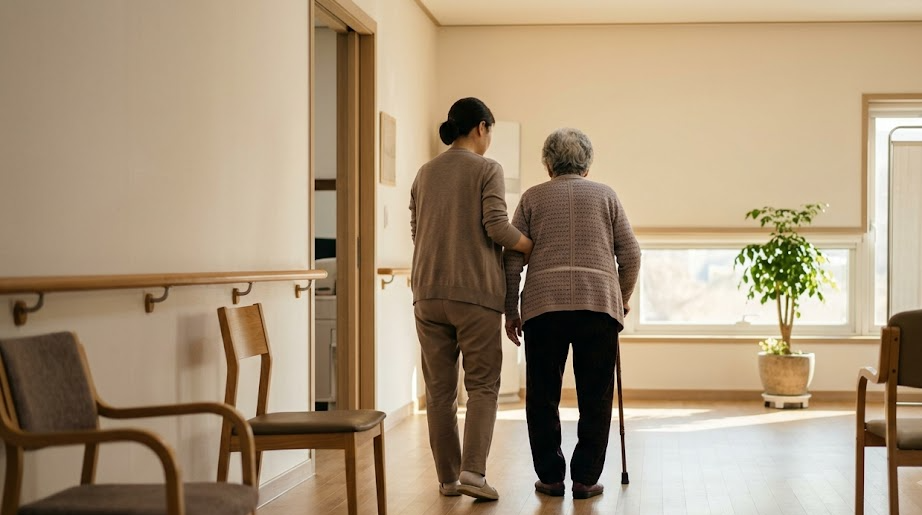
The 'Act on Integrated Support for Community Care Including Medical and Long-Term Care', or the Integrated Care Support Act for short, took effect on March 27. From the same day, local governments across the country entered the main phase of community integrated care. Those covered are people aged 65 and older who need several kinds of help at once because of frailty and illness, and people with severe disabilities such as physical or brain lesion disabilities who have high medical needs. It is the first case in which an option other than moving to a hospital or a facility has been written into the sentences of a law.
The procedure is fairly simple. An application can be filed at whichever is convenient among the eup, myeon and dong community service centers, the city, county and district offices, and the National Health Insurance Service. A specialist then reviews 58 items such as daily living function and health status to make a comprehensive assessment, and designs and connects a combination suited to that person from among 30 services in the four areas of health care, health management, long-term care and daily living care. That means bathing and meals, escort to hospital, lowering thresholds and installing handrails are all linked through a single window.
The Ministry of Health and Welfare said on the 26th, a day before the law took effect, that it had completed the placement of dedicated integrated care units and staff in all 229 cities, counties and districts nationwide. The system was designed in three stages, an introduction stage (2026-2027), a stabilization stage (2028-2029) and an advancement stage (from 2030). The scale the introduction stage takes on is set at 1.28 million older people standing on the borderline of hospital or facility admission, 1.46 million people with disabilities aged 65 and older, and 150,000 people with severe disabilities under 65.
The funding to carry that scale is not as thick. The budget the government has set for integrated care this year is presented as 91.4 billion won, while another count puts the share that actually goes down to basic local governments at 62 billion won once labor costs and other items are taken out. The two figures are hard to compare as they are, because the scope of calculation differs. Counted either way, the project funds one local government can spend average less than 300 million won.
The fact that the funding is scattered adds to the burden. The creation of a care fund that would gather into one stream the money divided among central government and local government budgets, health insurance and long-term care insurance remains at the discussion stage. The method of taking a little from several pockets to fill one person's day has been passed on to the field as it is.
A day before the law took effect, the question of people broke out in the front yard of the National Assembly. The Federation of Korean Trade Unions and the Korean Confederation of Trade Unions held a news conference at the National Assembly Communication Hall on the morning of the 26th and demanded that unions be able to take substantive part in the process of discussing integrated care policy, and that measures to improve the treatment of care workers be put forward. The conference was co-hosted by Rep. Nam In-soon and Rep. Lee Soo-jin of the Democratic Party of Korea. Care that goes to the home is in the end made up of the labor of someone climbing the stairs of that home.
On the day the law took effect, the Democratic Party of Korea's Special Committee on Social Welfare held a seminar, 'The Opening of the Integrated Care Era, the Role of the Special Committee on Social Welfare', in Meeting Room 9 of the National Assembly Members' Office Building. Kim Won-il, a professor at the Graduate School of Education of Ewha Womans University, presented 'The Structural Shift of Care Policy in 2026', and Lee Yong-jae, a professor at Hoseo University, presented 'Community Integrated Care and Strengthening Services'. Health and Welfare Minister Jeong Eun-kyeong and Park Ju-min, chair of the National Assembly's Health and Welfare Committee, sent congratulatory messages in writing.
The enforcement decree holds the key to widening the reach of the system. The decree limited eligibility to people aged 65 and older or registered people with severe disabilities, and to bring anyone else into the coverage a local government must first consult with the Ministry of Health and Welfare. Even if a region finds a young patient with a severe condition or a single-person household whose care has been cut off, it is hard to take them in right away before going through this consultation. The law has opened the way for finding eligible people and carrying out the policy to be entrusted to specialized institutions, and how the public and private sectors will share this work is drawn up from now on in each region.
There are also signs worth putting some hope in. In the pilot project carried out earlier, the share of those who had been providing care, including family members, who answered that their support burden had decreased is put at 75.3%. It is a response that shows what changes when care moves from one family's private share to the work of a community.
The introduction stage runs until 2027. How far the size of the budget and the conditions of care workers are filled in during those two years will make the real face of this law. What is clear is that the conversation that until yesterday began with counseling on entering a facility begins from today at the eup, myeon and dong window with "How can you keep staying in this home?" If the day of a parent or a neighbor aged 65 or older is precarious, an application form can be received at either a community service center or a branch of the National Health Insurance Service.