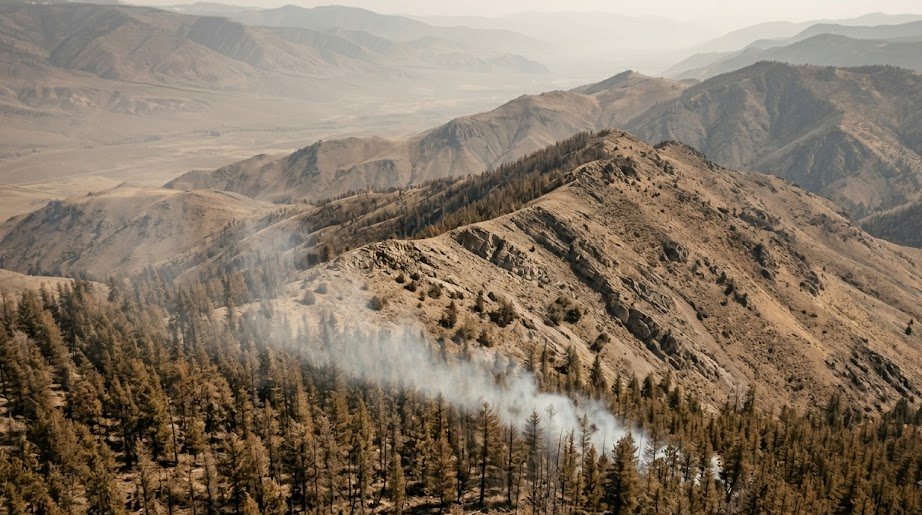
The Korea Forest Service raised the national wildfire disaster crisis alert nationwide from "caution" to "alert" as of 4 p.m. on the 26th. As of that point, dry weather advisories were in effect across most of the country except the Honam region. Over the past week, 36 wildfires broke out nationwide. The season when spring flowers bloom and the time when forests are at their driest have arrived together again.
Under the raised level, forest disaster prevention agencies place at least one sixth of their officials on emergency standby and increase monitoring personnel in areas vulnerable to wildfire. Local governments activate regional disaster and safety countermeasure headquarters to prepare their response. The national wildfire disaster crisis alert operates in four stages: attention, caution, alert and serious. This adjustment raised the level by one stage, from caution to alert.
Korea Forest Service statistics show that late March is the time of highest wildfire risk in the year. The massive wildfires that swept the Yeongnam region last year also occurred at the same time. It is hard to see this as a coincidence of the calendar.
It is closer to a seasonal condition in which the leaf litter dried through the winter, rising temperatures and increased outdoor activity all come together at once. That the same conditions repeat every year means the timing of preparation is also predictable every year.
Forest authorities pointed first to the physical risk created by dry weather advisories and rising temperatures as the reason for the raise. They also cited the preemptive nature of acting in advance ahead of a sharp increase in hikers and spring outing visitors during the flowering season. It is an approach that deploys personnel before the risk arrives, rather than following after the risk has broken out.
Seen more broadly, this alert is not a one-off event. In 2025 in Korea, record heat waves and large wildfires, a severe drought described as the worst in 108 years, and torrential rain exceeding 100mm per hour all appeared within a single year. It is a pattern in which the dry season and the wet season each run to extremes. Land that has been dry for a long time burns more easily, and burned forest cannot hold back the downpours that follow.
There is no need to read such records as grounds for despair. That observed values remain showing how heat wave days, drought intensity and rainfall intensity built on one another within a single year means the priorities of adaptation policy do not have to be set by intuition. Where to place personnel in which season, and which forests to fit with firebreaks and water storage facilities, can be weighed using observed values. Analysis compiling the 2025 records is reported to have been taken up at the level of a body under the direct authority of the president.
Of course, records do not become policy on their own. With adaptation alone and no reduction, the range of extremes keeps widening, and with reduction slogans alone and no adaptation, the fires burning on ridgelines this spring cannot be stopped. The seasons Korea went through last year showed that both axes have to be pushed together. And much of that implementation begins with individual behavior before budgets and personnel.
Kim Si-hoon, head of the Korea Forest Service's Wildfire Prevention Division, asked people to refrain from illegal acts such as smoking and unauthorized burning near forests. Most causes of wildfire ignition originate at human fingertips. If you plan to climb a mountain to see the flowers this weekend, it is enough to leave the lighter out of your backpack and not burn the dry brush at the edges of fields. In a forest at the alert stage, the cheapest and surest firefighting equipment is a spark that was never lit in the first place.