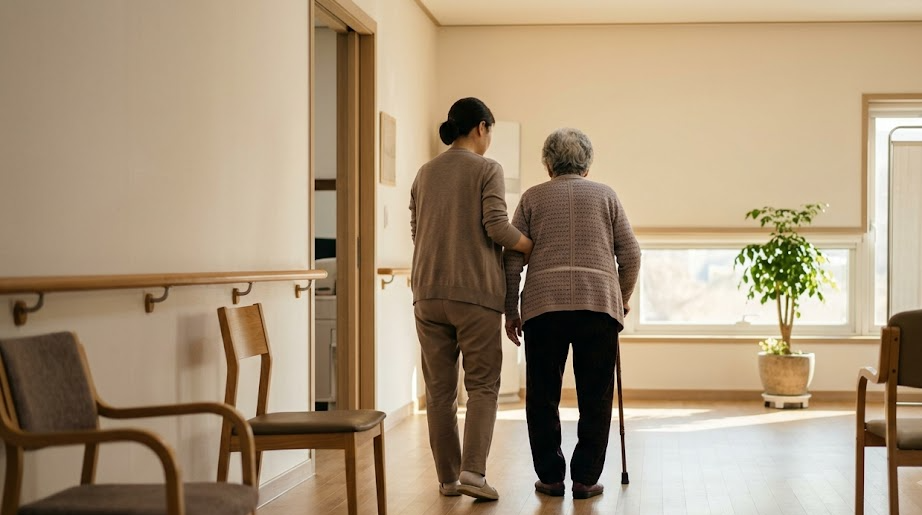

Community-based integrated care takes effect nationwide from March 27. It is a system that allows people to receive medical, long-term and daily care together while remaining in their own homes rather than moving to a hospital or facility. The law behind it is the Act on Integrated Support for Community Care Including Medical and Long-Term Care, shortened to the Integrated Care Support Act. The same week, a law supporting children and young adults who care for family members also takes effect.
The process begins with a single application. Applying at either an eup, myeon or dong community service center or the National Health Insurance Service is enough, and the local government then draws up an individual support plan suited to that person and connects the services. Assessment is carried out through an integrated assessment survey examining 58 items across five areas including medical care, nursing and functional ability, and once a plan is confirmed, reviews follow every three months. Connecting the process of returning to the neighborhood after discharge from a hospital or departure from a facility is also part of this flow.
In the first year, the target group is older people who have difficulty managing daily life on their own, older people with disabilities, and people with severe disabilities who have high medical needs. This includes home care benefit users aged 65 and over, people who did not receive a long-term care grade, and discharged patients. The Ministry of Health and Welfare's roadmap divides 2026-2027 as the introduction period, 2028-2029 as the stabilization period, and 2030 onward as the advancement period. In 2028 the scope widens to include people with mental illness and others, and in 2030 the plan is to expand to all citizens who need care.
The range of services also grows in stages. It is organized into four branches, health care, health management, long-term care and daily living care, and this year it starts with 30 types including home visit treatment, dementia management and household support. Through the roadmap on March 5, the government said it would increase these to 60 types by 2030. Home visit rehabilitation, home visit nutrition and hospital accompaniment are to be included.
Regional population data explains why this system is needed. Daegu entered super-aged society status in April 2024 with people aged 65 and over making up 20.9% of its population, passing through 22.1% in 2025 to reach 22.4% this February. Of 2,351,461 people, 525,605 are aged 65 and over. Households of older people living alone also more than doubled, from 57,723 in 2015 to 117,487 in 2024, and by 2052 an estimated 42.5% of Daegu's population will be older people.
What those concerned want their later years to look like is clear. In Daegu's 6th Community Social Security Survey, 2,964 households with older members were asked what they would do if their health worsened, and 71.6% answered that they would receive home care services and stay where they currently live. Those who said they would enter a care facility accounted for 18.6%.
Daegu has named its integrated care model "Dandi Care" and starts it on the 27th. Applications can be made without regard to income or assets, and services are connected about a month later after a home visit survey and assessment.
When it comes to money, assessments differ. This year's integrated care budget is 91.4 billion won, and about 62 billion won of that is allocated to expanding local government specialized services. On the nature of this money, the Ministry of Health and Welfare explained on March 19 that it is only a budget to help expand specialized services and is not the entire funding for integrated care, and that other sources such as health insurance and long-term care insurance are also involved.
On the other hand, some point out that this is the actual amount available once personnel costs and system construction costs are excluded. At a funding debate held at the National Assembly Members' Office Building on March 18, the problem was raised that the funding is scattered across the general account, the special account for balanced development, the health promotion fund, health insurance and long-term care insurance.
The conditions of the people who actually run the system also became an issue before the launch. In Incheon, a press conference calling for proper implementation of integrated care was held on the morning of the 24th in front of city hall, organized by the Korean Confederation of Trade Unions Incheon branch. Although the Incheon Social Service Agency was designated as a specialized institution for integrated care, the union argued that care workers at its Michuhol Comprehensive Home Care Center are employed on hourly-wage fixed-term contracts, leaving even the 15-person quota unfilled. A demand to revise the enforcement decree, which limits eligibility to people aged 65 and over and those with severe disabilities, was raised as well.
The foundation itself is in place. All 229 cities, counties and districts nationwide have finished preparations by enacting ordinances and setting up dedicated organizations. Since those 229 local governments share the 62 billion won, concerns follow that the range of services may vary by region. The nationwide figure of 30 types and the roughly 90 that Daegu says it has prepared are counted in different ways, making direct comparison difficult.
Once the 27th passes, applications will start piling up at each local government's counter. Families who worried about where a parent should go after discharge from hospital, and older people who were left out of grade assessments and received no services at all, will be able to get an answer through a single application for the first time. How much that answer varies by neighborhood will become clear this summer when the first service connection figures come out. What is certain now is that, instead of telling someone who has come to find a few stairs hard to manage to pack their bags, the state has for the first time chosen to send people to that home.