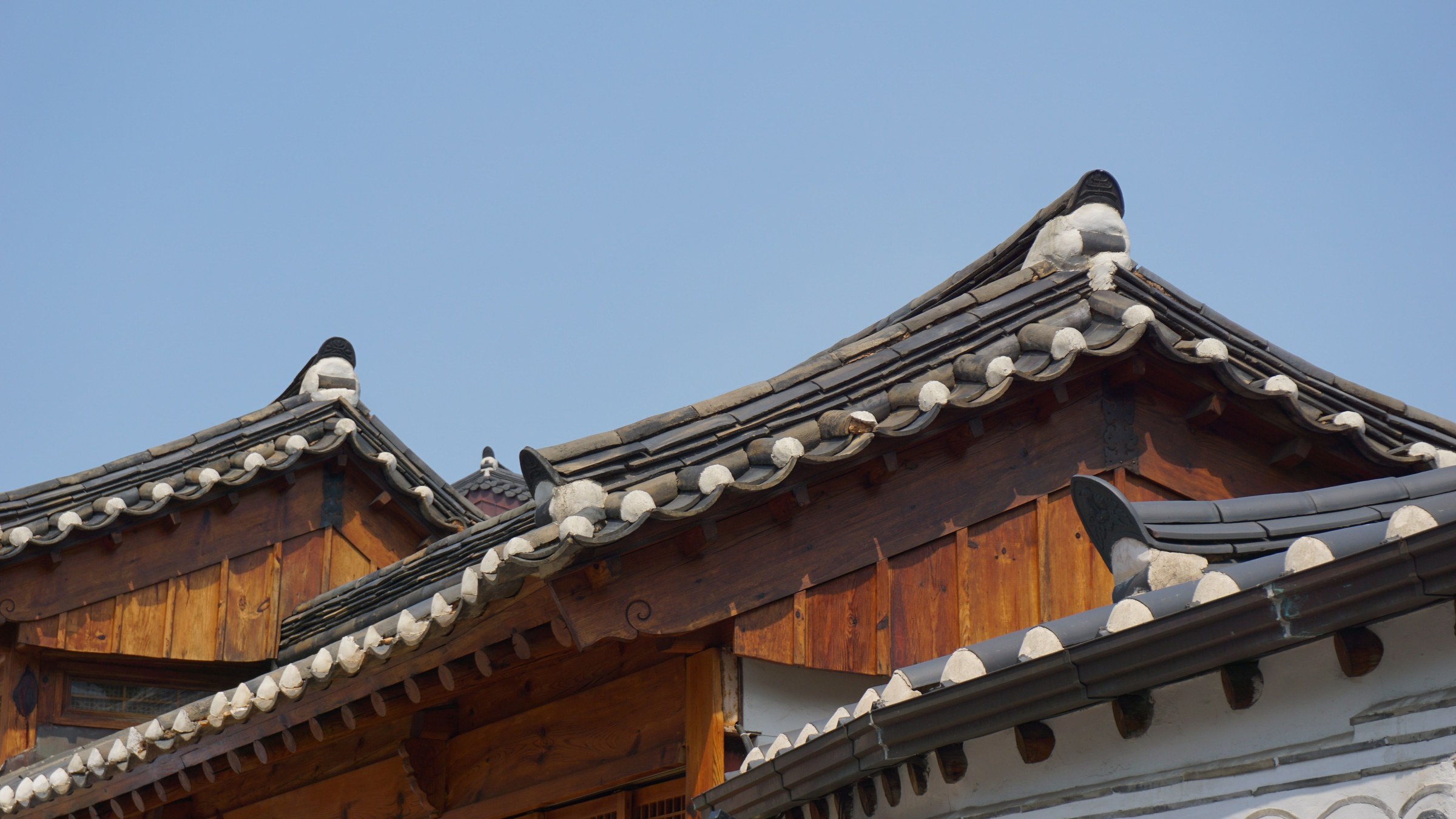
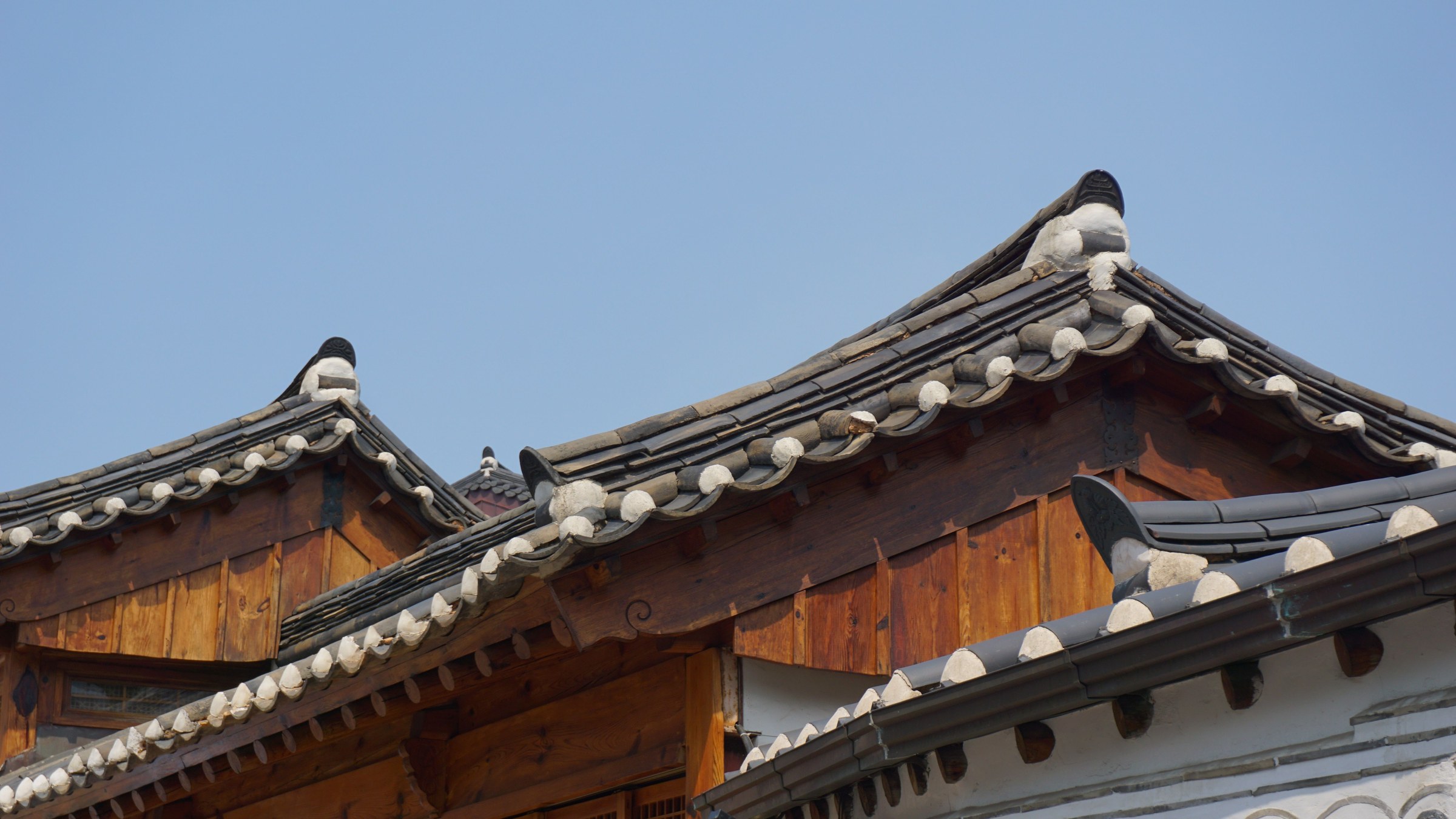
Under a cloudless spring sky, several tiled roofs lock shoulders. Along the ends of the eaves, white plaster is set like round dots, and beneath it the wooden walls have ripened red with the color of long exposure to the sun. The shadows are short and sharp, so it is the hour when the sun stands highest.
A single roof tile can do nothing on its own. Only when the belly of the next tile is laid on the back of the one in front, and another tile on that back, does a channel for water appear. Nothing in the roof's curve was attached as decoration.
It is the result of laying one tile at a time, and a design that measured in advance the path rainwater would take. The lines in the photograph look soft because that design was refined over a long time.
Resting on one another is not the work of the tiles alone. The end of the left roof covers the body of the middle roof, and the ridge of the middle roof disappears behind the eaves on the right. Somewhere at the back, another ridge pokes its head out. The layers made by houses that live wall to wall, brushing eaves against eaves, are the shape of a village that no drawing records.
Following the shadows, you come to see that the angles at which the roofs sit are slightly out of line with one another. The shade of the left eaves falls straight down the wall, while the dark band made by the middle roof is pushed at a slant toward the yard. It reads as a sign that the houses locking shoulders can hardly be said to sit facing exactly the same place. If the sunlight is the same and the slant of the shade differs, the shape of things resting on one another is closer to a trace of enduring each one's own circumstances than to a rule.
The spring sunlight reveals this order of stacking for a moment and soon erases it. When the sun tilts, the shadow of the front roof will climb onto the roof behind it, and the layers that were clear a moment ago will merge into a single black ridgeline. If you look at the photograph again, we suggest counting from the far end, from the roof that hangs most faintly.