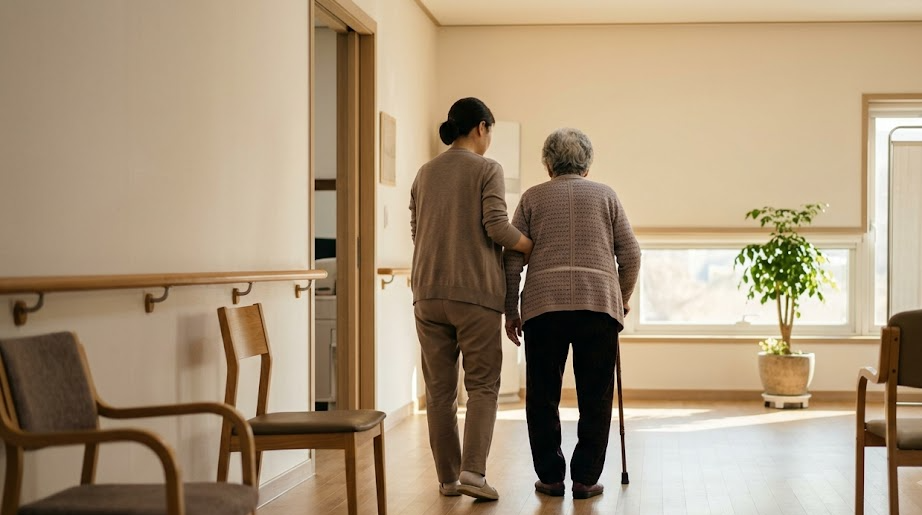
Community-based integrated care takes effect nationwide on the 27th of this month. It is a system under which people who had to move between hospitals and facilities and apply separately for each service they needed will receive linked support in one place. Ahead of the launch, an analysis found that South Korea's public social welfare spending is lower than the OECD average. It means the scope of care is widening while the size of the budget to support it falls short of international standards.
The Ministry of Health and Welfare held the third Integrated Care Policy Committee meeting at the Government Complex Seoul on the 5th of this month and announced the "Community-Based Integrated Care Roadmap." Minister Jeong Eun-kyeong chaired the committee. The roadmap is laid out in three stages: an introduction period (2026-2027), a stabilization period (2028-2029), and an advancement period (2030 onward).
The first stage links 30 services across four areas: health care, health management, long-term care, and daily living support. The target group is older adults who have difficulty with daily living, older people with disabilities, and people under 65 with severe disabilities and high medical needs. Physical and brain lesion disabilities are included here. In the second stage the target group expands to people with severe mental illness, and from 2030 the number of services rises to 60.
The government has set out goals of building a system that provides needed services at once, reducing social admissions and institutional placements, and easing the care burden families have carried. A method of linking budget support to performance indicators such as the rate of decline in social admissions and placements will also be introduced. What percentage to reduce will be decided going forward.
Social admission is an administrative term, but within it are people who remain in hospital beds because they have nowhere to go. When the help needed to stay at home is cut off, the hospital takes on that role instead. Families give up one of the two, nursing care or making a living. This is exactly the point integrated care is aimed at.
A diagnosis from another quarter has a different texture. The Korea Institute for Health and Social Affairs, releasing four new research reports on the 8th, presented an analysis finding that social risks in South Korea are concentrated among low-income groups while the redistributive effect of social security finances is relatively limited. It also noted that policy design needs to take account of both demographic change and rising prices. The detailed indicators contained in each report have not been made public.
It was also noted that the very types of social risk are increasing as aging, low birth rates, and changes in the labor market influence one another. In the past it was enough to prepare for life after retirement, but now instability during working years, gaps in care, illness, and disability are layered onto a single person's life at the same time. The lower the income, the more densely these risks accumulate.
The size of spending was not the only issue identified. Apart from the scale, it was also pointed out that spending is skewed toward certain areas. The detailed proportions showing which areas received how much were not released. It means that increasing the total and rearranging where it is spent remain separate tasks.
Integrated care, beginning two weeks from now, is an experiment where these two strands meet. Bundling services together also reveals how scattered budgets are being used. The design of linking budgets to performance indicators comes close to a declaration that, in place of total spending, the measure of performance will be how many more people no longer have to remain in a hospital bed. The two years of the introduction period will test that measure.
Starting March 27, each city, county, and district becomes the point of contact. If you are caring for an older adult who has difficulty with daily living or a family member with a severe disability, you can ask your local government which services are linked. It will take four years for the 30 services to grow to 60. The people who know most precisely what is missing in the meantime are those providing care right now.