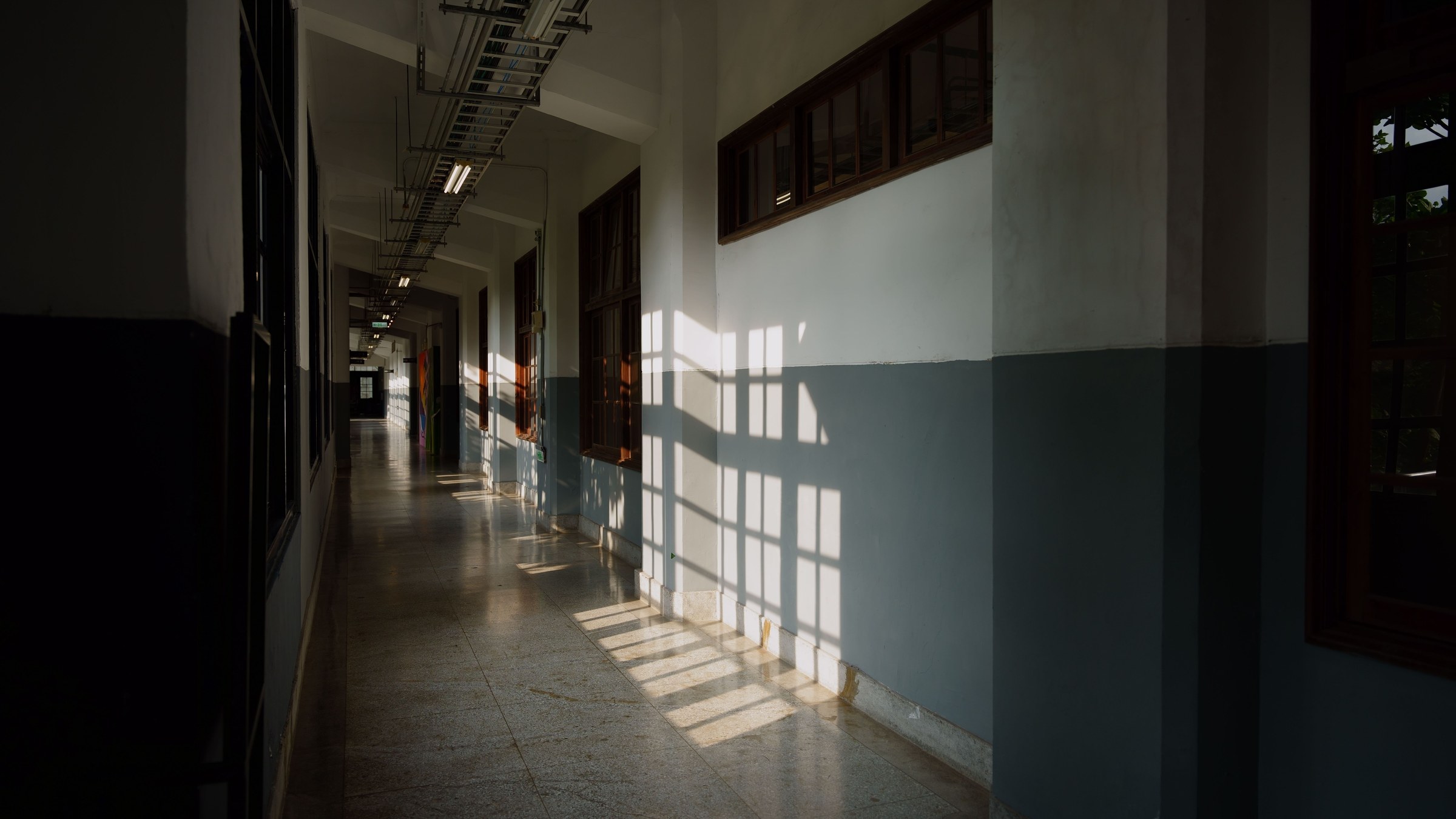
A school corridor stretches out long. The late afternoon light coming through the windows on the right has transferred the shape of the window frames onto the blue-gray paint on the lower part of the wall. The grid continues onto the terrazzo tiles of the floor and then fades, and the far end of the corridor is dim, with no fluorescent lights on.
Though there is not a single person here, the space does not look empty. The pipes running along the ceiling, the floor polished smooth by long wear, and the dark brown of the wooden window frames tell how many footsteps have passed through here. For decades the light coming in at the same hour at the same angle would have drawn the same grid on this wall.
A classroom window is the window children look at the longest. When a lesson is dull, after being scolded, on a day of quarreling with a friend, it is where the eyes settle. The size and orientation of a window, and what can be seen outside it, look like minor choices on a blueprint, but they are not minor for the person who spends most of the day inside.
Some school corridors are bright like this, and some get no light all day. Deciding the budget and the order for repairing old buildings is in the end also deciding how much light comes into whose day. That difference is not written on a report card, so it goes unnoticed for a long time.
The light in the photograph will soon move on and the grid will be erased. But tomorrow at this hour, the light will come in through the same wall again. How many children will pass in front of it is not in the photograph.