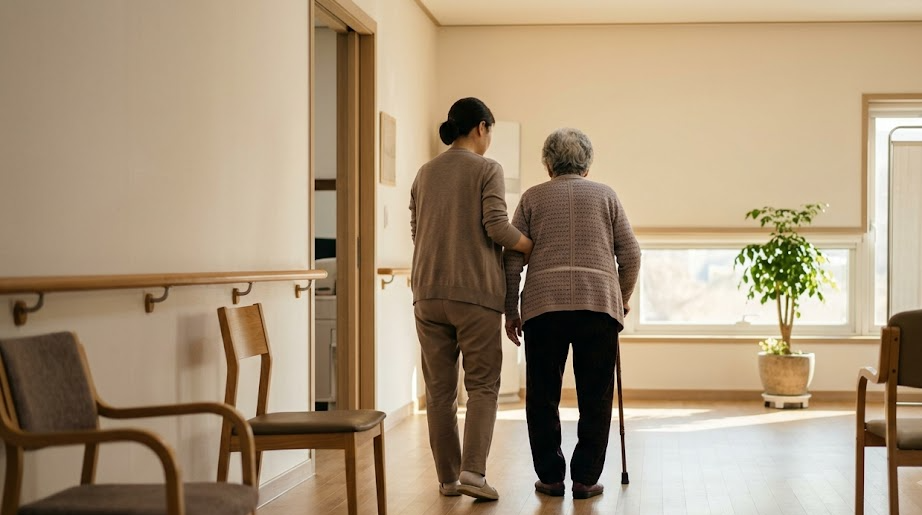
The Act on Integrated Care Support, which provides medical care, long-term care, housing and daily living support together in the homes where people live rather than in hospitals or facilities, takes effect next month. Integrated care, which began first in Gwangju, expands nationwide from March. The effective date is set for sometime in March, but the date itself has not yet been formally announced.
When the law takes effect, local governments will have more work to do. The structure is understood to assess and connect the services needed by home care benefit recipients, hospital patients aged 65 and over who are being discharged, and people with disabilities, all at once. The assessment, the connection and the visits that follow are all work that people do by going to homes.
The Ministry of Health and Welfare said on the 24th that it will revise the Enforcement Rules of the Social Welfare Services Act to change the name of the community welfare center program "community protection" to "community integrated care and protection." The purpose of the revision is that the scope of welfare has widened as single-person households increase and isolation deepens, and that it will establish a basis for the public and private sectors to work together on welfare blind spots, support for single-person households and case management. The obligation to install soundproofing in counseling rooms will also be eased, lowering the barrier to establishing and operating welfare centers. The revision will go through interagency consultation, legislative notice and Ministry of Government Legislation review starting late this month before being promulgated and taking effect.
What community welfare centers do now falls into three areas: service provision, case management and community organizing. The name integrated care is now formally added on top of that.
Hiring numbers have grown noticeably. The Gwangju Metropolitan City government confirmed on the 23rd that it will hire 624 local public officials this year. That is 2.9 times last year's 210, and for social welfare positions alone the figure went from 11 to 107. Daegu Metropolitan City set 771, 2.1 times its previous number, and Daejeon Metropolitan City set 484, an increase of 131, while Daegu's social welfare positions jumped from 19 to 108.
Ulsan Metropolitan City, which hired no social welfare officials at all last year, will hire 59 this year. Its overall total also grew from 144 to 549. Busan Metropolitan City drew up a plan to select 1,096, and its social welfare positions went from 5 to 176.
Still, larger numbers do not mean every position gets filled. In Busan, the central government decided to fund personnel costs for dedicated integrated care staff in the first half of the year covering 344 public officials, or 1.36 billion won, but the hiring plan announced on the 9th of this month covers 245 people, including 176 grade 9 social welfare officials and 69 nursing officials. That is about 100 fewer than the number the budget was set for. Half of the personnel costs for new hires comes from the national budget, and local governments have to cover the rest.
[Illustration: a grid divided into sixteen cells with only two shaded dark and the rest left empty | Caption: Two of Busan's 16 districts and counties have created dedicated units]
The same goes for organization. Among Busan's 16 districts and counties, the ones that have newly created an integrated care division are understood to be two, Sasang-gu and Yeongdo-gu. Where there is no dedicated department, integrated care work is added on top of the work of existing departments. For the person receiving care there should be a single point of contact, but on the giving side the organization has not yet been brought together into one.
Some places have set up the framework from the start. Yangsan City created an integrated care support team in January and signed home medical care center pilot project agreements with two clinics, Yonsei Bit Family Medicine Clinic and Deobareun Internal Medicine Clinic. The project connecting discharged patients to their communities is run on an ongoing basis as a national pilot project with Pusan National University Yangsan Hospital, the responsible medical institution, and seven long-term care hospitals, and in March one more agreement will be added with Yangsan Jeil Hospital. Yangsan Community Welfare Center and Ungsang Community Welfare Center were selected as integrated care providers and will handle neighbor care and meal support, and integrated support meetings are held at least twice a month.
The process starts at the eup, myeon and dong level. When a person is identified in the neighborhood and an application is made, the city, the National Health Insurance Service and the National Pension Service conduct a comprehensive assessment together, an individual support plan is drawn up, and the integrated support meeting decides whether services will be provided.
Gyeonggi Province said on the 19th that it had selected four localities, Hwaseong City, Gwangmyeong City, Anseong City and Yangpyeong County, as integrated care cities and would build five types of infrastructure during the first half of the year. They are neighborhood visiting care primary doctors, a one-stop nursing and long-term care package, return-to-daily-life care homes, return-to-daily-life treatment stations providing discharged patients with up to three months of intensive physical therapy and rehabilitation, and dedicated AIP managers. Provincial and municipal funds together come to 6.4 billion won.
Whether physical therapy can be received at home the day after discharge, how many weeks it takes for a visiting nurse to come. The success or failure of the system is decided in gaps like these. A little more than a month remains until the March effective date, and in that time each local government has to hold exams, select people and put them in their positions. The exam tickets of those already preparing for the social welfare civil service exam list a number of positions with a different digit count from last year's.