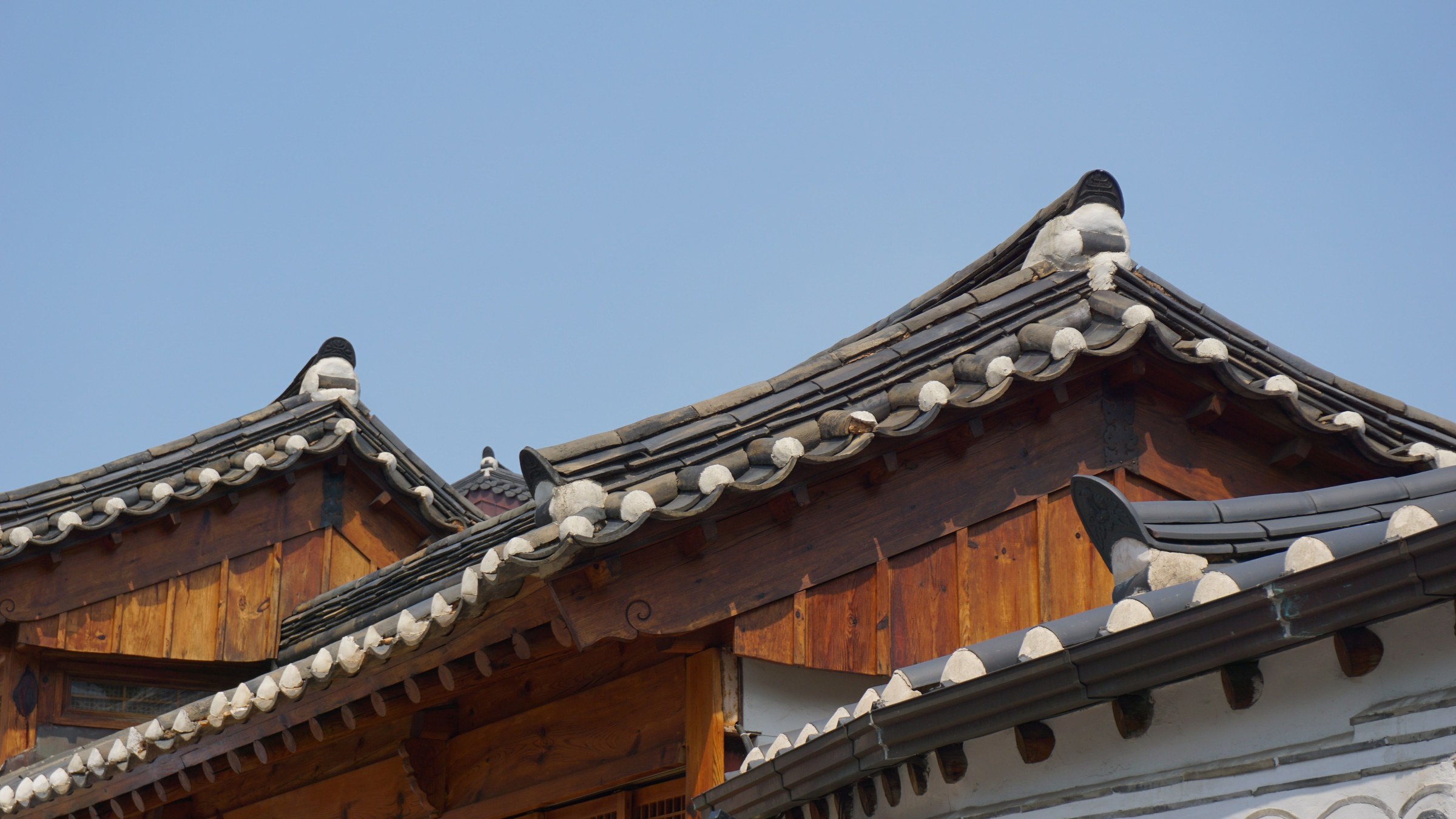
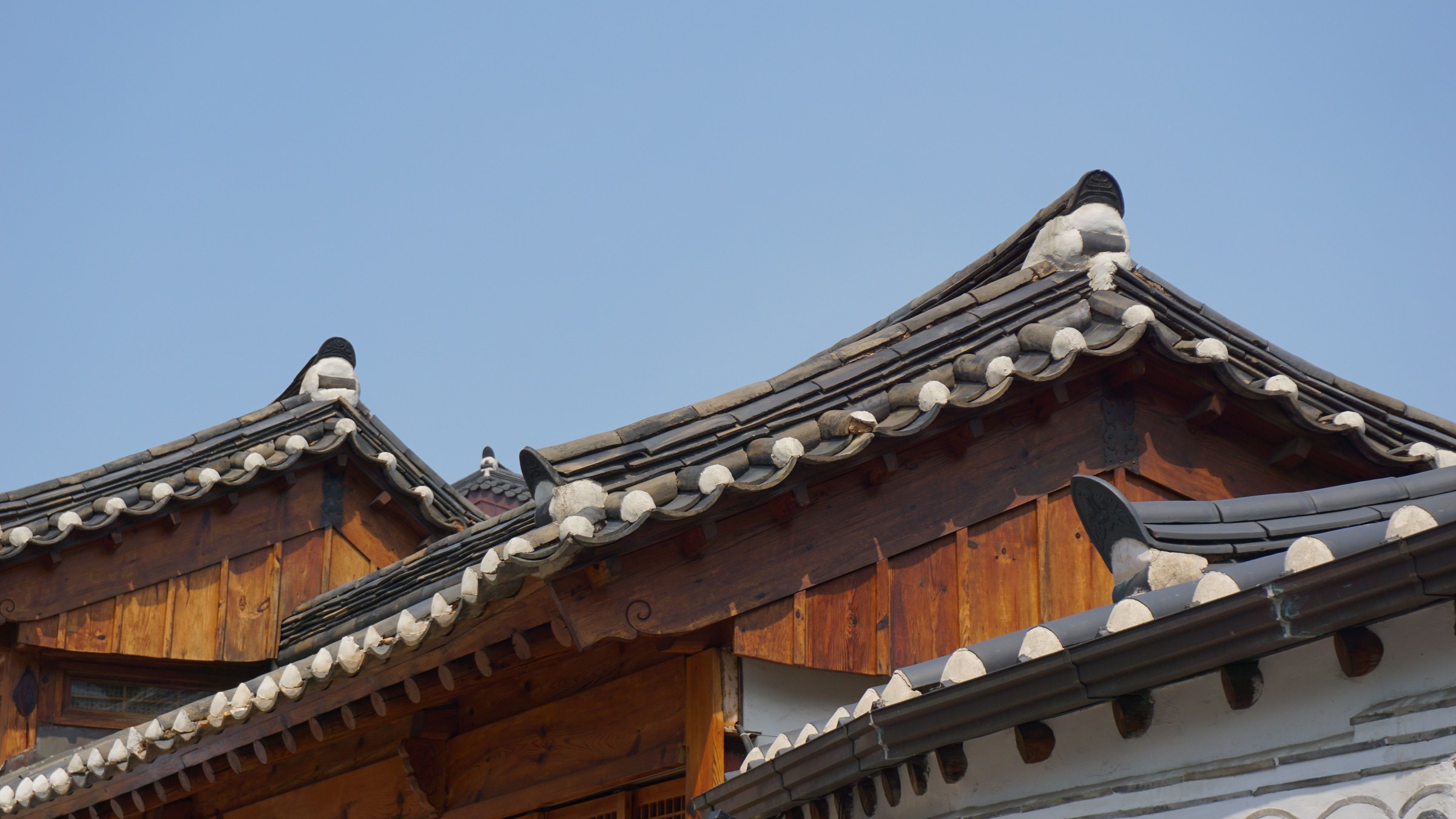
Where the winter sky has drained away its color, three sets of eaves hang out of alignment. The roof on the left draws back into shade, and the roof in the middle takes the sunlight head on, its tiled backs shining silver. The white faces of the end tiles are lined up at even intervals along the edge of the eaves, and the wood beneath them has ripened to a brown that has fed on sunlight for a long time.
A roof tile never stands alone. One lays its body on the back of the tile below, and that one in turn supports the next, and only then do the valleys form and the water finds its path. Without the overlapping parts it is nothing but scattered earth, and it does not become a roof. The three roofs in the photograph also stand behind one another, overlapping front to back, and become a single scene.
The reason the eaves reach far outward is, in the end, for what lies below. The angle that cuts off the summer sun and draws the winter sun deep into the room, the distance opened up so that rain does not touch the earthen wall. That today's light comes in low and brightens even the grain of the white wall is no accident. It is a consideration worked out in advance.
The shade the sunlight makes lies at a slant toward the courtyard. The line the eaves' shadow draws on the earthen ground reaches far inside the roof's edge, showing plainly that the sun is turning low. The end of the shade stops before it reaches the wall.
The work of supporting and resting does not take place only where it can be seen. This faint line, transcribed onto the ground, tells us so.
Between the black waves of the tiles and the pale blue of the sky, that empty margin takes up half of this photograph. The roof has stopped there, its tips lifted slightly toward that empty place. Following the edge of the eaves once more, the sky begins at the point where the line breaks off.