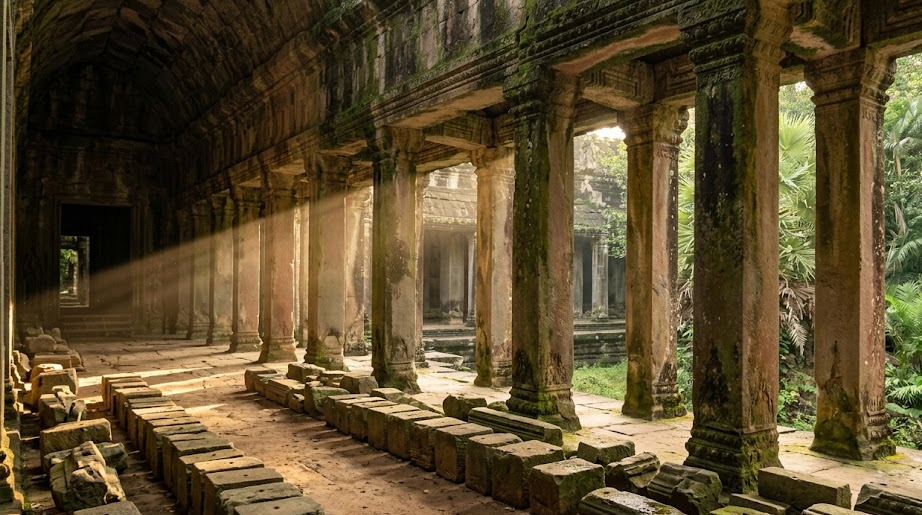
Lifting a single stone and setting it back in place took ten years. The international symposium held on the 16th (local time) in Siem Reap, Cambodia, was an event that laid out the progress and the results of the second phase of the conservation and restoration project covering the Preah Pithu temple and the Elephant Terrace. About 70 officials gathered at the event, prepared by KOICA (Korea International Cooperation Agency). The second phase project is due to end at the end of this month.
The stone of Angkor is sandstone. Run a fingertip across it and a rough grain catches, and through hundreds of years of rainy and dry seasons black water stains and moss have settled on the surface in layers. To raise a collapsed stone structure again, one has to read the direction and the strength of that grain, and to read it, equipment and people are needed. Leaving both behind at the same time was the method of this cooperation.
Korea is understood to have first laid a hand on the restoration of the Angkor site in 2014. The scope of the cooperation widened after that and the second phase project began in 2019, and adding up that time comes to ten years. On site, the expression "about ten years" is also used. Either way, it is not a short period to stay with a single site.
The second phase project held to three lines. Conservation and restoration of the Preah Pithu temple group and the Elephant Terrace was one, strengthening the capacity of researchers and staff of Cambodia's APSARA National Authority, which manages the site, was two, and support for high-performance stone processing, analysis and testing equipment was three. That the latter two lines were handled with the same weight as conservation and restoration tells us about the nature of this project. It is a design different from an approach that leaves only restored stone structures behind and withdraws.
APSARA National Authority Director-General Hang Peou said that day that the capacity to protect his country's cultural heritage had grown firmer with the support of the Korean government. He also added an assessment that scientific surveys and field-centered training had served as an occasion to raise the staff's expertise. Kim Chang-ryong, Korean Ambassador to Cambodia, Choi Moon-jung, KOICA Cambodia country director, and Kim Dong-ha, division head at the Korea Heritage Agency, attended the event together.
Working on someone else's heritage always comes with tension. Is it right to leave the original form as it is, or is it right to raise what has collapsed so that people can see it? There is no correct answer to this question, and that is all the more so in a place like Angkor, where tourism is the backbone of the local economy. The fact that an exhibition hall presenting the restoration results is being operated near the project site shows an attempt to work out in one place both the protecting of stone and the showing of it to people.
This symposium, along with laying out the results, also had the character of presenting Korea's development cooperation experience in the cultural heritage field to the international community. This is as far as can be confirmed now. No specific plan or schedule for follow-up cooperation has been disclosed, and the same goes for the number of local workers who took part in the restoration. Two photographs of the Preah Pithu Chom temple, before and after restoration, only show this stretch of time in compressed form.
The phrase "technology export" does not hold these ten years well. The equipment will grow old someday, and the project ends at the end of this month. What is left at the last are the hands of the APSARA National Authority that know how to read the grain of sandstone, and what those hands pass to the next generation can be confirmed only by someone who has been to Siem Reap. The exhibition hall beside the temple stands at the point where that confirmation begins.