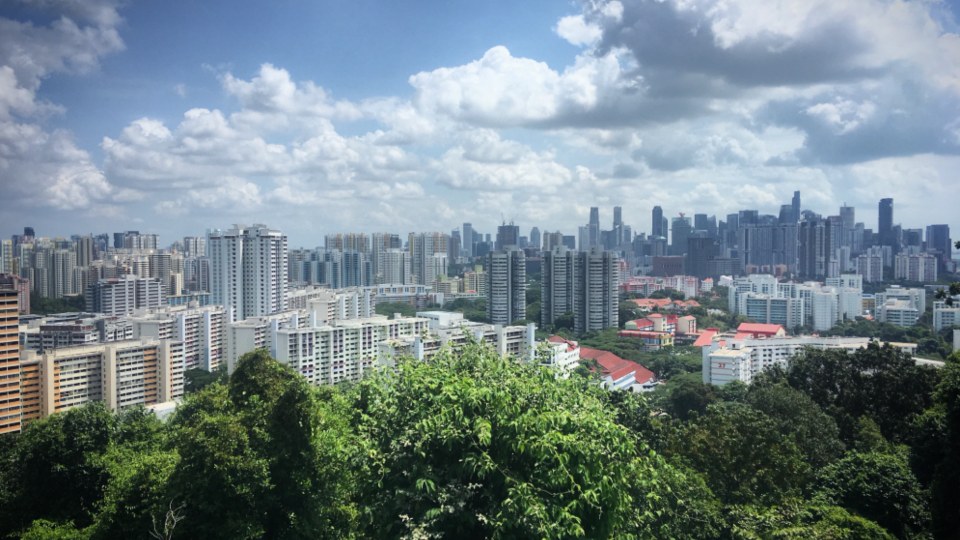
The bottom half of the frame is nothing but trees. Light close to noon breaks white across the upper surfaces of the leaves, and the shaded interior sinks into a dark blue-green. Only beyond that green ridge do the white apartment walls and red roofs begin, and farther back the city's high-rises stand in a foggy gray. Thick cumulus clouds hang low in the sky.
The order of the photograph is interesting. In most city photographs trees appear as decoration slipped in between buildings, but here the forest takes up the front of the frame and the city has stepped back. It is probably because the camera was up on a hill, but that accidental angle briefly sets right a proportion that is usually reversed.
That mass of trees looks still, yet it works all day. The leaves catch carbon from the air and store it in their trunks, and shade and evaporation cool the heat the asphalt has built up. The soil beneath the roots takes in falling rain and releases it slowly. A device that returns within the city what the city has emitted stands on that hill.
A scene like this remains because there were people who decided to keep it. On a map, green is the square most easily erased when a development plan moves in. One old tree in a neighborhood, one line of blank space on a redevelopment drawing, in the end make the bottom half of this photograph.
Look at the photograph again. Consider what is left once the forest at the bottom of the frame is erased, and what will be put into that empty land. Which side of that photograph does the green outside your window stand on?