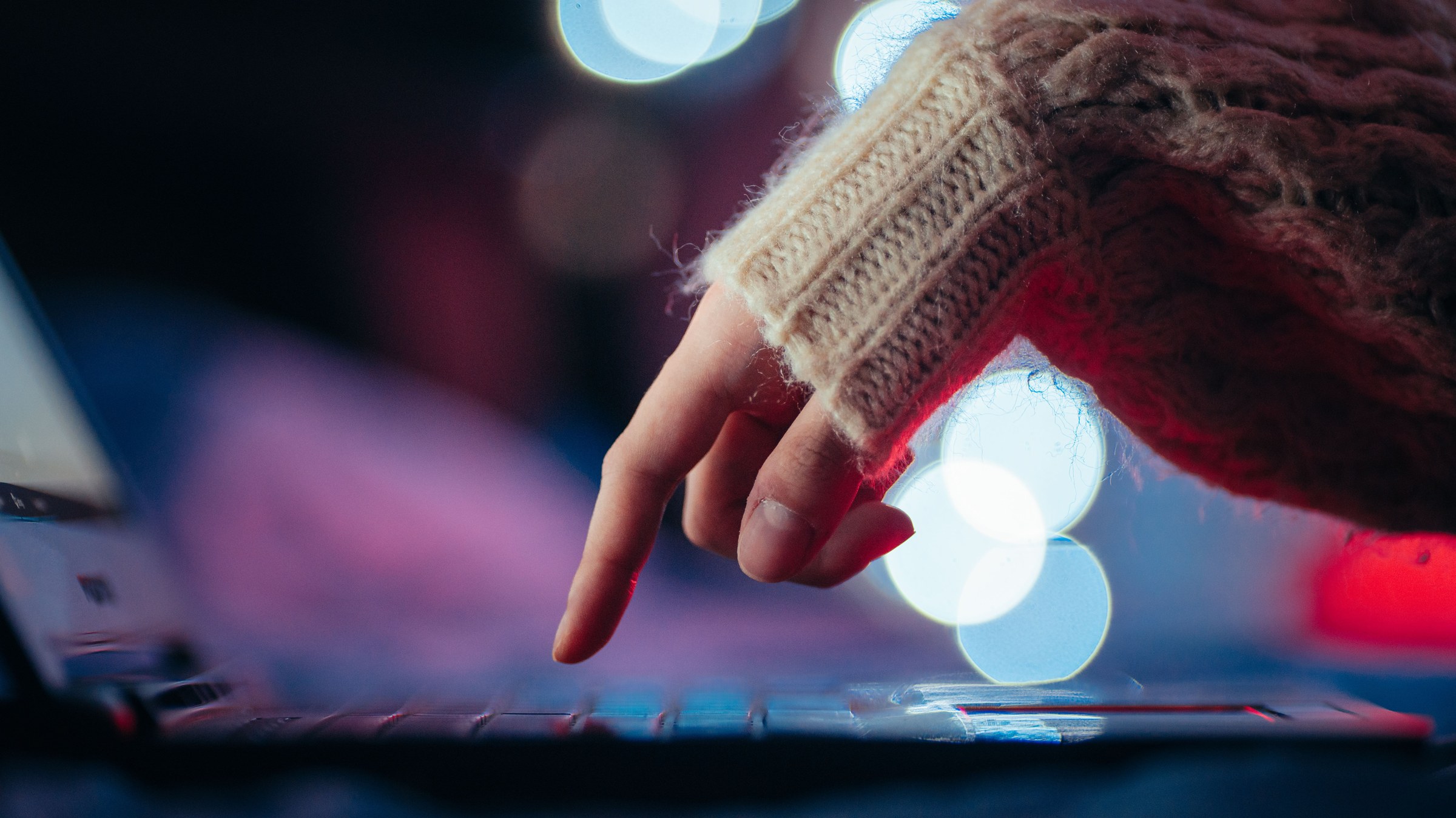
A knit sleeve runs past the wrist and halfway down the back of the hand. Only the index finger is extended as it descends toward the keyboard, and the remaining fingers are curled inward. The background has settled into deep navy.
About five clusters of white light are scattered and floating in the upper part, and at the lower right a red light spreads out, blurred. That red tint rests thinly on every knuckle. It is night.
The fingertip is just short of touching the key.
The motion it takes to make a machine do something has shrunk this far. One line of text, one finger. What moves on the other side of the screen is not visible from this angle.
Lowering the output of a power plant, and a car beginning to roll on its own, both start from a contact like this. The making side grows thicker each year and the pressing side grows thinner each year. The flow in which machines take over the share people once had to learn will keep tilting toward this single index finger.
Look again at the left edge. The silver corner of the laptop lid has been cut off outside the frame, and the open screen is nowhere in the photograph. The red light comes from behind the person and the white clusters hang on the opposite upper side, so that even a single fine hair on the back of the hand has gained an outline.
The light is this detailed, yet what the finger is pressing toward has been erased. The more convenient it gets, the more such moments of a screen cut away also increase.
The keyboard backlight has gathered at the tip of the fingernail as a blue dot. Where that dot will land, the photograph never shows.