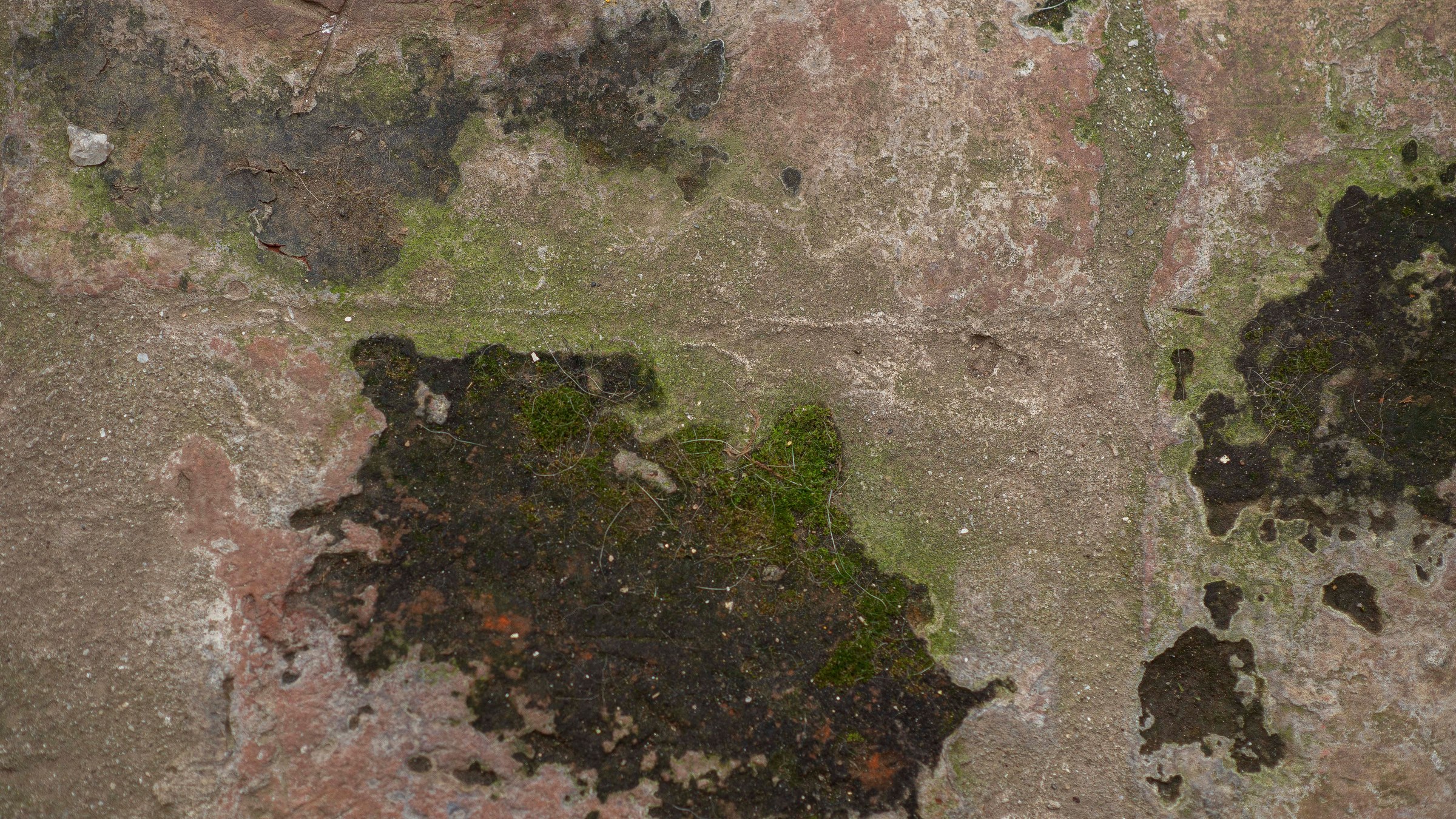
A mass of dark blue-green moss covers the lower half of the center stone. Its border is jagged like a saw, and the green is deepest along the upper rim of that mass. The color of the stone does not stay a single gray.
Pink and faint red tints seep out here and there, and a thin dusting of yellow-green has settled on the surface of the upper stone. It is a cloudy midday with almost no shadows.
One mortar line runs horizontally and one vertically, dividing three masses of stone. These are lines drawn by a person. The moss has climbed over those lines and laid a pale green band onto the upper stone as well.
What the hands that stacked this wall fitted together were faces and angles. The moss came afterward. Over several passing rainy seasons and the long stay of shade on the same side, a pattern no person chose spread across the red stone.
Half of the power an old wall has to hold the eye comes from the skill that stacked it, and the other half from the summers that passed over it. When it comes time for repair, how much to strip away is always difficult.
Look again at the stone on the right. It is the same moss, but the green has nearly drained out and only black stains remain like scabs. This is the side the water reaches less. Above the moss in the center, a few dry thread-like stems are scattered, showing that even where the green is at its peak, drying parts are mixed in.
In the upper left corner, a single white pebble is embedded in the flesh of the stone. A small grain that would have been mixed into the mortar on the day the wall was raised remains just as it was.
Following the edge of the moss with the eye, it is hard to tell whether it was the rain or the shade that drew that line.