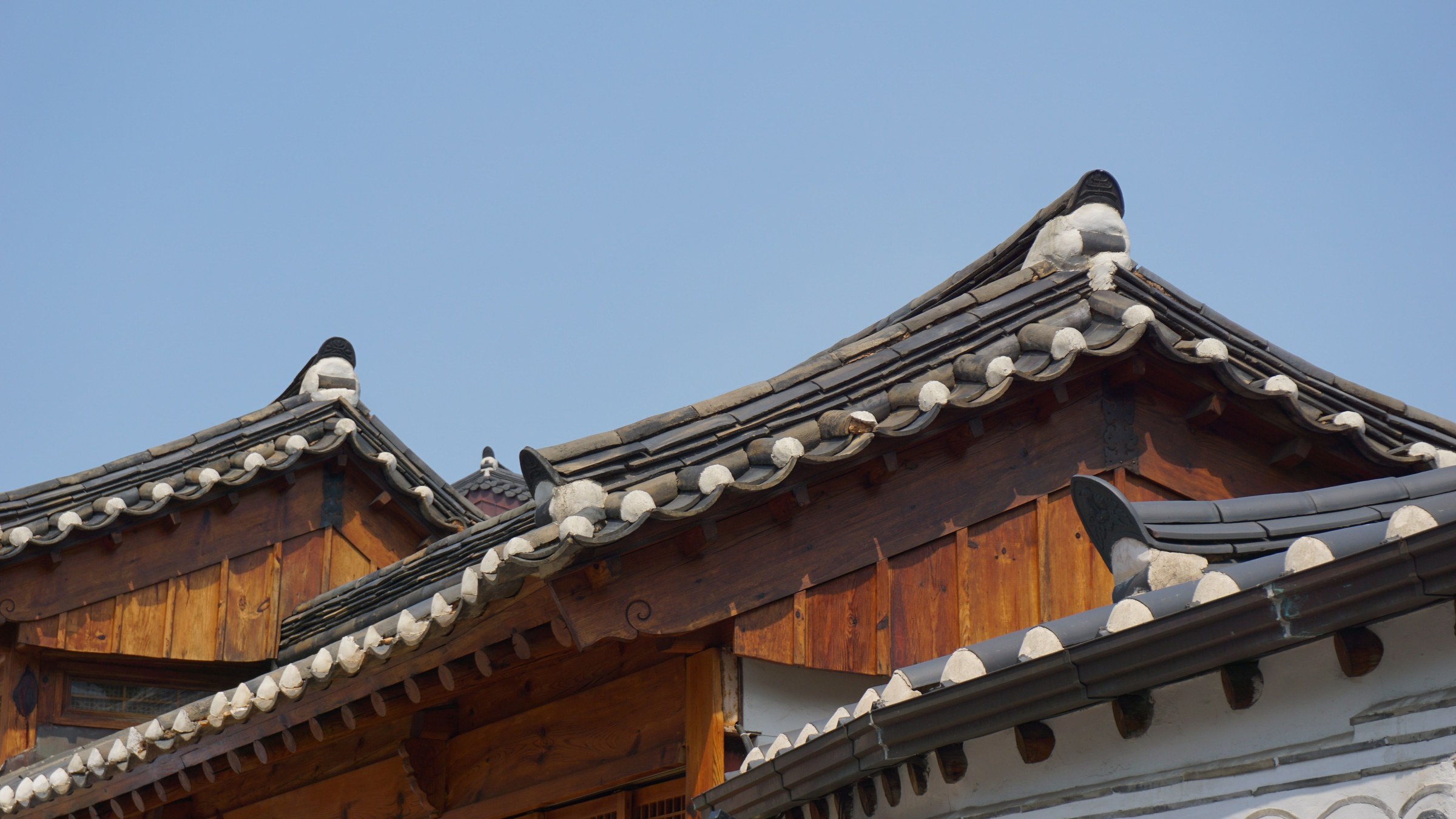
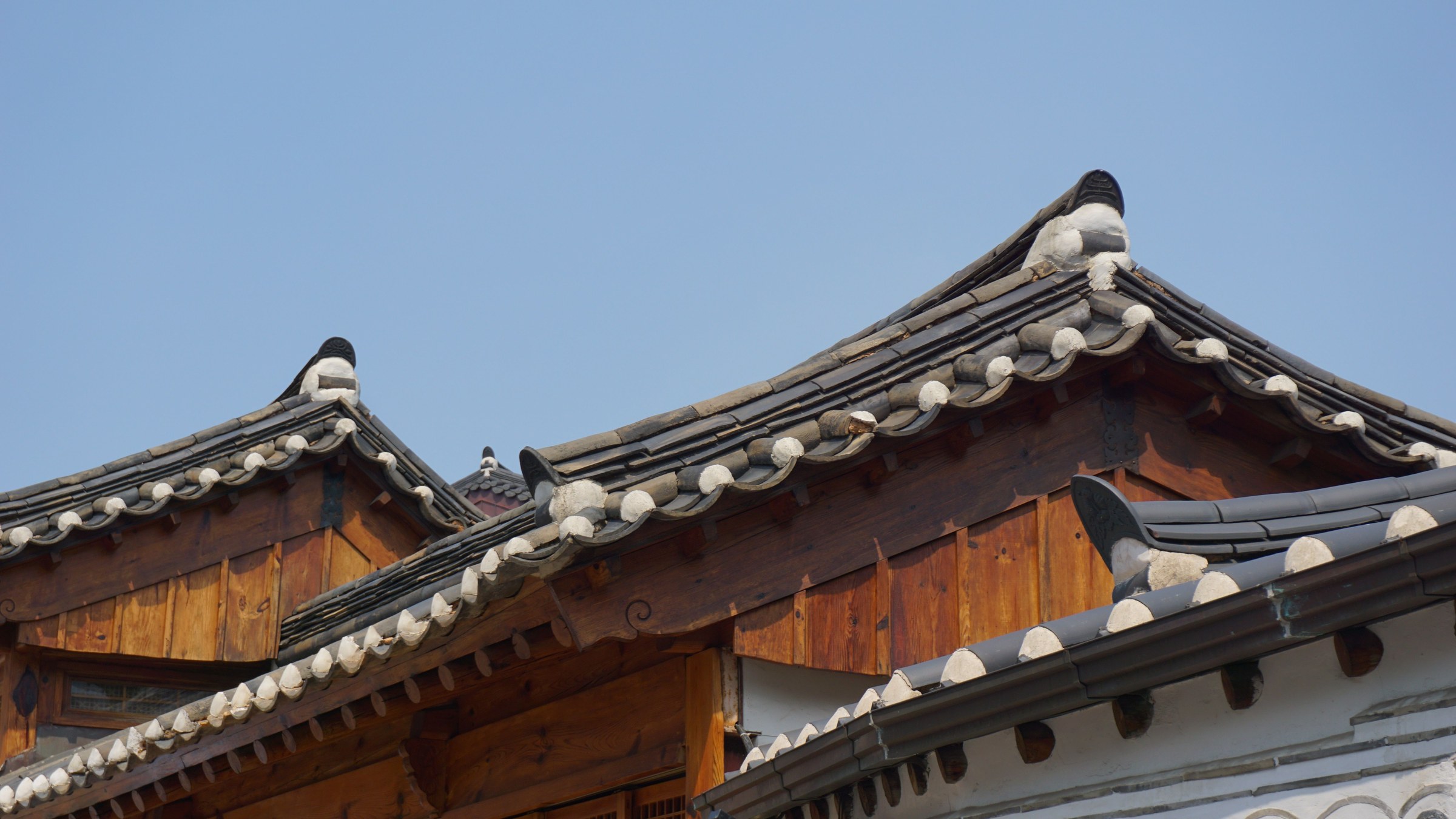
Three tiled roofs cut across the sky at an angle. The highest ridge rises up on the right and then runs down a long way to the left. At the end of every eave, round white end tiles sit in a row, drawing a dotted line between the gray roofs and the pale sky.
Below them the wood grain has ripened red, and the light comes in from the left, pressing the space under the rafters into deep shadow. There are no clouds.
The roof is curved to let the rain run off. When the tiles are stacked layer on layer to make channels for the water, the curve lifts slightly at the end. Though it is a line made by hand, it resembles the shape of a grown branch.
Each time one building went up, the height of the one beside it would have been checked. In the evenly connected ridges there is an agreement reached over several generations, beyond the skill of one person.
Look again at the lower edge of the photograph. A small lamp hanging in the shade of the eaves is cut half out of the frame. It is an electric light that will come on when night falls.
That lamp is a sign that these roofs have not gone into a museum. Someone opens that door and comes out, passes the wall with black half circles set against its white surface, and goes down into the alley. For an old thing to remain, it has to be used.
Grass sprouts on untended tiles within a single season, and a yard no one walks through soon caves in. That lamp is a maintenance cost and an evening greeting at the same time.
Look up again. The white end tiles seem to be walking along the eaves. If you count them, you might be able to guess which row is longer and which roof is older.