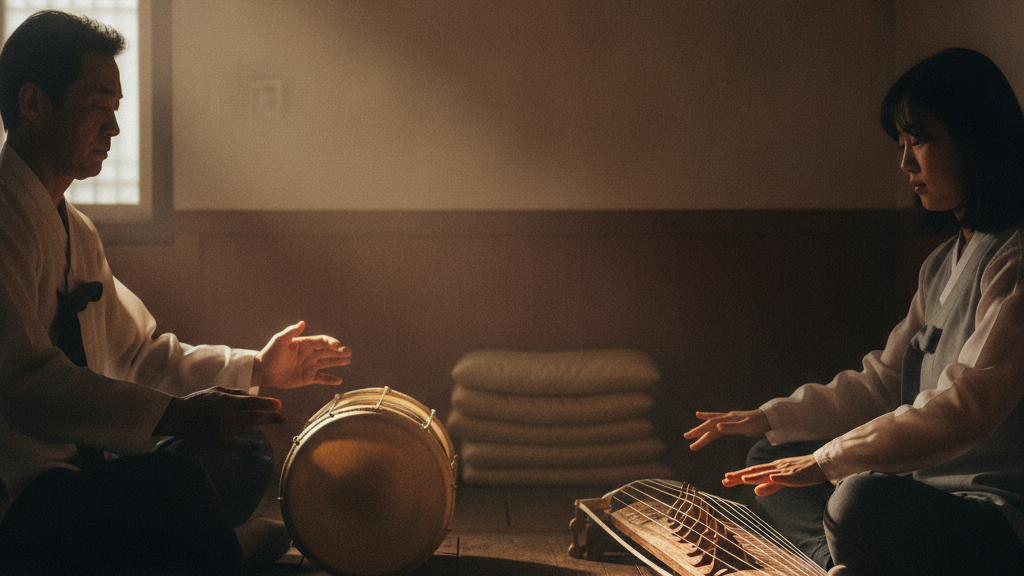
The National Gugak Center announced on the 6th that it had completed its "Improvisation Gugak Masterclass." A final total of 40 people took part in the course, which began on the 29th of last month and ended on the 4th, and completed the entire program. The original recruitment target was 30, but applications exceeded that number, so the center expanded the enrollment after a separate review. This was the second year the program was held.
The genres covered were Jindo ssitgimgut and Donghaean byeolsingut, Heungtaryeong, Sinbaennori, improvised salpuri, orthodox gueum sinawi, and Gyeonggi gutpungnyu sinawi. These melodies cannot be fully captured on paper. Playing the same piece twice does not produce the same sound.
Master musicians in the folk music field, including Kim Young-gil, Park Eun-ha, Park Hwan-young, Bang Ji-won and Chae Su-jeong, served as instructors. Instead of explaining, they produced the sounds themselves and drew the bow. Participants held instruments alongside them and took the rhythms and breathing into their bodies. The program combined ensemble classes with advanced hands-on instruction.
The word transmission is often paired with preservation. But improvisation cannot be frozen in place. A recording leaves only one version of that moment, and how it will change in the next round is known only to the person who picks up the instrument that day. So this kind of artistry crosses only from person to person.
One noticeable change in this course was the participants' backgrounds. From a flow centered on students majoring in the field, participation by performers active on professional stages increased. That means people who have continued performing under their own names came back to learn again. The proportion, and the comparison with the previous year, has not been made public.
On the final day, participants held a presentation session to show what they had learned over the six days. It is the moment when someone who had been following a master's fingertips must strike the first beat on their own. At that point improvisation finally becomes the learner's own.
Seo Seung-mi, director of the National Gugak Center, said the center would continue refining programs for creativity rooted in tradition. The center did not say when the next session would be held or at what scale.
The brushing sound of the jijeon in ssitgimgut, the smell of rosin pressed into an ajaeng bow, the low burst of air made by a salpuri cloth cutting through the air. These things do not transfer fully even on video. The National Gugak Center runs regular performances and education programs throughout the year. For anyone who wants to experience how gut melodies travel between people, it is worth looking over the application form when the next recruitment notice goes up.