On the 5th, Rep. Hwang Jung-a of the Democratic Party of Korea introduced, as lead sponsor, the Special Act on the Promotion of and Support for Physical AI Development. Physical AI refers to artificial intelligence that goes beyond answers on a screen and moves in the physical world with a body such as a robotic arm or wheels. The same day, Nvidia Chief Executive Jensen Huang came to Korea looking for physical AI partners, and Amazon unveiled a new warehouse robot that understands human speech. They were three days that pushed the industry forward, but the rules covering the people who will work beside those robots did not move within the same three days.
The core of the special act lies in running demonstrations quickly. It lifts regulations on the use of raw data employed in robot operation and training, and contains incentives to bring in key overseas talent and infrastructure for attaching AI to manufacturing. The regulatory sandbox window is gathered at the Ministry of Science and ICT, and a provision was also included under which an exemption is deemed designated if no notice of rejection arrives within 60 days. The validity period of an exemption is extended from two years to five years.
A legal basis for a "physical AI specialized demonstration testbed" was attached to this. In designated pilot zones, a fast-track regulatory confirmation system operates and the application of some laws is loosened. The industry subcommittee of the Democratic Party's AI Powerhouse Committee heard views from SK Group, Hyundai Motor and Kakao Mobility at a discussion session in April this year. Much of what industry requested has been reflected in the bill, while conversely employment-related provisions do not appear in what has been disclosed so far.
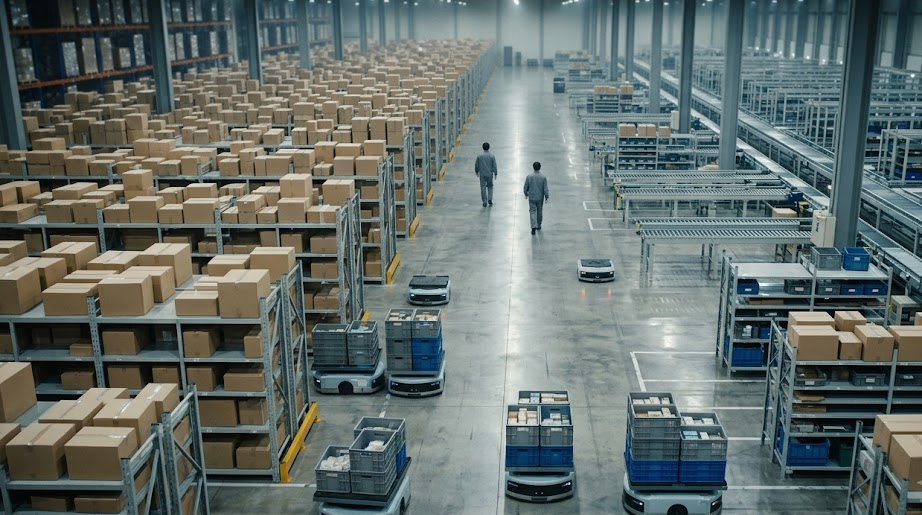
The announcements by global companies are more concrete than the bill. The next-generation Proteus unveiled by Amazon carries up to 400kg and understands spoken instructions in plain language. Where the previous generation stayed near loading docks, the new model is designed to roll through most areas of the warehouse where goods move. It is being tested at the company's own research facility, and deployment in Europe in the first half of 2027 has been set as the target.
The same announcement also carried Vulcan, a robot that senses touch, and a plan to expand a container handling system. Amazon said it would put 10 billion euros into overhauling its European logistics facilities over the next several years, and said it would hire 25,000 more warehouse workers in Europe. But over the past year or so there have been job cuts of about 30,000 at headquarters and in the retail, cloud and video divisions. Chief Executive Andy Jassy said the overall size of the workforce would shrink over several years as AI is adopted.
The reason robots should stand in for human bodies also remains in the statistics. A report by one research institute counted 56% of serious injuries at U.S. warehouse sites in 2024 as coming from Amazon. Amazon's share of employed warehouse workers was 39%, so injuries were concentrated far more thickly than its employment share. Automation lifts risk out of the same facility and lifts jobs out with it.
The situation in Korea is no different. Hyundai Motor Group is training autonomous driving, smart factory and robotics models with 50,000 Nvidia Blackwell GPUs, and has decided to put 3 billion dollars into physical AI in Korea together with Nvidia. LG has decided to jointly develop a reference robot in the ecosystem of Isaac GR00T, an AI platform for humanoids. Boston Dynamics' Atlas was introduced at CES 2026 as lifting 50kg, reaching its arms up to 2m and operating even at minus 20 degrees.
Hyundai Motor has presented a roadmap to make 30,000 robots a year by 2028 and put more than 25,000 of them into its own production sites. The Hyundai Motor branch of the Korean Metal Workers' Union, in a newsletter in January this year, set the annual maintenance cost of Atlas at 14 million won against an average annual salary of 130 million won for production workers. The union's position is that robots cannot be brought in without labor-management agreement, and it is demanding that new AI and robot clauses be put into the collective agreement.
Discussion on the tax side is old but has been folded away each time. A robot tax came onto the public stage with Bill Gates' proposal in 2017, and the European Parliament raised the possibility of unemployment along with a compensating tax and basic income in a draft report in 2015, then removed the two items from its final resolution in February 2017. The U.S. government gave a negative assessment of a robot tax in a report in October 2016 and presented vocational training and the social safety net as alternatives. In Korea, the Korea Institute of Local Finance issued a related report in December 2024, and discussion is reviving in academia.
The exemption period is extended from two years to five years. The provision recognizing an exemption if there is no answer within 60 days is also tuned to the side that is hurrying demonstrations. Whether employment-related provisions will go into the same law is a question to be settled in standing committee review.
In the first half of next year, in a warehouse somewhere in Europe, heavy loads will begin to move at a single spoken word. How many years it will take for that scene to move to factory floors in Korea is written in the roadmap, but where the person who stood beside it goes is not written in any document. The bill has been introduced and the discussion is starting now.