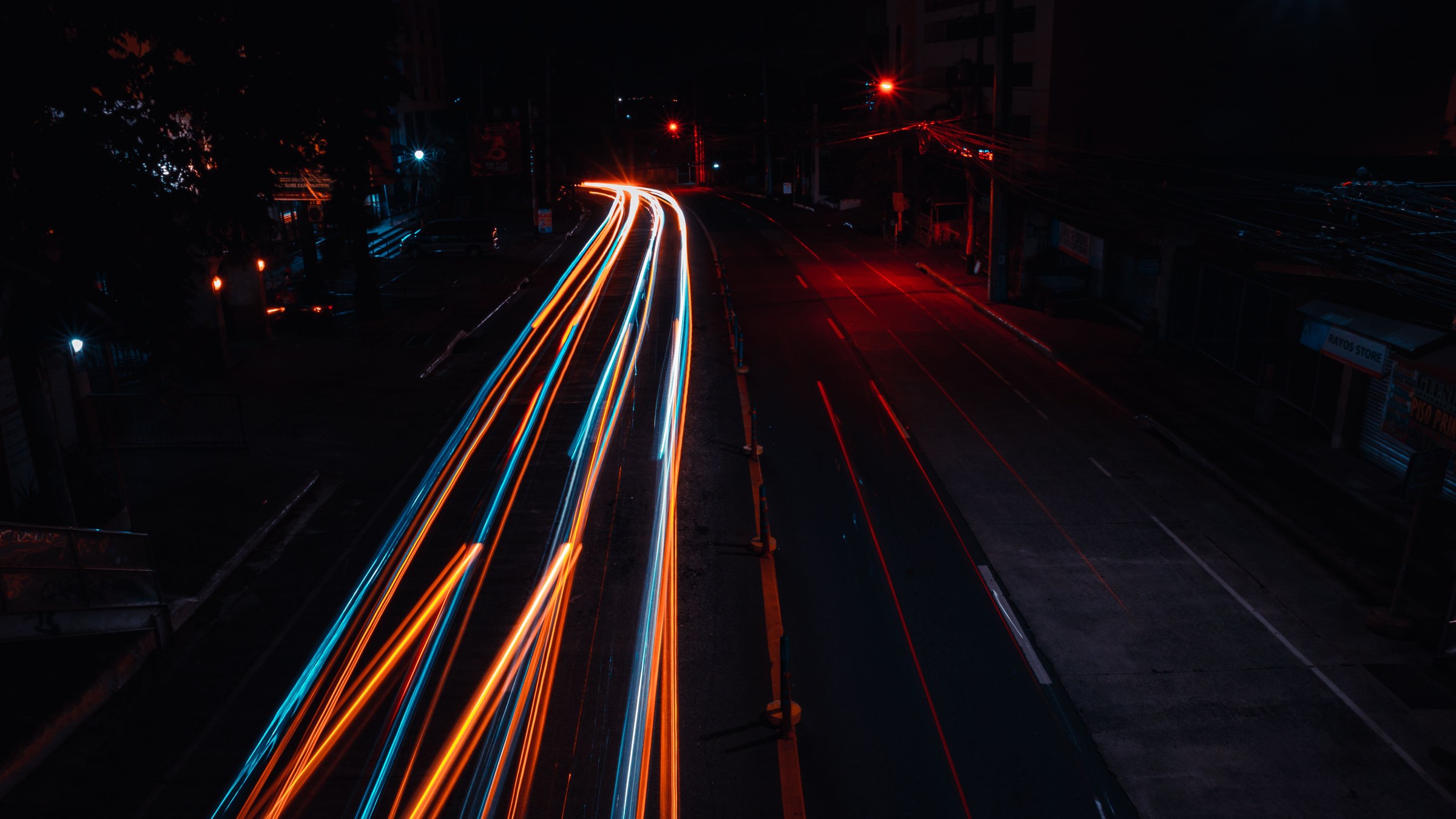
Seen from a pedestrian overpass, the night road splits into two branches. In the left lanes, several strands of blue and orange light lie stacked over one another and flow on, while in the right lanes only a few thin red lines remain. The green and red dots of a traffic signal and a single streetlight spread like stars at the top of the frame, and everything else is black. During the few seconds the shutter stayed open, the cars disappeared and only the trails remained.
What this photograph shows is flow. Looked at one car at a time, each is an individual trip heading for its own destination, but when several time periods are stacked into a single frame, they become one bundle of lines with thickness and density that also reveals where it is headed. The algorithms that optimize traffic signals and the systems that adjust dispatch intervals end up reading a picture accumulated in just this way. How fast any one car was going is passed over, and the shape of the whole bundle is what gets looked at.
The thickness on the left and the sparseness on the right are information in themselves. Where the congestion is, and at what hours the city tilts to one side, is written directly into the density of the light. As electric vehicles increase and autonomous driving mixes into the roads, the color and texture of these lines will change, but the way the lines get drawn will not. The city always records the paths it has passed through in light.
The lines of a circuit diagram take on meaning only when current flows through them. The same holds for this road, where people are in the places the trails thicken and night is in the places they thin. Looking at the photograph again, the fact that the black portion is larger comes into view. It is the area left with no line drawn across it at all.