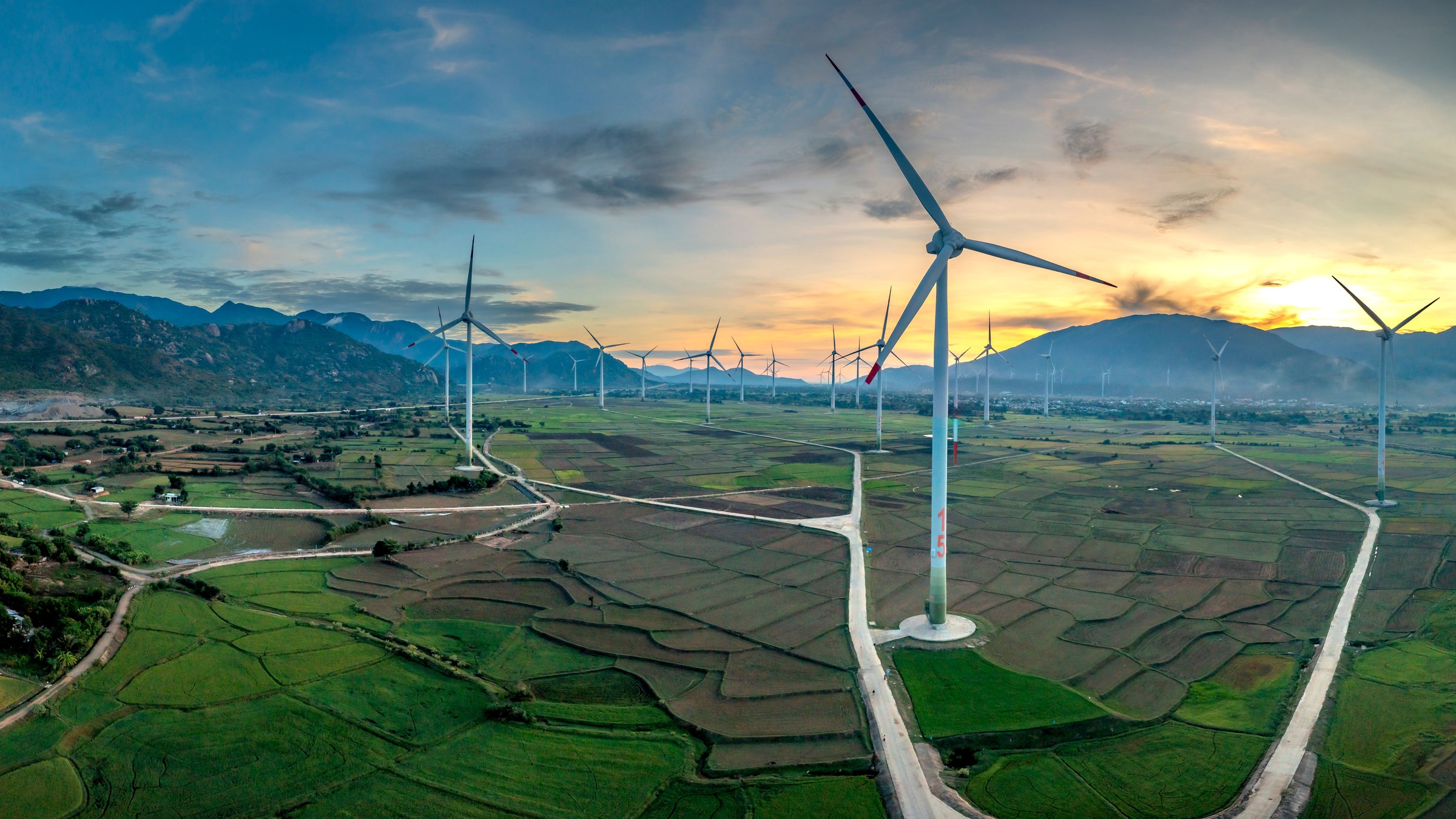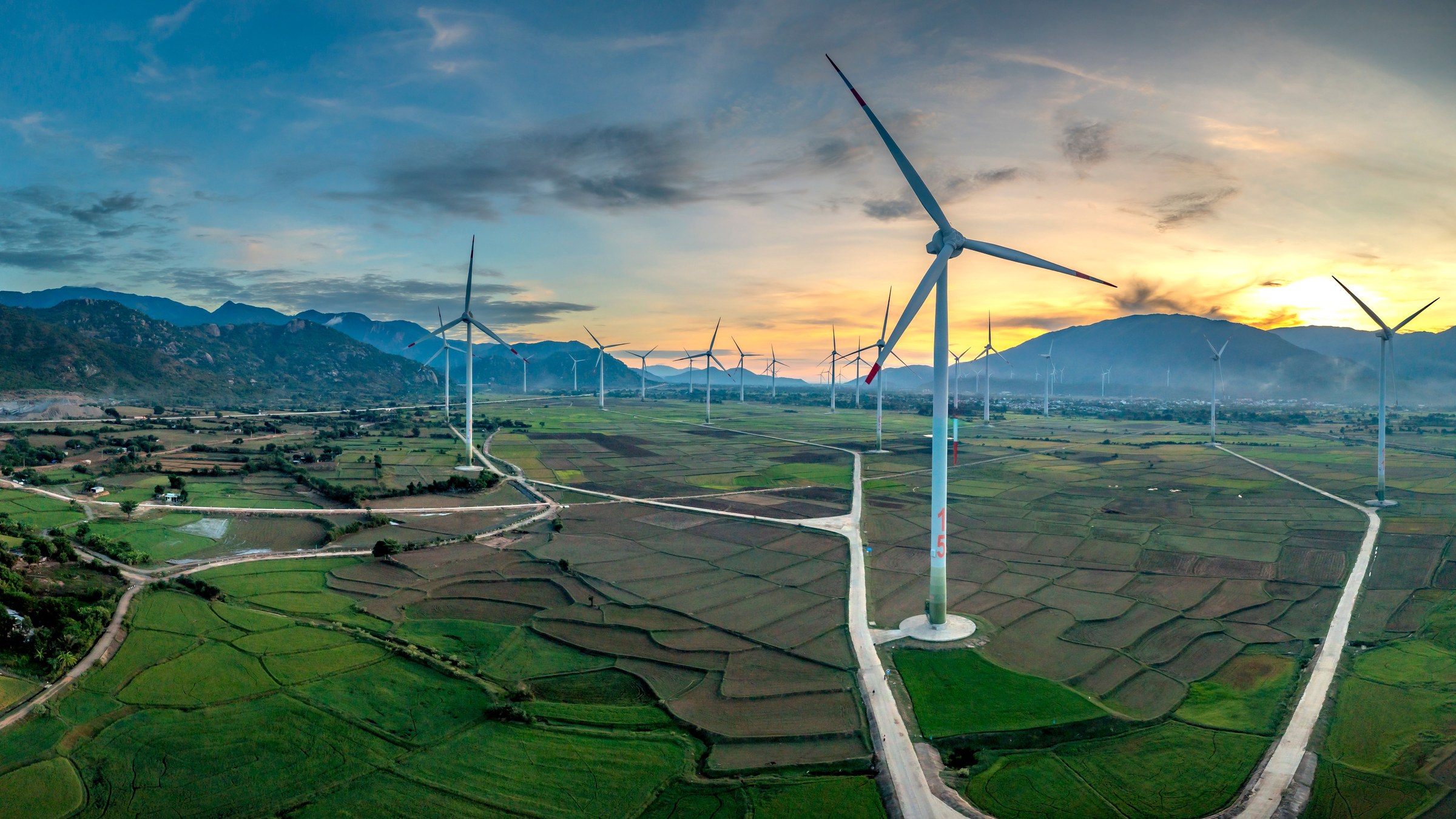
At the hour when the sun drops behind the mountains, the sky spreads from orange into blue-gray and the clouds lie in long stretches. Below it the field still holds the green of the turn into summer, and the lines made by the paddy banks run on like a patchwork quilt. A single white column stands dividing the frame vertically, and behind it columns of the same kind line up and recede toward the misted foot of the mountains.
What catches the eye first is the size, but look long enough and the narrowness shows. The blades use the sky broadly, while the ground the column stands on is the size of a single circle. Outside that circle it is still paddy, still field, still dirt road. Farming and power generation lie together on the same map.
When we think of a power plant, we usually think of smokestacks and walls along with it. There is no wall here. There is no need for a road to bring in fuel, or a road to carry out what is left from burning. The wind passing across the sky simply sets down some force on its way past.
A scene like this does not come about on its own. It is the result of people sitting down and deciding where to build, whose land to cross, and where to send the electricity. Whether the paddies stay green or not is likewise being decided now.
At the right edge of the frame, a blue water container lies overturned, half perched on a paddy bank. Beside it a folded shovel handle stands stuck in the soil, and a small handle for opening and closing the waterway is caught in the frame as well. It means that while that large white thing takes the wind, someone came every day carrying that container to bring water in. The large and the small share one evening.
Look at the photograph again and a road appears. A white concrete road passes between the paddies and reaches the base of the column, and that road keeps going beyond the frame. Because someone went out to lay that road, this evening was photographed the way it was.