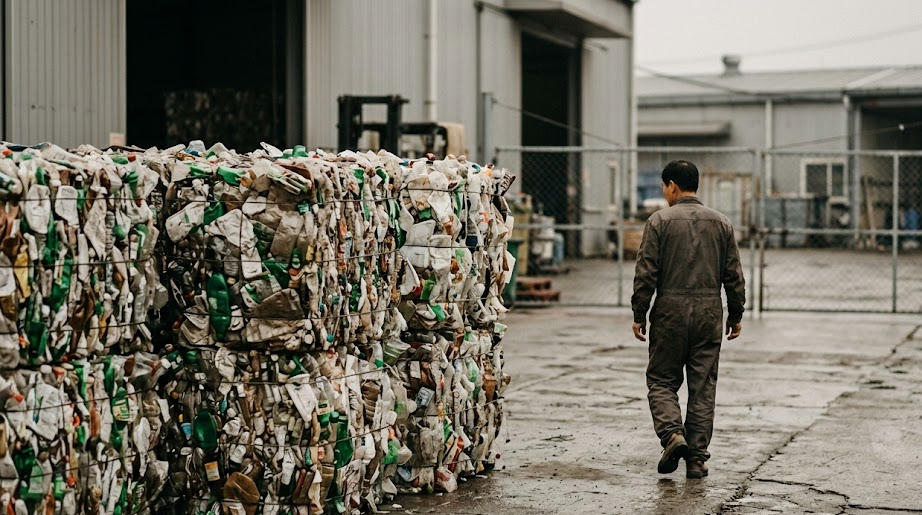
Three out of every four pieces of plastic discarded in South Korea do not come from the recycling bins in our homes. Households account for about 25%, and the remaining 75% comes from factories and business sites. The figure was presented by Kim Kyung-wook, CEO of WithWe, at a recent roundtable on fostering the regional climate tech industry, and it shows a gap between where recycling policy has focused its attention and where the waste is actually pouring out. While the global plastics treaty is deadlocked over production limits, there is an area at home that can be addressed without waiting for the treaty to be concluded.
The international negotiating table has hardly narrowed. A camp of some 100 countries and a camp of oil-producing states are at odds over whether plastic production itself should be brought under regulation. Core provisions such as reduction targets and base years have not reached agreement. When and in what form the treaty will be settled is hard to say with certainty at this point.
Turning to the domestic picture, a different one comes into view. Waste plastic from households is backed by subsidies under the Extended Producer Responsibility (EPR) system, and a collection and recycling market has been built up to a degree. The 75% coming from business sites, on the other hand, is left entirely to the private market with no public support, a point raised at the roundtable. It is the same plastic, but the reach of the system differs completely depending on where it came from.
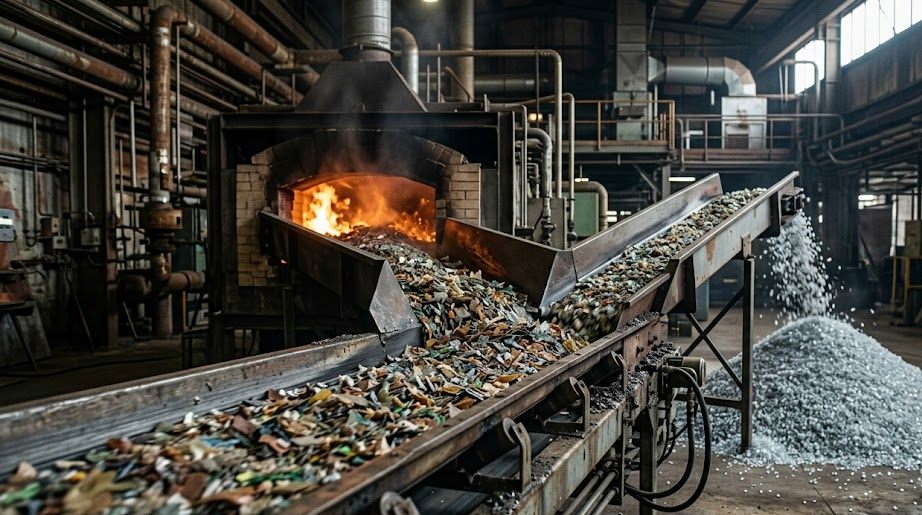
What drives the choices in a market without support is predictable. Industrial waste plastic mostly goes through shredding before its treatment route is decided, and the biggest criterion at that point is treatment cost. If sending it to a cement kiln as fuel is cheaper than bringing it back as material, that is where it flows.
This is not a matter of blaming individual operators. In a market designed so that cost is the only yardstick, anyone would make the same choice.
On top of this comes another calculation built into the system. A concern was raised at the roundtable that burning plastic to obtain heat is recognized as recycling under the system. The recycling rate rises in the statistics, but the plastic is burned rather than returning as material. When the word recycling covers a wide range, the amount actually circulating is hidden behind the indicator.
Two pillars were put forward as an alternative. To supplement recycling policy built around household waste, a proposal was made to develop AI and robot-based sorting technology and at the same time build a market for buying and selling recycled feedstock. As sorting precision rises, the cost of material recycling falls, and once demand to buy recycled feedstock appears, it commands a better price than conversion to fuel. Technology and demand have to move together for the conclusion of the cost calculation to change.
Conditions on the funding side are not bad. In February this year, the Financial Services Commission unveiled a plan to supply 790 trillion won in climate finance from 2026 to 2035, and said it would channel more than half of the newly supplied funds to non-capital regions and more than 70% to small and medium-sized firms. Sorting facilities and recycled feedstock plants are mostly located in regional industrial complexes, and the operators are small and medium-sized enterprises. How much of this plan is allocated to the resource circulation sector will only be known once the detailed breakdown comes out.
The discussion took place at a roundtable held by the office of People Power Party lawmaker Kim So-hee and Impact On under the title "Chungnam's Industrial Transition and Future Jobs for Young People, Opened by Climate Tech." Lee Sang-shin, research fellow at the Climate Change Response Research Center of the Chungnam Institute, Lee Jun-seok, director of Enginova, Jeon Jae-hong, CEO of AES Tech, Jung Su-ho, CEO of Voltacera, Lee Jae-yeol, researcher at AAC Bio, Kim Kyung-wook, CEO of WithWe, and Park Yong-hee, director of the Korea Climate Tech Association, attended, and Park Ran-hee, CEO of Impact On, moderated. The issue of shutting down coal-fired power plants was cited as the reason Chungnam was chosen as the first region in the series. It is the fifth of seven sessions in total.
Not many people know where the plastic from the offices and worksites where they work ends up. It can start with asking whether the waste treatment company the firm has contracted with burns it or turns it back into feedstock. As more people ask that, a new line appears in contracts that had listed nothing but the treatment price. It is something that does not require waiting for the treaty text to be finished.