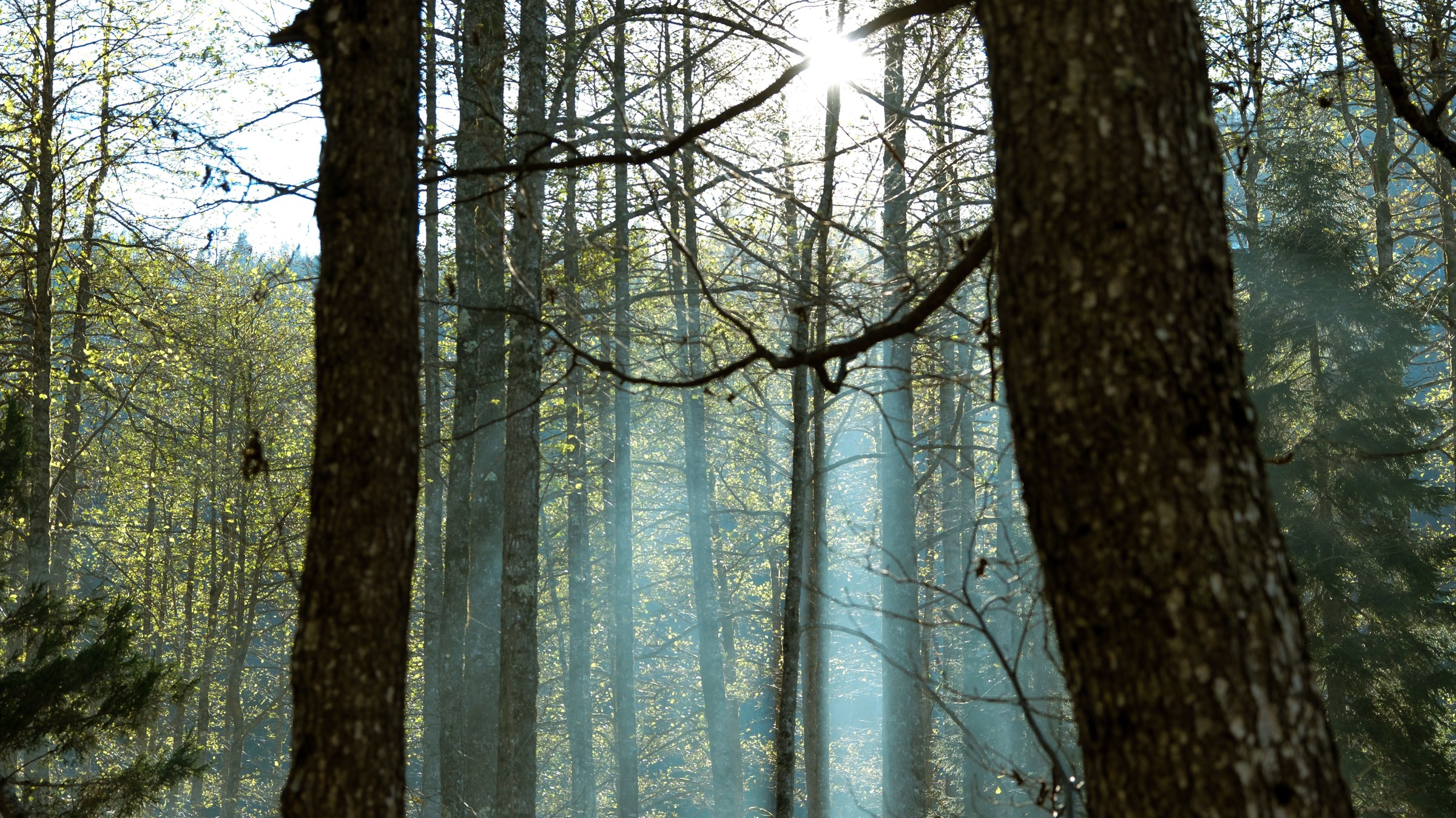
It is a morning with the sun hanging low. Light breaking through the branches passes through the mist and forms several thick shafts that come down to the ground at an angle. The black bark of the two trees in front is sunk in shade, and behind them slender trees stand in layers in the pale blue air.
The light is visible because moisture remains in the air. The humidity that the ground and the leaves breathed out overnight floats without dispersing, and those fine particles catch the sunlight and make it visible to the eye. The process of the forest breathing briefly took on a shape.
From this hour the leaves take in light and move carbon from the air into their bodies. Each pale green new leaf in the photograph is charged with that work, and the thick trunks are the result of that accumulated time. The forest has repeated what we call reduction every morning, without a name.
This scene is not maintained on its own. Where trees have disappeared to logging and development, neither the mist that catches the light nor the leaves that receive it remain. Protecting the forest that is left and bringing back the forest that has been lost matter equally.
The darkest place is at the foot of the two trees in front. On that ground the shafts of light do not reach, last season's fallen leaves lie pressed down and wet, and a fallen branch is half decayed and being buried in the soil. Decay also belongs to the forest's breathing. While the leaves move carbon into their bodies, the leaf mold in the shade takes those bodies back and returns them to soil, so the side that makes room for new leaves to grow is this darkness the light passes by.
Look at the photograph again. On the ground the shafts of light have reached, somewhere below it, there will be a tree that has just begun to grow.