Timed to the night opening of Gyeongbokgung Palace, the National Gugak Center will stage its 2026 resident performance "Seeds of Sound" at the palace's Sujeongjeon Hall starting Wednesday, May 20. The performance runs about 70 minutes and is held four times a week, Wednesday through Saturday, at 7:30 p.m. There are 10 shows in the first half, from May 20 to June 5, and 15 in the second half, from September 2 to October 2, for a total of 25. The National Gugak Center announced the schedule today.
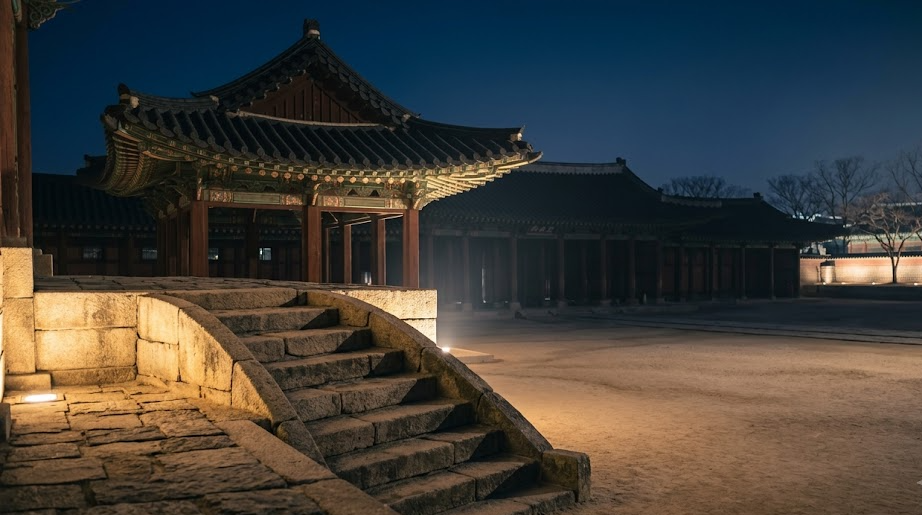
The stage is a temporary structure erected on the Sujeongjeon terrace. A wooden stage is laid over the cool grain of the granite terrace, and mapping video is projected onto the front of the hall. The stone holds the day's heat until late, so the ground underfoot stays lukewarm even on a May night. On it, some 60 performers from the Court Music Orchestra and the Dance Theater move.
The story follows a musician in a slump. Experiencing court arts firsthand, he realizes that "the heart of taking pleasure together with the people" is the root of music, and in the end finds his own sound. The theme reads as follows.
"Letters and scores are all seeds of sound, and those seeds sprout only when everyone enjoys them." The structure brings King Sejong and a modern musician face to face across time.
The program opens with Daechwita, passes through Bongnaeui, Suryongeum, Chunaengjeon and Cheoyongmu, and closes with Yeominrak. The nabal and nagak of Daechwita are sounds that strike the palace walls and return, and Bongnaeui is a work that renders the Yongbieocheonga into music, song and dance. Suryongeum will be presented in the saengso byeongju setting, in which the danso and the saenghwang sound together, the organizers said. Reinterpretations layering K-pop choreography onto Chunaengjeon and idol group dance onto Cheoyongmu have also been announced.
Director Yang Jung-woong is in charge of direction and the script. He is the person who created the play "Faust" and the opening ceremony of the PyeongChang Winter Olympics. Court music is planned by Lee Gun-hoe, artistic director of the Court Music Orchestra, and dance by Kim Chung-han, artistic director of the Dance Theater, each of whom also takes part.
Talk of reviving music in a palace always carries an awkward side. The terrace is stone made to be walked on, but it is also an object of preservation, and the walls of the hall are not surfaces put up to receive light. The permit and safety conditions for the stage installation and video projection were not included in what was made public. What is clear is only that protecting the heritage and using the heritage must be done together on the same night.
Location-based AR photo zones are placed within a 400m radius of Sujeongjeon. Shooting with a phone's front camera recognizes the face and creates an image of the user wearing Daechwita costume and blowing a nagak, while shooting with the rear camera applies a frame of traditional instruments. Park Sung-bum, head of the National Gugak Center's music division, said more than two million foreign tourists visit Gyeongbokgung Palace each year. That is the range of visitors this performance is aiming at.
Admission is free. Only the palace entrance fee of 3,000 won is paid separately. Reservations are taken on a first-come, first-served basis from May 14, one week before the first performance, on the National Gugak Center website (www.gugak.go.kr), and the capacity is 120 people per show. The day after tomorrow, in the morning, the reservation window opens.