More than 10,000 plastic bricks have been stacked to rebuild the last banquet of an era. "Brick Jinyeon: A Joseon Court Banquet Built With Lego," a special exhibition at the National Gugak Museum of the National Gugak Center, has been organized as a show that travels rather than stays in one place. It uses a modular design that is easy to dismantle and move, and it is understood to be the museum's first project designed specifically for touring. Admission is free.
The time the exhibition holds onto is 1902. "Imin Jinyeon," which marked both Emperor Gojong's entry into the Giroso and the 40th anniversary of his enthronement, was the last banquet the imperial house of the Korean Empire officially held. The music and dance of that year went into paintings and documents and slept there for a long time. Raising the formations fixed on paper back into three dimensions is the starting point of this exhibition.
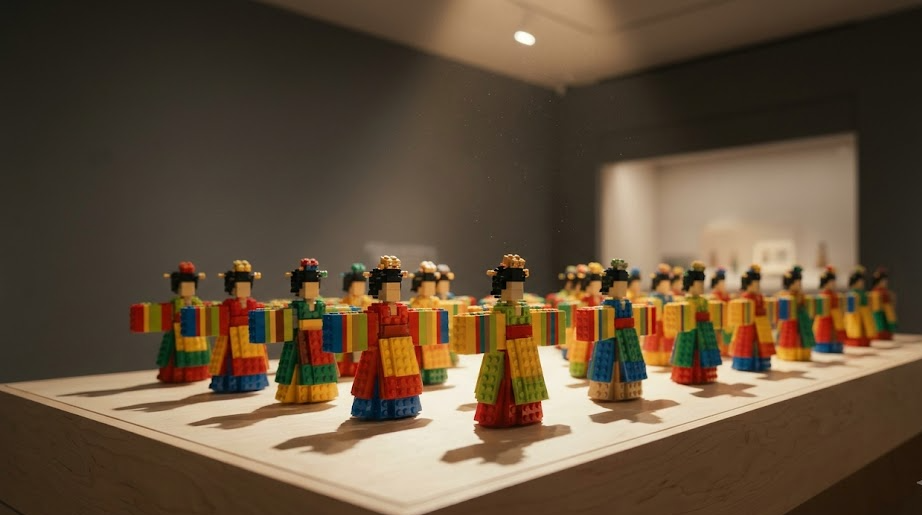
The viewing route branches into three rooms. In the first room, "Dancing Lego," Lego artist Colin Jin used more than 10,000 bricks to render the formations and costumes of five traditional court dances as dioramas. Smooth, hard plastic surfaces stand in for the layers of silk and the flow of sleeves. A single part the size of a fingernail becomes one dancer's shoulder, and those shoulders together make the geometry of the formation.
The second room, "Tradition Newly Stacked," calls for the visitor's hands. A brick-type tile structure made by the media art group Everyware is placed there, and it does not wait in a finished state. Only when visitors fit the tiles in one by one does the form emerge. The image at its base is the Irworobongdo, which stood behind the king.
The folding screen behind the king's back, which no one could touch, becomes here an object that is not complete unless visitors fit it together. It is a choice that sets a symbol of authority down as material for play. The shift is not entirely smooth. Whether the sensation left after the strictness of ritual is removed reads as intimacy or as lightness is open to different answers from each visitor.

The third room, "A Fleeting Moment, an Eternal Record," closes the visit with the court painting "Imin Jinyeondo Byeong." It is the point where formations handled in bricks return to the flat surface of the painting. Because the assembly and the original are placed one after the other, visitors retrace on brushstrokes the forms they learned with their hands. The route is arranged so that the record comes after the play.
The transmission of intangible heritage always sits on this tension. To keep the original from being damaged it must be placed behind glass, and to pass it to the next generation it must be put in the hand. The brick as a material is one proposal for passing between the two. Because it is not the real thing it can be touched freely, and because it is not the real thing it also carries the risk of being confused with the original.
Two stops on the tour have been confirmed. The exhibition at the National Library of Korea, Sejong runs through May 31, and it opens at the Members' Office Building of the National Assembly for three days from June 17-19. The next destination has not been decided.
In the exhibition hall the sound of bricks locking into each other is very small. That click of friction cannot overlap with the drumbeats of 1902. Even so, the sensation left on the fingertips lasts longer than a painting seen only with the eyes and passed by. In Sejong or in Yeouido, fitting in a tile yourself is worth trying.