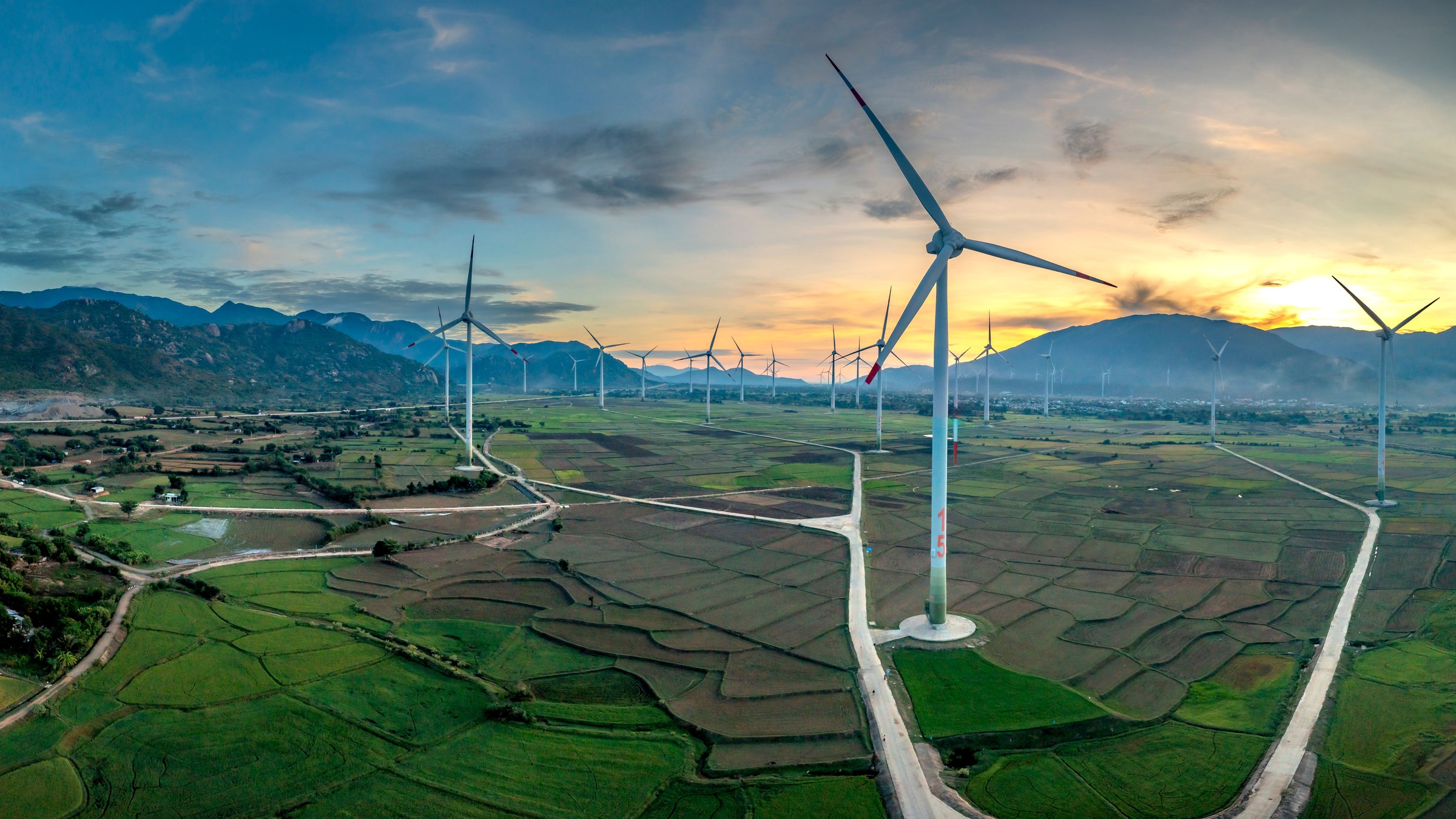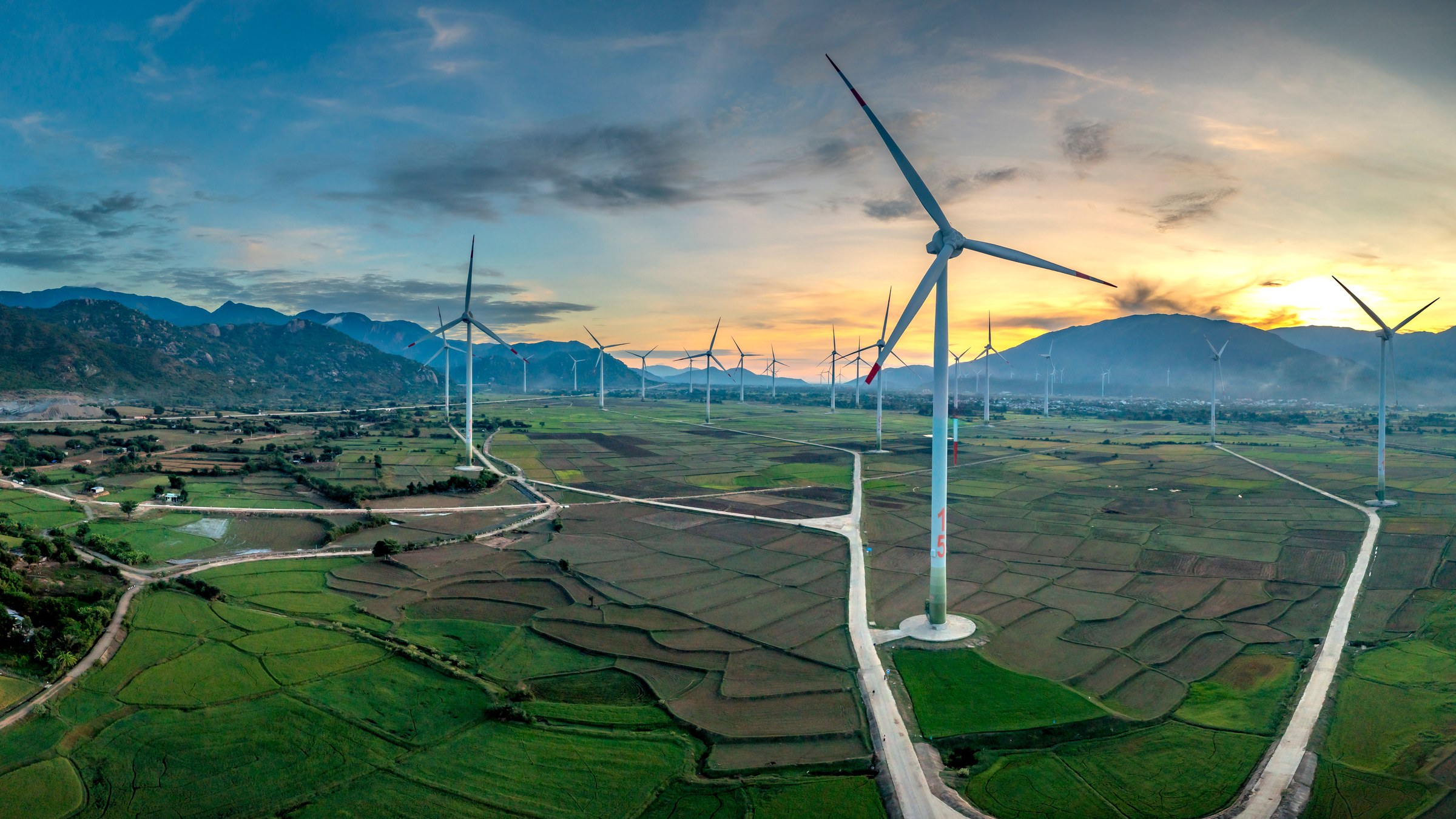
The sun settles behind the mountains and the sky splits into blue at the top and orange near the horizon. The fields are stitched together in green and brown like a patchwork cloth, and a thin white road stretches between them. White towers stand on it one by one. The near ones are large enough that the blade tips run off the edge of the frame, and the far ones grow smaller in the haze.
The towers catch the eye first, but what holds it is what lies below them. The paddies are still paddies, and the fields are still fields. The land did not change wholesale because generating equipment moved in. What each tower stands on is a single small circle, and the rest is still farmed.
The wind does not have to be dug up. It is not excavated, not hauled, not burned. It is closer to catching what passes by for a moment, turning it, and sending it on again. So there is no smoke in this scene, and the orange in the sky is sunset, not exhaust.
This evening is not a special day in a special place, it is an evening possible anywhere the wind blows. Deciding what to put where is being settled now, and that decision will remain for a long time, like that white road.
The light comes in at a slant from low on the left side of the frame. So each tower's shadow lies long across the paddy banks, and only one face of each blade takes the orange and turns bright while the other side sinks into gray. The same light rests thinly on the water furrows between the rice plants, and the generating equipment and the crops are wet at once. The lower the sun goes, the further the shadows reach toward the farmland, but that shade soon moves on and the ridges take their share of the evening.
Look at the photograph again. Which way are the blades turning? Follow with your eyes where the wind comes in from and where it slips away.