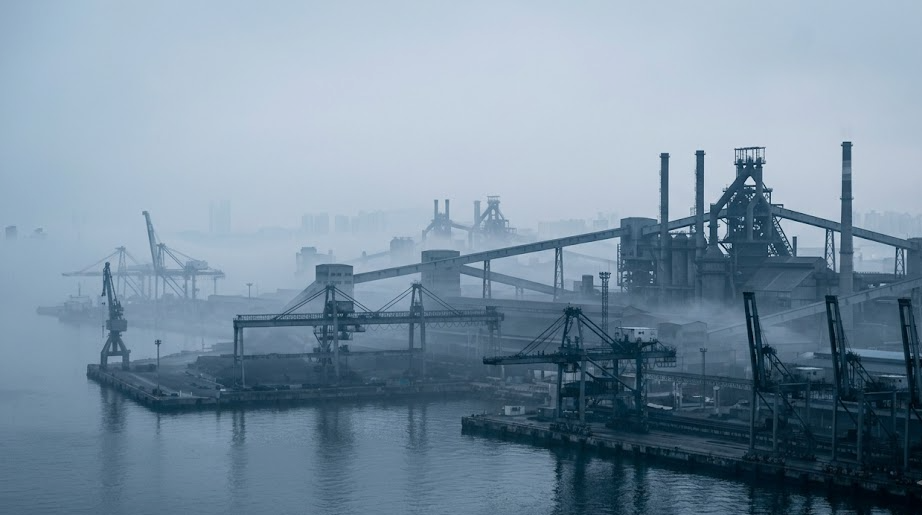
The low-carbon transition timelines for steel and petrochemicals were taken up as a central agenda item at Green Transformation (GX) International Week, which opened on the 20th. On the 21st, a low-carbon steel seminar under the theme "The K-Steel Act and the Strategic Design of GX" was held at the Utop Marina Hotel in Yeosu, attended by some 50 people from the steel and petrochemical industries, the government, environmental agencies and the media. The seminar, hosted by the incorporated association NEXT, was joined by the Ministry of Climate, Energy and Environment and the Korea Iron and Steel Association. Combined, carbon emissions from the two sectors amount to about 65% of total industrial emissions.
The event's theme is "Green Transformation, a Path to Growth for All," and it runs through the 25th. In the afternoon, a seminar on "Policy and Investment Strategies for the Clean Chemical Transition of Petrochemical Industrial Complexes" followed at the same venue. Among regulatory factors, the EU Carbon Border Adjustment Mechanism (CBAM) was identified as a force pushing up demand for low-carbon steel.
Cost estimates were also presented. According to an analysis by NewClimate Institute researcher Nora Chang, if Korea's steel industry lowers its total emissions intensity by about 36%, the additional cost burden under CBAM effectively converges to zero. The base year and the target date for the reduction were not specified in this presentation. Yoo Mi-young, head of the Korea program at the Mission Possible Partnership, gave a presentation on "Korea's Low-Carbon Steel Transition and Its Economic Ripple Effects."
Japan's timeline runs along a longer time axis. Since 2008, Japan has developed technology for hydrogen reduction of blast furnace carbon dioxide through the "COURSE 50" project centered on Nippon Steel, and from 2023 it raised this to a demonstration stage called "Super COURSE 50." The target date for commercialization is around 2030. Financial backing has been designed alongside it, with the Japanese government pursuing a GX strategy totaling 150 trillion yen (about 1,500 trillion won) over roughly 10 years from 2023, allocating 20 trillion yen of that to high-carbon-emitting sectors such as steel and chemicals and raising the funds through the issuance of "GX Economic Transition Bonds."
The units of the Korean plan are different. POSCO is planning a hydrogen-based steelmaking demonstration plant in 2030, with the related investment put at about 830 billion won. A company official said the goal is to introduce demonstration facilities in 2028 and develop commercial technology by 2030, but the dates given for the demonstration plant schedule and for the demonstration facility schedule do not match each other. The value of GX efforts in Korea's steel industry cited at the seminar is on the order of 45 billion dollars.

Government funding plans also show a gap between totals and execution. The target for climate finance has grown from 420 trillion won by 2030 to 790 trillion won by 2035, but where the increase of about 370 trillion won will be spent has yet to be disclosed. A Financial Services Commission official said no specific execution plan for climate finance has been prepared. The share of renewable energy in power generation was given as 11%, and the government is targeting more than 20% by 2030.
Ko Eun, vice president of NEXT, said in her opening address and keynote lecture that the K-Steel Act (Special Act on Strengthening the Competitiveness of the Steel Industry and the Carbon Neutral Transition) and the finalization of the GX strategy by the government-wide GX Planning Group are both scheduled for the first half of 2026. She proposed writing into the law the parallel pursuit of DRI-EAF, a combined process pairing direct reduced iron with electric arc furnaces, as a short- to mid-term measure alongside hydrogen-based steelmaking. Her explanation was that volumes must be produced before 2030 to take an early position in the green steel market, and that the capacity to respond to variables is needed so green steel can be made even without green hydrogen. The fact that the global green hydrogen supply chain is expanding more slowly than initially planned due to project delays and immature transport technology was cited as a variable in green steel production.
In the petrochemical sector, Solutions for Our Climate researcher Kim A-young proposed including "NCC electrification" in the scope of core strategic technologies and high-value-added transition in the enforcement decree of the Petrochemical Special Act, and including a budget for supporting NCC electrification demonstration in the Climate Response Fund. The facts that energy import dependence reaches 90% and that imports came to 238 trillion won in 2024 were placed as the backdrop to the transition discussion. Kim Sung-hwan, Minister of Climate, Energy and Environment, said in his opening address at the opening ceremony on the 20th that international cooperation is needed for the energy transition, then delivered a keynote lecture on "Korea's Energy Transition Policy." He said that if the decarbonization transition is delayed, China will take the green industry market, noting that China holds about 90% of the global solar power market.
GX International Week continues through the 25th. The government has said it will release the "Korea Green Transformation Strategy (K-GX)" in June. What to watch in that document is the share allocated to steel process transition and the years of execution, and whether short- to mid-term processes such as DRI-EAF are included among the support targets. These are points that cannot be confirmed from totals alone.