With the Act on Integrated Care Support taking effect on the 27th of last month, integrated care programs crossed the starting line in local governments across the country. Yeoju City has finished selecting its service providers, and Jeju Province has decided to concentrate administrative resources on getting the system settled early. Yeonsu-gu in Incheon is putting its "Whole Neighborhood Integrated Care," which combines food and housing, into full operation. But for the system to run, someone in the end has to open the door, come in, prepare meals and wash bodies.
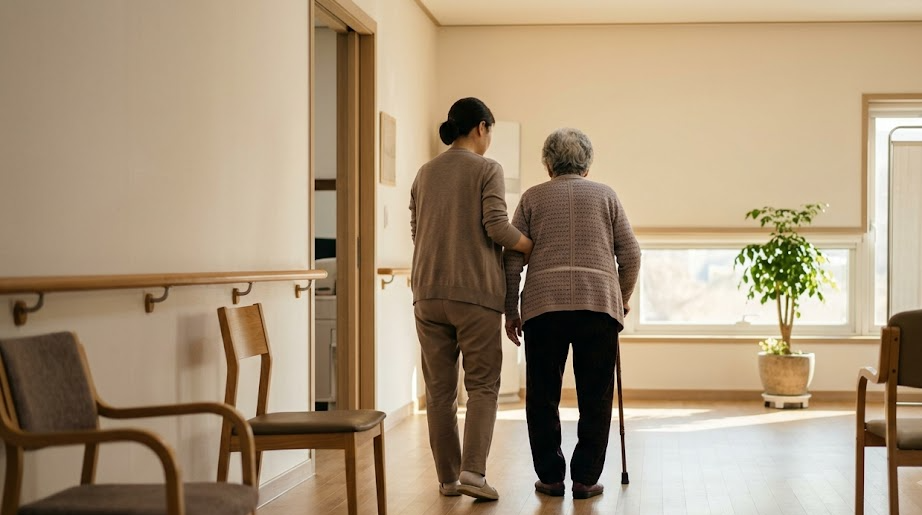
A report titled "Outlook for the Elderly Care Service Workforce and Policy Tasks," released by the Korea Development Institute (KDI) on the 20th, found that such people will be in short supply. Demand for long-term care services will grow to more than 2.4 times the 2023 level by 2043. Care workers, meanwhile, will rise from about 710,000 in 2023 to a peak of about 800,000 in 2034 and then turn to decline. Keeping services at the current level would require up to 990,000 more workers as of 2043, according to the analysis by Kwon Jung-hyun, a research fellow at the Department of Fiscal and Social Policy.
Those providing care are aging as well. The share of care workers aged 60 or older is projected to exceed 70% going forward. That means the age gap between those who need care and those who provide it is narrowing.
The channels raised as alternatives are narrow. Foreign care workers account for less than 1%, and even those who do arrive are concentrated in the Seoul metropolitan area. Care robots have been shown to ease the physical burden on care workers in some functions that assist with mobility, but their spread is limited because of introduction costs and uncertainty about their usefulness. The point is that it is difficult to fill the workforce gap directly with machines or migrant labor.
Home medical care, the other axis, is also less than fully organized. The 2026 spring symposium held by the Korean Academy of Home Care Medicine (chaired by Lee Kun-sei) at the Samjung Hotel in Seoul on the 19th closed pre-registration early for the first time since the academy launched in 2023, and attendance rose about 50% from previous years. That was the backdrop for assessments from the field that demand for home medical care is growing since the law took effect.
Lee Hye-jin, a professor at Seoul National University Bundang Hospital, listed service standardization and quality management, closing regional gaps, expanding eligibility, a 24-hour response and emergency admission system, and stronger management of non-covered services as tasks. Oh Dong-ho, director of Mirae Neurology Clinic, said medical institutions run by a single physician cannot afford to hire a multidisciplinary team and need local government support. Rep. Kim Sun-min of the Rebuilding Korea Party, a member of the National Assembly's Health and Welfare Committee, noted that even after local governments expanded their dedicated organizations, there are cases where the field response stops at simple guidance.
Regions are filling that gap in their own ways. On the 15th, the Yeoju City Senior Welfare Division confirmed providers in five areas, household support, personal hygiene support, mobility support, housing environment improvement support and meal support, after in-person screening involving five welfare experts, and the agreement ceremony will be held on the 27th. Asan City was selected for a social solidarity economy innovation model and is pursuing "Integrated Care for Seniors" with 500 million won in state funds.
The Goyang City Social Economy Support Center will hold the second lecture in its open course on integrated care at 3 p.m. on May 6 in the center's training room. The lecturer is Yoo Yeo-won, executive director of the Salim Medical Welfare Social Cooperative in Eunpyeong-gu. For 12 years the cooperative has run dentistry, obstetrics and gynecology, psychiatry and an oriental medicine clinic around family medicine, while operating home visit care, mutual care, health neighbors, a day care center and a home care welfare center. In the first lecture, Noh Tae-jin, director of Seohwa Oriental Medicine Clinic, described his own experience providing home medical care.
A system starts on paper, but paper cannot take the place of people. Yeoju's agreement ceremony is on the 27th of this month, and Goyang's second lecture is on the 6th of next month. In the meantime, a doorbell rings again today at some house, and someone takes off their shoes and steps inside.