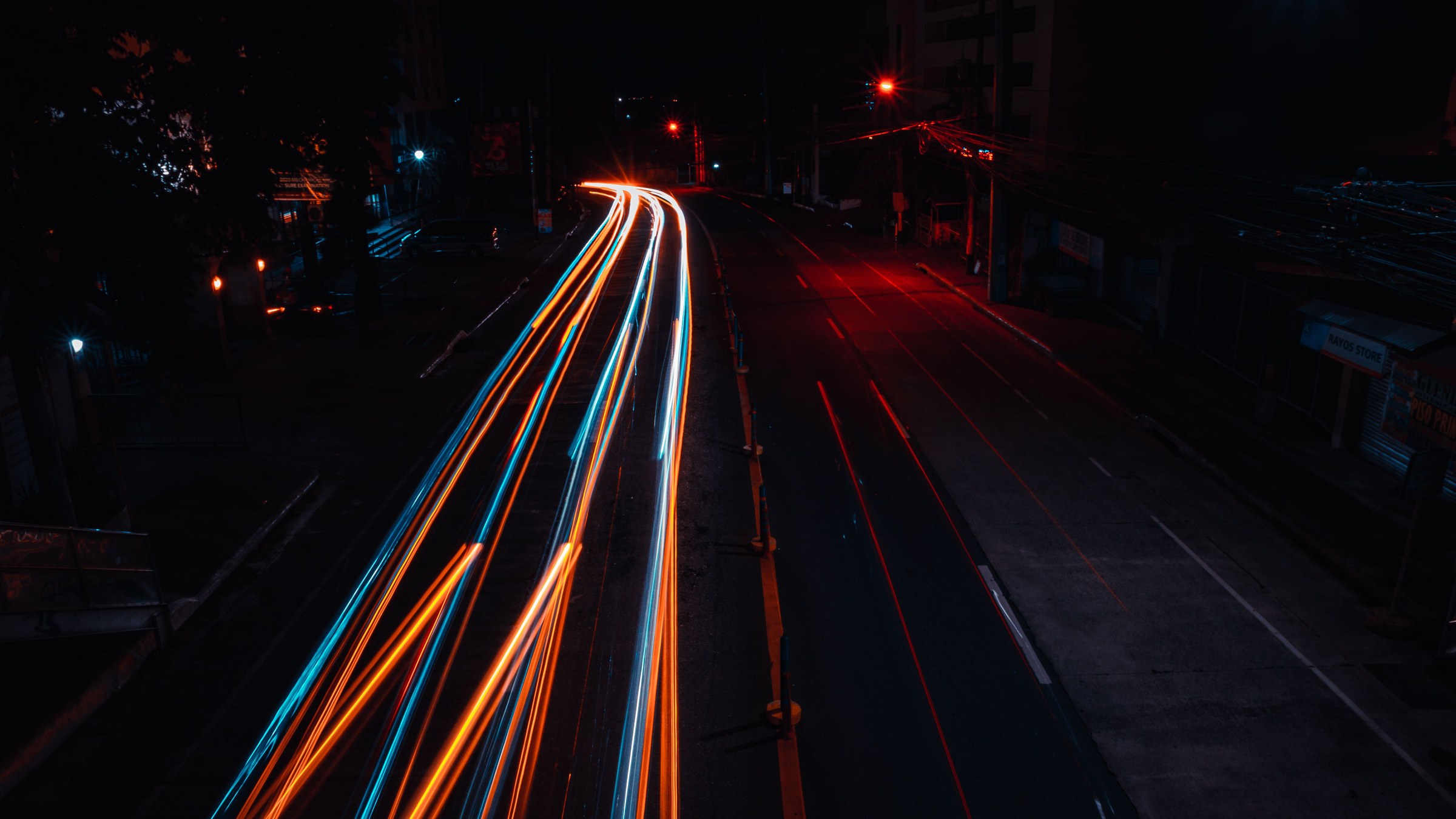
This is an arterial road at night, seen from above on a pedestrian overpass. While the shutter stayed open, vehicle headlights were left as blue lines and taillights as orange and red ones. In the left lanes several strands trace a gentle curve and flow down toward the bottom of the frame, and in the right lanes a red line brushes past a shop shutter and recedes. Only the red dots of the traffic light and the white flare of the streetlamps stand still.
What catches the eye first is that the lines vary in thickness and spacing. Some strands passed through thick and bright, others thin and wavering. Each vehicle was traveling at a different speed and left a different trace of changing lanes. Once a single photograph compresses several dozen seconds into one, what would normally be seen only as individual vehicles reads as a single flow.
Technology that handles urban traffic largely sees the world the way this photograph does. It looks at accumulated trajectories rather than what each individual driver chooses, and on that basis it adjusts signal cycles, lane allocation and dispatch intervals. Whether it is autonomous driving or electric vehicle charging plans, it comes down to the question of when and where these lines thicken.
The circuit metaphor is comfortable because it is clear which way things flow. The blue lines flow this way, the red lines that way. Unlike a circuit, on a road the current chooses its own path. What a designer can do is decide where to place the resistance.
Looking at the photograph again, the right lanes are far emptier than the left. Same hour, same road, yet the flow is tilted to one side. Where the city was heading that night is written in that asymmetry.