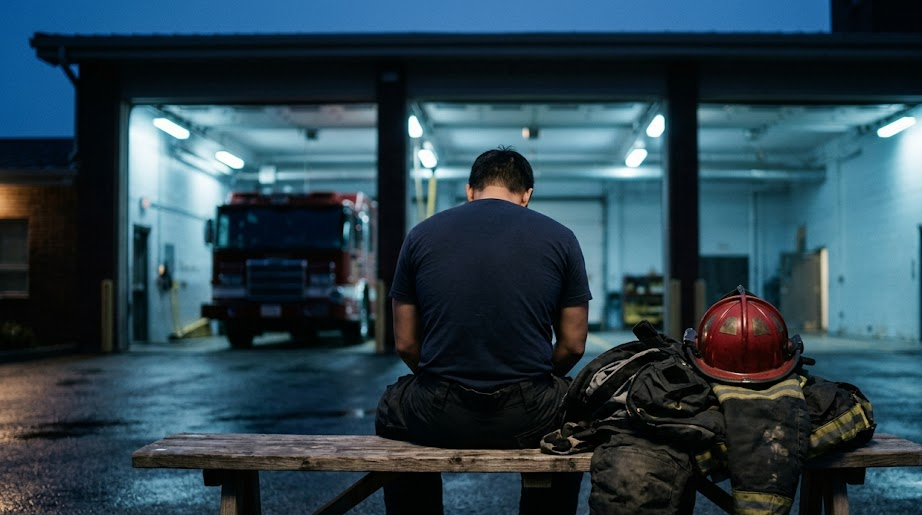
The National Fire Agency and the Korean Neuropsychiatric Association have signed an agreement to promote the mental health of firefighters and provide psychological support. The Fire Agency announced this on April 10, saying it would expand the designation of "mental health partner hospitals" that firefighters can visit from the current 98 to 253. The signing ceremony was held the previous afternoon, April 9, at the Korean Neuropsychiatric Association conference room, where Fire Commissioner Kim Seung-ryong and association chairman Choi Jun-ho signed the agreement. The association has roughly 4,500 psychiatric specialists.
The two-and-a-half-fold increase in partner hospitals means a slightly shorter day for firefighters who had to drive several hours from their stations to receive treatment. Until now, firefighters have largely borne their trauma on their own. They did not tell colleagues, they avoided leaving a hospital record, and when the next call bell rang they went straight back out.
In a mental health survey conducted by the Fire Agency last year, firefighters were exposed to traumatic events an average of 5.8 times over the past year. That means facing scenes of people injured or killed nearly six times a year. The detailed design of the survey was not released, but the average figure itself shows what daily life in this occupation is like.
The trend has moved gradually, but in one direction. According to materials the Fire Agency submitted to the National Assembly last year, in surveys of firefighters over the six years from 2019 to 2024, the share in the PTSD risk group rose from 5.6% to 7.2%. Over the same period, the depression risk group grew from 4.6% to 6.5% and the suicide risk group from 4.9% to 5.2%. That works out to about one in fourteen falling within the risk range for post-traumatic stress.
The agreement covers several items beyond the hospital expansion. The two organizations will create a pool of outside expert advisers to provide psychiatric consultation across the Fire Agency's health and safety policies and programs. The Fire Agency also presented a plan to provide specialized psychological support, where necessary, to firefighters deployed to disaster sites. The Fire Agency will cooperate with the association's public mental health promotion projects and research support.
The agreement is known to be a response coming eight months after the so-called "firefighter PTSD" controversy surfaced. Eight months is not a short time, and calls came in every day during that period. When systems fail to keep pace with the time firefighters live through, the cost is always paid in the field.
How the state manages the mental health of high-risk occupations is not a question confined to firefighting. The Aviation Safety Act requires airlines to draw up and carry out annual health promotion activity plans for pilots that include job stress management and mental health counseling and assessment. But domestic airlines leave the actual operation to each company's discretion, and there is no national system tying it together. The case of former Air Busan first officer Kim Dong-hwan (49), reported in March, who killed one colleague captain and attempted to kill another under persecutory delusions, prompted another look at how pilots' mental health is managed.
By airline, Korean Air and Asiana Airlines provide individual in-depth assessments and counseling involving aviation medical examiners for the pilot occupation, separate from mental health checkups for all employees. Jeju Air runs an MBSR program for pilots, while Eastar Jet and T'way Air operate separate counseling. Air Busan and Jin Air run integrated programs without separating pilots from non-pilot occupations. Even within the same high-risk occupation, the depth of care available differs by company.
Having 253 partner hospitals does not mean firefighters will immediately open the door to a consulting room. The agreement announcement did not include guidance on how treatment records are reflected in personnel decisions or job assignments, or who covers the costs. Lowering the threshold and getting people to open the door are different tasks.
Still, one change is clear. The work of firefighters searching out hospitals on their own will now be taken on jointly by the Fire Agency and a body of specialists. The point at which the expanded designation is actually completed, and the regional distribution, will have to wait for the next announcement. What should be checked then is not how many sites were designated but how many of the firefighters who endured 5.8 events last year actually opened that door.