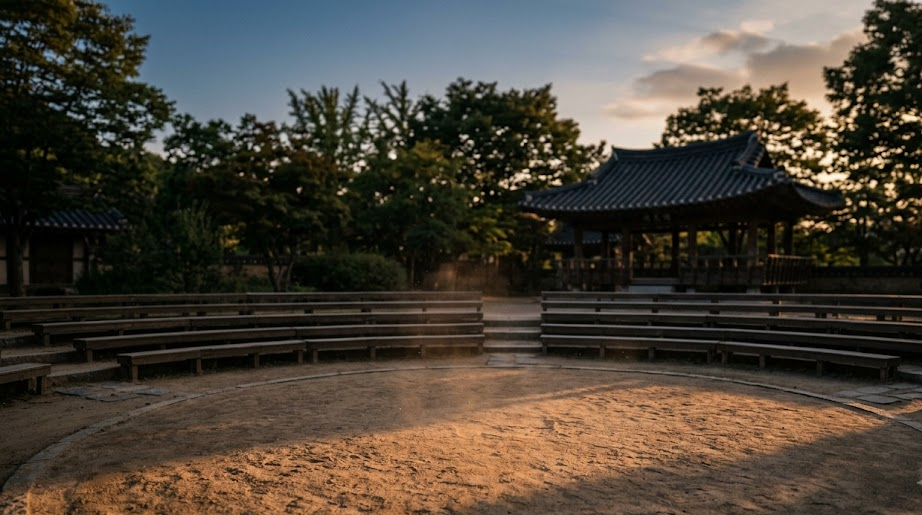
The National Gugak Center announced on March 23 that it will begin 'Yeonhui Panpan,' its 2026 resident yeonhui performance series, on April 4. Fourteen pan in all will be held at 5 p.m. on Saturdays in April, May and October at the Yeonhui Madang of the National Gugak Center in Seocho-dong, Seoul. It is the first resident performance the National Gugak Center is presenting this year.
The title means "the pan keeps opening." Rather than dividing the stage from the seats, it carries the intention of rebuilding the Yeonhui Madang as a communal space where performers and audiences tread the same dirt ground and pass excitement back and forth. The outdoor round madang is a space where the lights never go out. At five in the afternoon, when the sun begins to sink, the audience's faces and the performers' sweat are fully visible to each other.
Seven groups are taking part. The Yeonhui Division of the National Gugak Center's Folk Music Group, the Yeonhui Division of the Busan National Gugak Center, the Hahoe Byeolsingut Talnori Preservation Society, Hannuri Yeonhuidan, the Namsadang Nori Preservation Society, Yuheeska and the traditional yeonhui troupe Kkokdusoe take over the madang in turn.
The opening performance on April 4 is the Folk Music Group Yeonhui Division's 'Yeonhui-Pan, a World Joined by Heung.' After the pan is washed clean with mungut and binari, it moves on to a nationwide nanjang where the sound of a spinning beona, bodies turning over in salpan and the fur of the lion dance tangle together. This program goes up again on April 18. On April 11, the Hahoe Byeolsingut Talnori Preservation Society puts on wooden masks and strikes at the hypocrisy of noblemen and scholars.
On April 25, Hannuri Yeonhuidan stages the newly created mask pan 'Tal:Seon (脫:線)' with a cast of about sixty, and on May 9 the Yeonhui Division of the Busan National Gugak Center unfolds 'Here Comes Yeonhui!,' which gathers together the yeonhui of the Yeongnam region. On May 23, the Namsadang Nori Preservation Society shows Namsadang Nori, a National Intangible Heritage, on the tightrope. The friction sound that comes when the rope sways once is a sound hard to hear indoors.
It is also a lineup in which preservation and transformation collide in one madang. Hahoe Byeolsingut Talnori and Namsadang Nori are designated National Intangible Heritage and go on stage in their original form, and in October Yuheeska, which attaches Jamaican ska music to yeonhui, takes the stage on the 3rd, and Kkokdusoe's 'Beautiful Companionship II,' which layers on Latin and African rhythms, on the 17th. It is a lineup that sets the hands keeping the original form and the hands mixing in new rhythms on the same dirt.
Of the fourteen pan, eight now carry names. The dates and performing groups for the remaining rounds have to wait for an announcement. Park Sung-beom, head of the Jangak Division at the National Gugak Center, explained that it has been prepared as a festival ground for anyone to enjoy, young and old alike.
Tickets are 10,000 won for all seats, and reservations are confirmed to be taken through Interpark NOL Ticket and by telephone at the National Gugak Center (02-580-3300). Eleven days remain until the first pan. If you sit at the edge of the madang at the hour when the spring sunlight begins to cool, the sound of the lion dance's feet kicking the dirt carries all the way to your feet.