
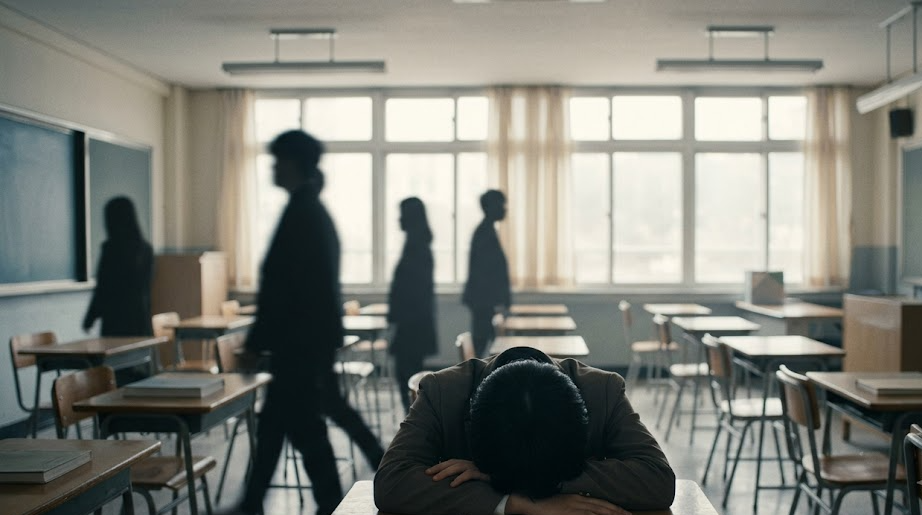
About eight in ten adolescents who died by suicide had never attempted self-harm or suicide before. This came out at the first Youth Policy Forum, held on March 13 at Post Tower in Jung-gu, Seoul, by the Ministry of Gender Equality and Family (성평등가족부) and the National Youth Policy Institute (한국청소년정책연구원). Hong Hyun-joo, a professor of psychiatry at Hallym University Sacred Heart Hospital, said that 70-80% of adolescents who die by suicide die on their first attempt. Fewer than 20% had a confirmed history of self-harm or suicide attempts during their lifetime.
There is a separate reason these figures read as frightening. Korea's adolescent suicide measures have long stood on the framework of "screening out high-risk groups and managing them." It is a method of narrowing the target and attaching resources on the basis of markers such as attempt history, counseling records and school maladjustment. If the children who left no such marker are the majority, it means the mesh of the finely woven net was set in the wrong place from the start.
The contrast presented at the forum is clearer. Adolescents who attempted suicide had shown the usual risk factors in advance, such as family conflict, economic hardship and school attendance problems. Adolescents who died by suicide had fewer such factors. The account continues that they were avoidant or compliant in temperament, and that outwardly visible problem behavior was rare.
What adults saw was also presented. The share who noticed warning signs sent during the lifetime of adolescents who died by suicide fell short of 40% among teachers, and did not reach 26% among parents. The two adults who spend most of the day with them missed it, and this is not explained by adults' indifference alone. It is likely that the signals themselves were faint from the start, or that the child's way of expressing it was not on the list we have been taught to call signals.
Broken down by sex, the texture of the change is different again. The suicide rate among female adolescents rose from 3.4 per 100,000 people in 2014 to 8.7 in 2024. Over the same period, male adolescents rose from 5.5 to 7.4.

Kwon Se-won, head of the policy research division at the Korea Foundation for Suicide Prevention (한국생명존중희망재단), said the suicide rate among female adolescents has grown to about 2.6 times the 2014 level. The rise in the 10-14 age bracket also exceeded threefold, and a trend toward younger ages is observed along with it.
The suicide rate for teenagers overall jumped from 4.7 per 100,000 people in 2017 to 5.8 the following year, and reached 8.0 in 2024. According to Professor Hong, about 10% of adolescents have thought about suicide, and cases that lead to an actual attempt stand at 2-3%. The gap between thought and attempt, and between attempt and death, is far narrower and harder to predict than we have assumed. In the United Kingdom, about half of the children and adolescents who died by suicide are reported to have had a previous attempt, which differs from the pattern in Korea.
Noh Seong-deok, a division head at the Korea Youth Counseling and Welfare Institute (한국청소년상담복지개발원), proposed that the existing understanding of suicide death as the end point of repeated attempts should be examined again. It may be a nonlinear event that occurs abruptly at the moment certain conditions come together at once. Park Su-bin, director of the Mental Health Research Institute at the National Center for Mental Health, said psychological autopsies are needed that read the "invisible signals," including interviews that meet bereaved families and friends directly, and even records of generative AI use.
Measures, then, move from screening to the universal. Kwon said a curriculum that builds social and emotional life skills should be set up in schools, where the largest number of adolescents gather. Professor Hong also proposed emotional education that helps adolescents notice their own feelings and put them into words, along with the work of finding risk factors. The aim is to have every child learn how to handle emotions in ordinary times, in place of waiting for crisis signals and then responding.
The statistics presented at the forum vary slightly from presentation to presentation in age brackets and base years, and an organized government announcement is scheduled for later. Establishing psychological autopsy as a system requires agreement beginning with how to handle sensitive personal information. Classrooms open every day while that discussion goes on. This forum confirmed in figures that a child who was quiet yesterday being quiet again today is no ground for reassurance.