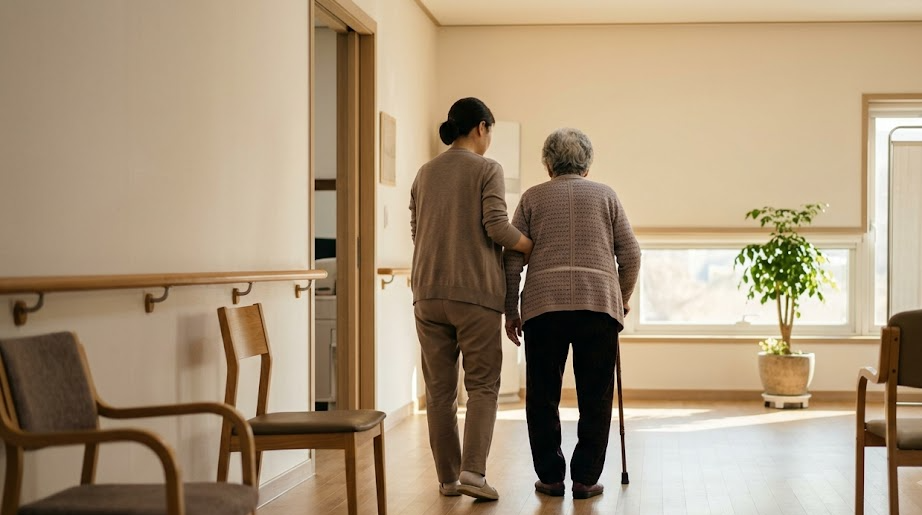
The Act on Integrated Support for Community Care, Including Medical and Long-Term Care, takes effect nationwide on the 27th. Older adults, older people with disabilities, and people under 65 with severe disabilities and high medical needs are covered in the first stage. They will receive 30 kinds of services, including medical care, care services and health management, in the homes where they live, without moving to a hospital or a nursing home. The law, enacted in March 2024, reaches the field two years later.
The biggest change is how to apply. Until now, people had to find the responsible agency for each service they needed and apply separately. When the person concerned had difficulty getting around, a family member went from agency to agency, and only those who knew which programs existed could apply. From the 27th, an application can be filed at a single location, either a community service center or a branch office of the National Health Insurance Service.
The 30 services in the first stage are organized into four areas: health care, health management, long-term care, and daily living support. Usage limits for home nursing, home care and home bathing will rise, and short-term respite care will become available inside day and night care centers. The route for doctors and nurses to visit homes through home medical care centers will also widen. The plan is to expand the services to 60, but when all 60 will be in place has not been disclosed.
The Ministry of Health and Welfare held the third Integrated Care Policy Committee meeting at the Government Complex Seoul on the 5th and discussed the implementation roadmap. The roadmap has three stages: an introduction period (2026-2027), a stabilization period (2028-2029), and an advancement period (2030 onward). In the second stage, people with severe mental illness will be added to the target group, and expansion to all people with disabilities will be reviewed. In the third stage, more categories with high care needs will be included.
Daegu and its autonomous districts and counties have run a pilot program called "Dandi Care" since September last year. It was a trial run of receiving care where one lives through a single application. A survey by the city put the group eligible for integrated support at 120,000, combining 60,000 people with disabilities and 60,000 older adults. The project budget, combining national and local funds, is 6.8 billion won.

A system moves only when people are assigned to it. Integrated care teams have been newly created in the welfare policy divisions of Daegu's nine districts and counties, with an average of four members per team and 38 in total. Set against 120,000 people, the load each staff member has to carry is not small. Daegu plans to hire about 150 more people in welfare, nursing and public health positions from the second half of this year.
A passage running through hospitals and neighborhoods is opening as well. Under the community linkage support program for discharged patients, a hospital with an agreement with a city, county or district screens and assesses patients due for discharge who need care and refers them to the local government, which then holds an integrated support meeting and draws up an individual support plan. Home visits by doctors, household support and health management are connected according to that plan. The design is meant to reduce cases where a patient is left alone at home on the day of discharge.
The system is not filled only by what has been newly created. The Gangwon Medical Welfare Social Cooperative formed a preparatory committee in Wonju in 2001 and was established the following year, opening Balgeum Clinic and Balgeum Korean Medicine Clinic the same year. It now runs three institutions: Balgeum Clinic, Balgeum Home Medical Care Center and Balgeum Home Nursing Center. The G-care managers it has deployed are village health activists, and they have connected medical staff with residents, and hospitals with the community.
Such organizations have been doing what integrated care sets out to do for more than 20 years, but the qualifications and contract forms under which they will enter as service providers have not been settled. Depending on how the system takes in the trust and the lists built up at the village level, the same 30 services will arrive differently. Conversely, if the connection is loose, people who find it hard to stay at home will head back to facilities centered on medical care.
About half a month remains until the 27th. Anyone whose parent or spouse is due to be discharged can ask the hospital's social work team whether the hospital has an agreement with the city, county or district where they live, and whether a linkage application can be made before discharge. By the end of this month, applications will also begin at community service center desks. The default of care is moving toward letting people who have long kept a home stay in it.