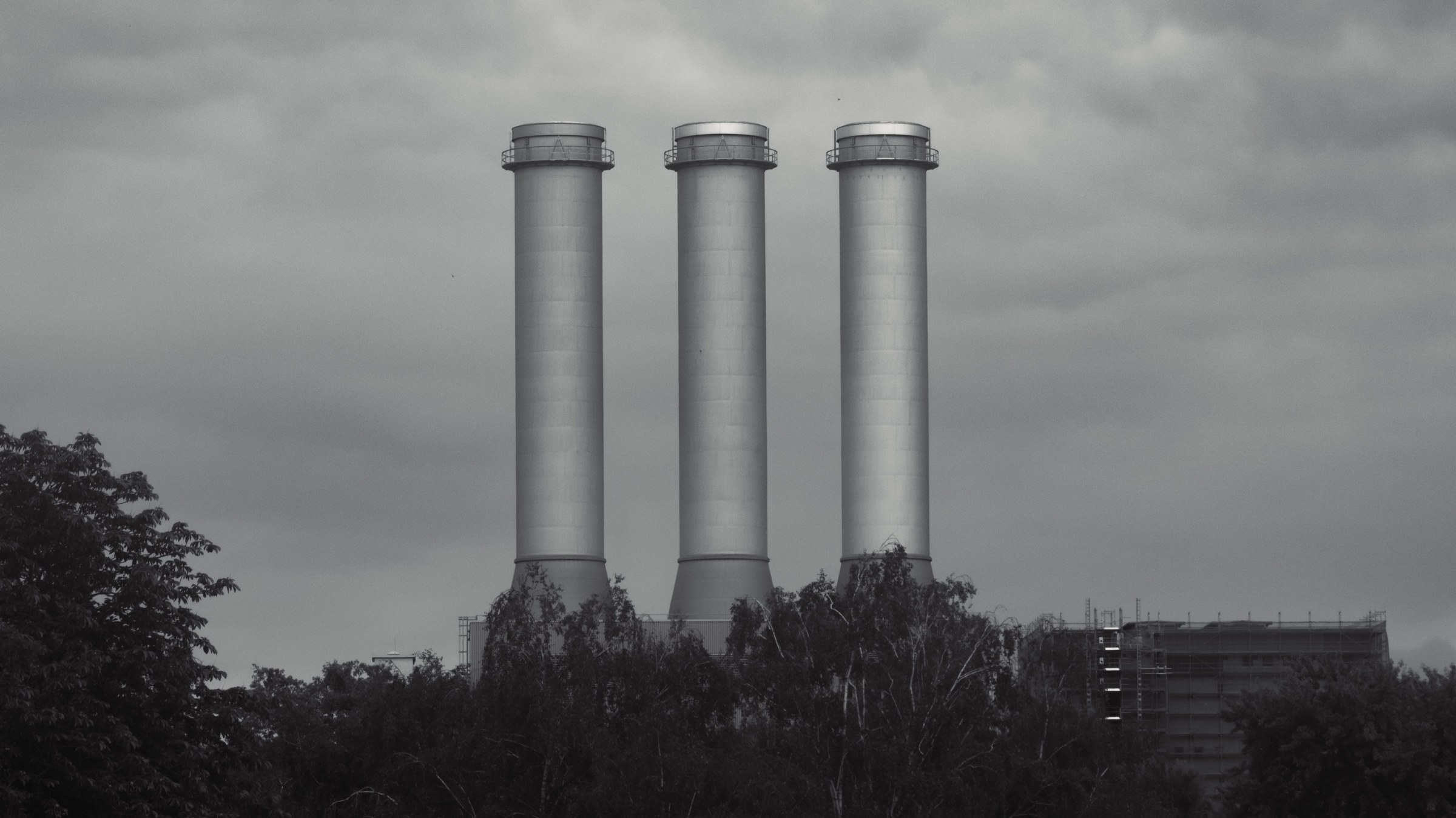
Under an overcast sky, three gray chimneys stand at even intervals. Horizontal lines from the construction joints remain on their surfaces, and the railings and ladders at the top are clearly visible. Not a single plume of smoke rises. The trees below are in full leaf, so the season does not look like winter, yet the light is flat all over, with no telling where it comes from.
The part of the photograph that reads largest is the empty space above the chimneys. A chimney is a structure built for emissions, and no emissions means the plant was not running at that hour on that day. It could be maintenance, it could be an hour without demand, it could be a phase when fuel prices do not add up. Either way the chimneys stand, and the money that went into raising them to that height was spent long ago.
The accounting of industrial transition turns difficult at this point. When the physical life of a plant and its economic life diverge, demolition costs, the use of the site and the jobs tied to it come up as tasks. Sentences about transition are mostly in the future tense, but the concrete remains there in the present tense.
Inside the wall on the left, a freight truck sits stopped with its nose pointed toward the chimneys. Chocks are set in front of the wheels, and the cargo bed is empty. It has the posture of leaving whenever there is something to haul, though whether that wait is one day or half a year cannot be told from the vehicle alone. The hands on the scaffolding and the parked truck inside the wall are working on different timetables on the same site.
The scaffolding hung on the building at the lower right catches the eye. Someone is still building or tearing down something on this site. That is the only thing moving in the photograph, and for the rest, only where they will drift is faintly visible, like the clouds in the sky.