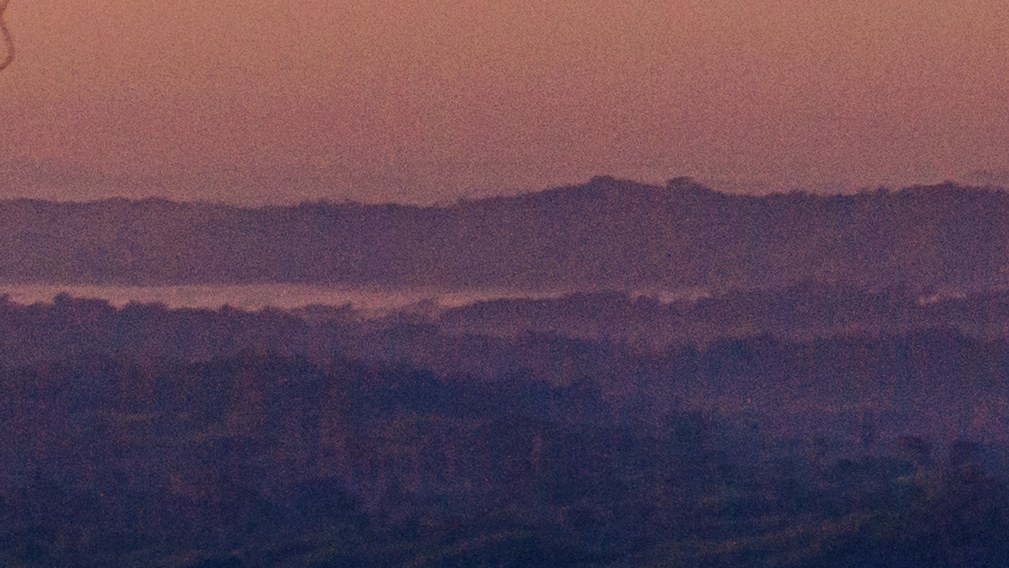
The sky is still close to purple, with a thin wash of pale apricot spreading above it. The ridgelines grow hazier from the near side to the far side, stacking up in four or five layers. White fog lies low in every valley, and on the left of the frame a single tree wrapped in dry vines stands as a black silhouette.
The forest at this hour is busy without a sound. Moisture that escaped from the ground and the leaves overnight meets the cold air and turns to fog, and from the moment the first light reaches them the leaves begin to draw in air again. The white band in the photograph is closer to the trace of a breath the forest has let out.
The reason the ridgelines look blurred in so many layers is that the space between them is full of air, water and trees. If that thickness thins out, the dawn may look clearer, but the fog disappears. What we speak of protecting is the thickness that fills that space.
Even while the stars remain, the forest has already begun its work. This brief gap between night and morning returns every day, but the thickness of the forest that fills it does not return on its own.
At the bottom of the frame, on the ground before the ridgelines begin, wet fallen leaves and moss are tangled together and pressed down dark. Around the base of the tree wrapped in dry vines the color is deeper, as though frost had settled and melted, and shallow marks where moisture spread along the grain remain. Rather than the fog having come down from the sky, it fits the frame better to see it as having risen slowly from that damp surface. If the pile of crumbled leaves underfoot had not held water through the night, the white band in the valley could not have been this thick.
Looking at the photograph again, you find yourself following with your eyes how far the most distant ridgeline runs. That its end cannot be seen is today's good news.