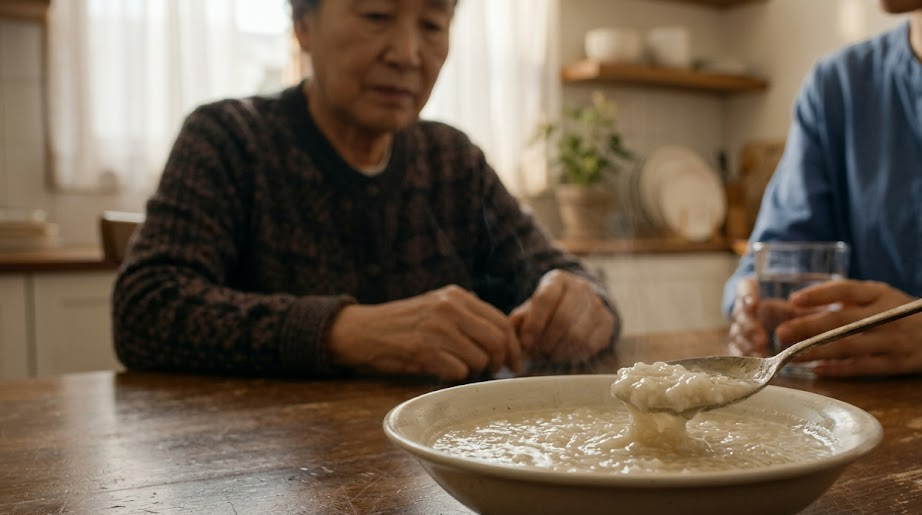
Integrated medical and long-term care takes effect nationwide in March. On February 3, a month before the launch, the Jeonnam Bioindustry Foundation (전남바이오진흥원, president Yoon Ho-yeol) signed a care food production contract and a business agreement with Bokji Union (복지유니온, CEO Jang Seong-oh). Under the contract, Bokji Union will produce five kinds of dysphagia porridge on consignment at the foundation's Care Food Center. The name of the system is large, but what is being prepared beneath it is one bowl that a person who has trouble swallowing can eat.
Dysphagia meals are meals for people whose strength to chew and swallow has weakened. For an older person who has come home after being discharged from hospital, the meals that come around three times a day become the hurdle met most often. Those who design care have staffing and budgets in view, but what is urgent for the person concerned is what to eat this evening. The point where integrated care begins also lies within that repetition of a single day.
Behind this contract emerging in Jeonnam lie several years of preparation. The Care Food Center is a facility that Jeonnam Province and Hwasun County established in 2021 through a Ministry of Agriculture, Food and Rural Affairs competition to build a demonstration and commercialization center for functional home meal replacements (HMR). The Jeonnam Bioindustry Foundation is a foundation established by Jeonnam Province in 2002, with about 200 specialists working at its eight centers and about 100 resident companies. Bokji Union developed the dysphagia meal brand "Hyoban" and last year received a patent for a finished dysphagia meal used as a meal replacement.
Hwasun County set up an integrated care division, the first among the country's basic local governments. What matters more than the fact that one department was created is that there is now a staff member to join together in one place the work that had been scattered among hospitals, care facilities and homes. Conditions such as the volume and period of this production contract are awaiting a confirmed announcement.
The process by which a system takes root in the field looks similar in other areas. The Netherlands' animal welfare certification scheme started from a private animal protection group and is still run mainly by the private sector, and instead of setting certification standards once and fixing them, it has adjusted them together with the market and farms. It is a method in which the side that keeps the standards and the side that demands them sit at the same table and keep revising them.

Conversely, the gap between intent and reality is also clear. In the 2025 "Study on Consumption Patterns of Animal Welfare Certified Livestock Products," more than 90% of domestic consumers said they wanted to eat animal welfare pork, but the share that had actually bought it was under 1%. Pig farms with animal welfare certification in Korea number 26, or 0.3% of the total. The distance between what people consider good and what is within reach has opened up that far.
Integrated care faces the same test. What the phrase nationwide implementation turns into in each neighborhood is revealed in who arranges next week's meals for a person who has been discharged. The five kinds of porridge are one very small answer to that question. One department in Hwasun and one production line in Jeonnam are putting that answer together now.
When March comes, cities, counties and districts across the country will begin running this system in their own ways. What has to be checked then is not how many programs have been added. It is whether a staff member whose name is known remains beside one person.
Porridge boils in the pot at the Care Food Center, and that porridge arrives at someone's table and is slowly emptied. The first report card for integrated care comes out of that bowl.