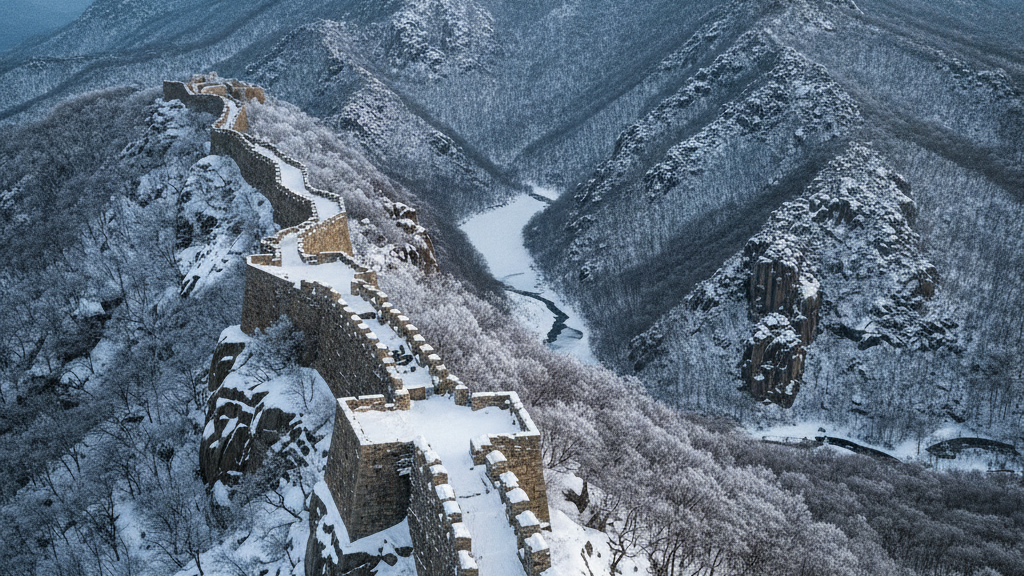
The "Capital Fortifications of Hanyang," which binds Hanyang Doseong, Bukhansanseong and Tangchundaeseong into one body, has been placed in the files of the UNESCO World Heritage Centre. Gyeonggi Province, the Korea Heritage Service, the Seoul Metropolitan Government and Goyang City jointly submitted the final nomination dossier on January 27. It is a version completed by reworking the draft handed over last September. From here the review procedure begins to roll.
Anyone who has touched the stones knows. The lower part of the wall is set with large stones roughly interlocked, and the higher it goes the more the dressed faces turn even. The feel against the palm differs from course to course, and on the day after rain a damp smell of moss rises up. The history of the fortifications raised to defend Hanyang goes back nearly 600 years.
The three walls each carried a different share. Hanyang Doseong encircled the administrative center, Bukhansanseong backed up the capital's outskirts in an emergency, and Tangchundaeseong wrapped around the storehouses where the people could take shelter and hold out in a prolonged war. All three are pogok-style fortifications, that is, a form built continuously along the ridges of mountains and hills while taking a valley into their embrace. The Korea Heritage Service assessed that this combination inherits the Northeast Asian tradition of wall building while showing the summit of the development of capital fortifications on the Korean Peninsula.
The bundling came out of failure. Hanyang Doseong was placed on the tentative list in 2012 and then pushed for inscription, but received a "not to inscribe" notice at the 2017 advisory body review and withdrew its nomination. Bukhansanseong likewise failed to clear the Cultural Heritage Committee's tentative list deliberation in 2018. It was after that, on the recommendation of the Korea Heritage Service, that the walls standing separately were bound again into a single narrative.
The road there was not entirely smooth. At the selection of "nomination targets," the last gate in the domestic procedure, the Cultural Heritage Committee deferred its deliberation once, and there were demands to further refine the criteria and principles for the heritage zone and the buffer zone. Depending on how far outside the walls the heritage area is drawn, the thickness of the regulation the city will have to bear after inscription changes. With the built-up areas of Seoul and Goyang coming right up to the walls, this drawing of lines does not end as a matter on paper.
The mood on the international review side is not bad. In its preliminary assessment, ICOMOS gave the opinion that the walls may meet the requirement of "outstanding universal value" (OUV). The field mission is reported to be scheduled to walk the walls themselves around the end of September this year. The final judgment falls to the World Heritage Committee in July 2027.
If inscription is confirmed, the "Capital Fortifications of Hanyang" will become Korea's eighteenth World Heritage site. For Gyeonggi Province it is the fourth on the list, after Hwaseong Fortress, the Royal Tombs of the Joseon Dynasty and Namhansanseong. Park Rae-hyuk, director general of the Culture, Sports and Tourism Bureau of Gyeonggi Province, said the province will work in step with the relevant agencies to respond throughout the inscription process and make the value of this heritage known to the international community.
About eighteen months of waiting remain. In the meantime the walls keep aging in place, and people walk on top of them. Climbing along the ridge from Daeseomun of Bukhansanseong, the wall stones grate underfoot, and beyond that sound the rooftops of Goyang and Seoul come into view together. Whichever way the review leans, these walls become the city's memory in proportion to the number of people who have heard that sound for themselves.