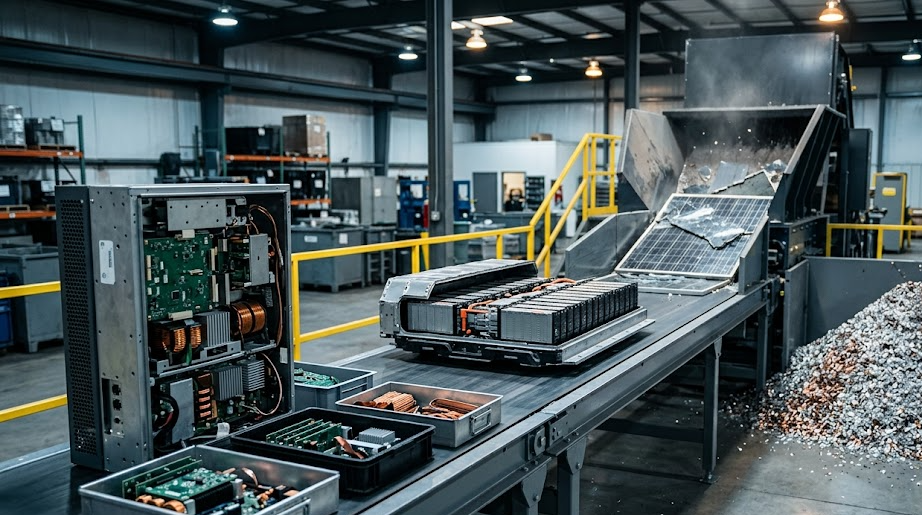
A repeater that has reached the end of its life on the roof of a telecom base station contains rare earths. Until now that metal has mostly been priced as scrap. The "2026 Resource Circulation Bureau Major Work Plan" released by the Ministry of Climate, Energy and Environment on January 26 comes close to a declaration that this calculation will change. A demonstration project to extract critical minerals including rare earths from waste telecom equipment was placed at the front of the plan.
The Ministry of Climate, the Ministry of Science and ICT and the three mobile carriers take part in this project together. The idea is to build a circular system running from dismantling to hub collection and recycling, and to release circular use guidelines containing the demonstration results. Depending on the document the name is split between "pilot project" and "demonstration project," but the content covered is the same.
The day after the plan was released, working-level activity began right away. On the afternoon of January 27, the first governance meeting for establishing a critical minerals procurement strategy was held at the annex of the Ministry of Climate, Energy and Environment, chaired by Kim Go-eung, Director General of the Resource Circulation Bureau. Officials from the National Institute of Environmental Research, the Korea Environment Corporation, the Korea Environmental Industry and Technology Institute, the Korea Environment Institute and the Korea Institute of Geoscience and Mineral Resources gathered to review domestic and overseas trends, the status of technology development and the state of future waste resources. The ministry also began drawing up a "Strategy to Strengthen the Circular Use of Future Waste Resources."
The strategy targets electric vehicle batteries, telecom equipment and permanent magnets. The background cited is the reality that a considerable amount of electronic waste generated in Korea has flowed overseas with its minerals still in it or been handled as plain scrap. A technology demonstration to recover rare earths from permanent magnets embedded in waste electronic products is also being pursued.
The tasks differ by item. For waste solar panels, technology will be developed to separate them quickly and at high purity while using less energy, in preparation for a rise in volumes. For lithium iron phosphate (LFP) waste batteries, whose low resource value leaves a weak incentive to recycle, a separate tailored management plan will be prepared. For used batteries, work continues to automate the entire dismantling and separation process and to convert hydrometallurgical processes into eco-friendly, high-efficiency methods.

Recovery technology alone does not gather minerals. The items have to reach the process. So collection bins for waste home appliances and waste batteries will be expanded to 40,000, more than double the previous year, and the scope of Extended Producer Responsibility (EPR) for electrical and electronic products will also widen starting this year. The intent is to broaden the channel through which raw materials come in by making manufacturers take on the collection of used products as well.
Arrangements on the industry side are also being reworked. A new "circular economy regulatory exception zone" will be introduced, lifting the waste regulations that applied to collection, transport and recycling when process byproducts are reused within a business site. The selection of leading companies and industrial complexes focuses on energy-intensive sectors such as steel, petrochemicals, semiconductors and food. The central axis of recycling policy also shifts from burning waste away to material recycling and chemical recycling, subsidies will be paid at different levels by type, and regulatory exceptions will apply to pyrolysis facilities.
Areas outside minerals are moving as well. The biogas production target system will expand from the public sector to the private sector this year, and solid fuel conversion of livestock manure will lower its threshold by allowing auxiliary fuel blending and easing standards on form and calorific value. A standard model for energy-independent villages will also be created by analyzing the volume of pig and cattle manure generated by region. For waste clothing made of a single material such as team uniforms, a system will be put in place to crush and grind it for use as filler or to draw long fibers through depolymerization.
The "First Circular Economy Framework Plan" that will tie all these pieces together is in the drafting stage. The plan period and target indicators have yet to be confirmed. Even when technology and institutions are ready, the last step remains at the discharge stage.
For separate discharge of paper cartons at apartment complexes, standards for dedicated collection bins will be set and collection bags distributed within the first half of this year. Carrying an old mobile phone that has been rolling around in a drawer for years and a spent power bank to a nearby collection bin is something that can be done this week. The fact that a single magnet inside them becomes a raw material to take the place of imported minerals has now begun to be written into policy documents.