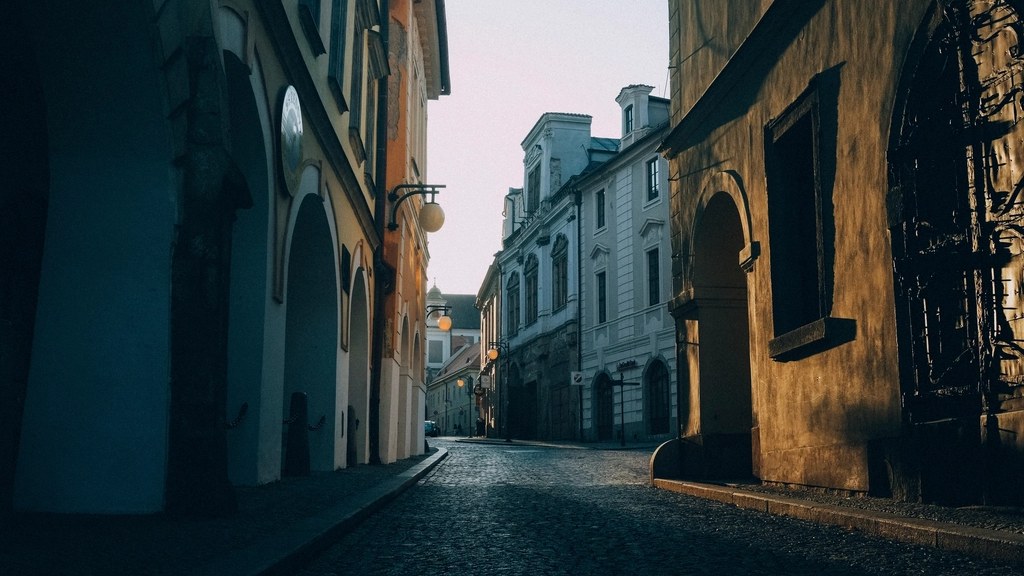
The sun has dropped behind the buildings, and only the right-hand wall of the alley remains yellow. The arches on the left are sunk in blue shade, and the stone pavement cools with the marks of the day's footsteps still on it. Three streetlamps have come on in a row toward the far end of the alley. This is the hour that is neither bright nor dark.
In an alley at this hour, people are passing through. Steps out to do the evening shopping, steps heading home after cram school, steps just now leaving for work brush past one another on this stone pavement. It is a short stretch in which the daytime city and the nighttime city change places, and the ones who bear that changeover are mostly the people who stay outside the longest.
The streetlamps cannot light the whole alley. Dark stretches always open up between one light and the next, and how a person endures those intervals differs from walker to walker. For one it is a familiar shortcut, for another it is a road where the breath is held a little each day. The word care is probably close to the work of narrowing these intervals.
The line where the yellow wall meets the blue shade bends at an angle about halfway up the right-hand wall. That line does not stay still. When the sun drops a little further it is pushed up along the wall, and a person standing on the yellow side crosses over to the blue side within a few steps. Before the darkness of an alley is a matter of streetlamps going off and on, it is also this boundary sweeping across the wall once a day.
The narrower the alley, the more the windows face one another. There are evenings when a single lit window comes down to the feet of a person passing below, and such evenings take over the share the streetlamps could not manage. How many of those windows in the photograph are lit, one ends up counting once more.