From the first day of the new year, household waste in the Seoul metropolitan area can no longer be buried in the ground as it is. With the ban on direct landfilling of household waste taking effect first in the metropolitan area on January 1, 2026, waste in volume-rate bags must now go through pretreatment such as incineration or sorting. Three weeks into the ban, that waste is traveling down the highways heading south rather than to new incinerators in the metropolitan area. That is the background to the regional conflict over long-distance incineration that surfaced in the very first month.
The regulation did not appear out of nowhere. A 2021 revision to the Enforcement Rules of the Wastes Control Act put in place a provision blocking direct landfilling without pretreatment, and the starting point of that agreement dates back to 2015, ahead of the expiration of the Incheon Sudokwon Landfill Site's service period. In other words, what would not be buried had been more than five years in preparation.
The problem was the alternative route. Public and private incineration facilities in the metropolitan area now have no room to take more, and new public incineration facilities were scheduled to be completed in stages only in 2027. It is a one-year gap in which the system arrived first and treatment capacity followed late, and the market is filling that space.
There are clues for gauging the scale. In 2024, the volume of household waste landfilled at the Incheon Sudokwon Landfill Site was 558,645 tons. With landfilling closed off as an exit, the calculation is that more than 500,000 tons a year must find another route. Official figures on the volume shipped from the metropolitan area to other regions since the ban took effect, and on the rise in treatment unit prices, have not yet been released.
Cheongju, North Chungcheong Province, is one end point of that route. Four private incineration companies operate here, and three of them have signed consignment contracts with metropolitan-area local governments. Bugi-myeon, where the incineration facilities are concentrated, is an area that has long faced complaints and conflict. On top of that, private waste treatment facilities are not subject to negotiations on inflow cooperation fees, so no official support measures for residents have been arranged either.
From the residents' point of view, the arithmetic is simple. The burden stays in the region, and the compensation moves only between the contracting parties. With a public facility there would at least be a negotiating table, but a private contract has no such procedure at all. The root of the conflict lies less in the fault of a particular company or a particular local government than in the system failing to keep pace with the growth of private consignment.
The principle the law points to has already been set. The principle of treatment at the point of generation has been established since around 2000, when regional landfill construction projects got under way in earnest, and the 2022 revision of the Wastes Control Act specified that household waste be treated first within the jurisdiction where it arises. Long-distance incineration is only an exception to this principle and cannot become an alternative.
The wavering of administrative signals also has to be noted. In September 2025, the Ministry of Climate announced that the direct landfill ban would take effect in principle while mentioning a special exemption of up to one year for local governments with plans to build incinerators, and in November it again stressed enforcement in principle. It signed a memorandum of understanding with the three metropolitan-area municipalities on December 2, but the exemption provision came out only on December 29, three days before the ban took effect. That means local governments and the industry had that much less time to draw up reduction plans.
Still, this gap is also a window to move reduction planning forward. Yangpyeong County in Gyeonggi Province cut its waste generation by 425 tons a year even as its population grew. It takes several years to expand treatment capacity, but a few months for the indicators to move on reducing generation. The time left until the metropolitan area's public incineration facilities are filled in is also time to experiment with reduction.
It is worth watching whether the staged completion of the metropolitan area's public incineration facilities, slated for 2027, proceeds on schedule, and whether channels for negotiation and support open up for residents living near privately consigned facilities as well. The completion schedule is a matter of capacity, and the negotiating channel is a matter of trust. If only one of the two is resolved, the conflict remains.
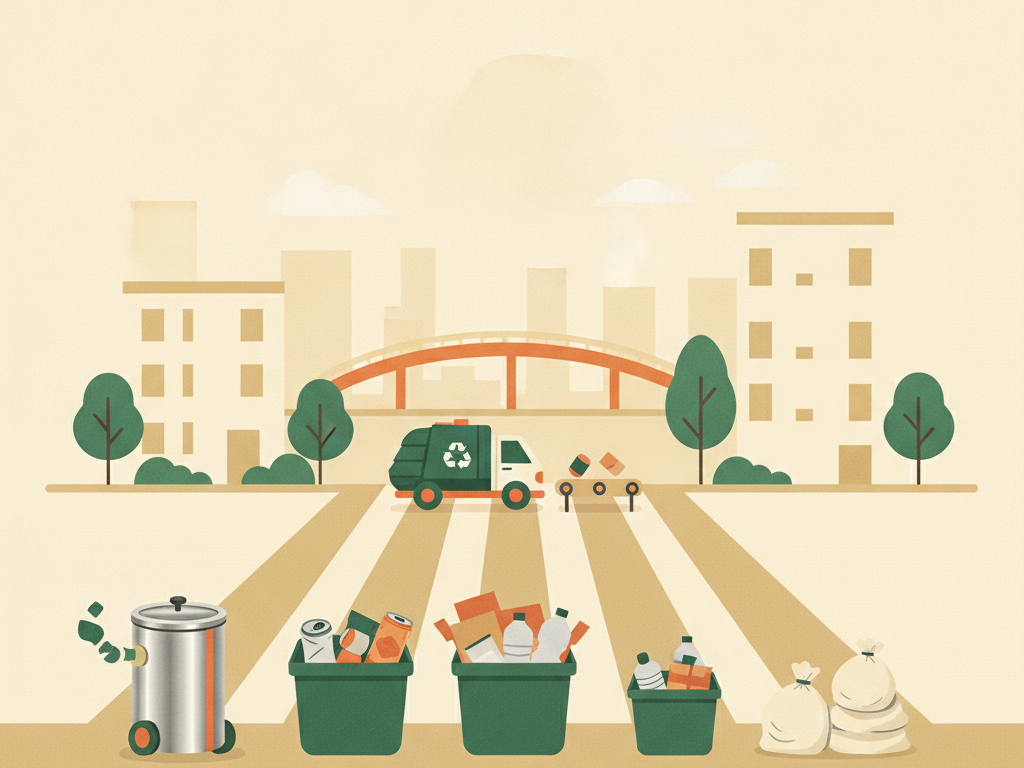
The surest reduction happens at the discharge stage rather than in front of the incinerator. Filtering out one more time the food moisture and recyclable resources that get mixed into volume-rate bags, that small habit actually determines the volume contracted for long-distance incineration. On this week's collection day, try opening just one bag and sorting it again. Whether our neighborhood's waste travels 400 kilometers or not starts with that bag.