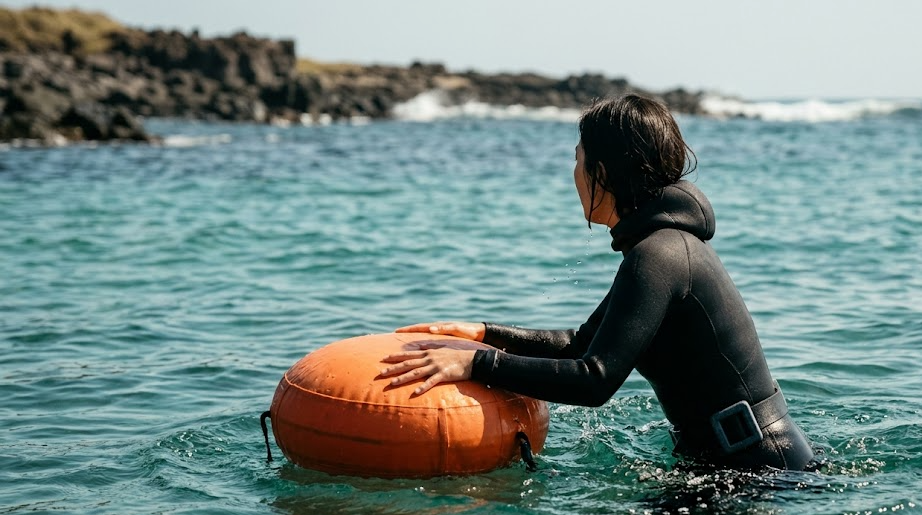
The 19th Jeju Haenyeo Festival was held at the Haenyeo Museum in Gujwa-eup, Jeju City. It is an event marking the 10th anniversary of the inscription on UNESCO's Representative List of the Intangible Cultural Heritage of Humanity. The organizers said the purpose of the festival was to review the 10 years since the inscription and to find ways to pass the tradition on. Over the same period, the number of Jeju haenyeo fell from 14,143 to 2,371.
The inscription came in 2016. Jeju haenyeo culture was designated a National Intangible Heritage the following year, in 2017, and in 2023 it was also listed as a Globally Important Agricultural and Fisheries Heritage. While the three heritage designations followed one after another, the number of people going into the water fell.
A teawak is a styrofoam float with a mangsari net attached to it, kept floating on the surface, and the body goes down beneath it. The sumbisori, the sound made on coming back out of the water, is not written down in any score. It remains only in the body of the person learning it.
So transmission is not transferred onto paper. The inscription protects the name, but it cannot hand down how to hold one's breath.
The reference dates for the two figures were not separately explained at the festival grounds. Depending on when Jeju had 14,143 and what year the count of 2,371 comes from, the span of time the decline covers also changes. Even so, the act of writing 2,371 next to 14,143 changed the character of the festival.
Wi Seong-gon, governor of Jeju, also spoke of the situation in which the number of haenyeo is falling.
The hand-tool marsh clam fishery at the mouth of the Seomjin River is in a similar situation. This method, in which fishers in Hadong and Gwangyang scrape the riverbed with a georaengi to bring up marsh clams, was placed on the list of National Important Fisheries Heritage in 2018, and in 2023 it was also listed as a Globally Important Agricultural Heritage by the UN Food and Agriculture Organization. It was the first in the country's fisheries sector.
The issue here is the flow of water. A figure has been put forward that an adequate flow for maintaining the fishery must be at least 15.03 tons.
A river's flow can be regulated, but the sea's cannot. What is short in Jeju is young hands who will spend a decade or more learning beside sanggun haenyeo close to eighty years old.
The heritage system gives awards to what has been well preserved. Preservation and use are usually spoken of as if they were the same thing, but in haenyeo culture they part ways. Haenyeo as tourism content can be increased, and haenyeo who dive cannot. The 10 years since the inscription have not narrowed the distance between the diving reenacted on the festival stage and the diving that actually takes place.
The Haenyeo Museum is in Hado-ri, Gujwa-eup. Even after the festival ended, the teawak, the bitchang and the worn mulsojungi remain in the exhibition hall just as they were.