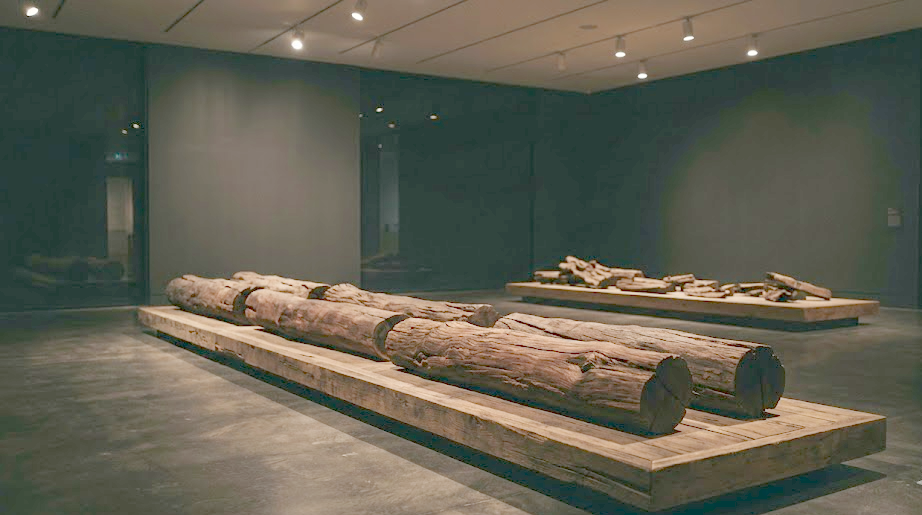
A special exhibition on red sandalwood recovered from the Sinan ship opened on the 15th at the Museum of Underwater Heritage in Mokpo. It is "Wood That Crossed the Sea, Red Sandalwood," prepared by the National Research Institute of Maritime Heritage. The institute announced the exhibition on the 14th, a day before the opening.
The exhibition marks the 50th anniversary of the underwater excavation of the Sinan ship. The Museum of Underwater Heritage, which hosts it, is the place that set aside its old name, the Mokpo Maritime Relics Exhibition Hall, and put up a new sign.
Red sandalwood (紫檀) is a tree that carries a purple tint in the first character of its name. The red sandalwood on view this time was lying on the bottom of the Sinan ship at the time of the excavation. It came with an explanation that the timber originated in Southeast Asia and dates back about 700 years.
There were letters on the wood.
One of the exhibits bears an inscription in the Phags-pa script. It is the writing system created and used by the Mongol Empire during the Yuan dynasty. Red sandalwood and a wooden tablet reading "Makosaburo" are also on display in the hall.
Who carved the letters and what they meant to mark on the wood remain unresolved even at the exhibition. A single stroke, a single notation can become a clue for tracing back the hands that touched this wood and the ports it passed through.
For a relic marking 50 years since its excavation, the deeper it is kept in storage, the less there is to worry about damage. But inscribed letters need many people to look at them before their meaning comes out. Marking a half century, the National Research Institute of Maritime Heritage decided to bring the wood out into the exhibition hall, and took on the burden of long exposure to light and air along with it.
Anyone stopping by Mokpo may find it worth looking for the piece of wood inscribed with Phags-pa letters in the exhibition hall of the Museum of Underwater Heritage.