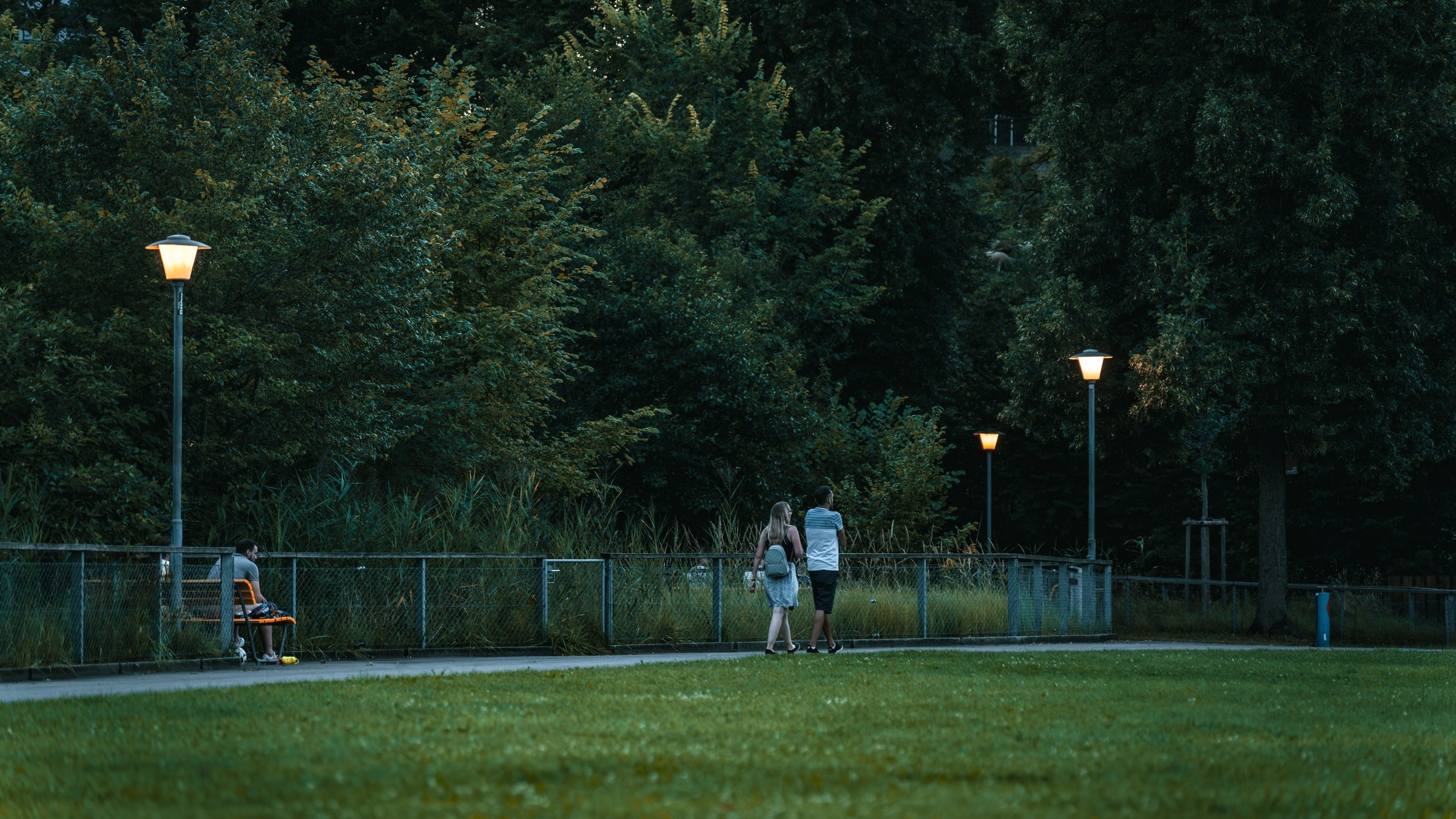
Three streetlamps have turned on their orange light at three different heights against a dim forest. The one on the left is the closest and largest, the one in the middle glimmers small through a gap in the trees, and the one on the right stands between them. The lawn still holds on to its green, but the trees above have already sunk into a blue gray. Two people pass down the middle of the paved path at a matching pace, and on the bench to the left one person sits alone.
Look at a photograph like this for a long time and the eyes lose focus on their own. There is not much to hold on to the way there is in a daytime scene. The shoulders come down a hand's width, the tension in the jaw loosens, and the breath lengthens once at the tip of the nose. The soles of the feet are standing on an indoor floor for now, and even so they recall the soft feel of a dirt path.
A mind that has spent all day telling one thing from another lets go for a moment in front of that darkness.
Just before the sun goes down completely, in those fifteen minutes or so when the streetlamps come on one by one, it would be good to step outside and walk a single loop. There is no need to go far, and a distance about like that paved path in the photograph is enough. If you shorten your stride by half a step from usual as you walk, you begin to hear the sound of your heels meeting the ground. After you have heard that sound about three times, three minutes have passed.
You can also carry the same walk over to the dishes at night. After washing one dish and before picking up the next, with your wrists still in the water, check once whether your shoulders have risen toward your ears. If they have risen, it is enough just to notice that they have. It is better not to hurry the body into putting them down.
The streetlamps will stay on for a good while after everyone has gone.