

380,000. That is the number of young workers employed in the information and communication industry and in professional, scientific and technical services. It is down 81,000 from a year earlier, or 17.6 percent. The decline came in the two industries that have been named as the most directly exposed to AI.
Around the same time, Tesla chief executive Elon Musk spoke of a much larger picture. In an interview with the British magazine The Economist, he predicted that in about five years AI could become smarter than the combined intelligence of all humanity. Setting aside the act of living as a human being itself, he said, there would be almost no area left in which AI would trail humans.
He set the same deadline for physical labor. He forecast that within five years humanoid robots - robots modeled on the human form that use hands and feet - will be deployed in numbers of at least 100 million and as many as 1 billion.
The prophecy and the statistics arrived in the same week, but they aim at different points in time.
According to the Korea Development Institute's report "Analysis of the Macroeconomic Effects of AI," the workforce that would fall within the scope of replacement by AI automation ten years from now is estimated at about 637,600 people a year. Narrowing that to cases where the cost of adopting AI is weighed against the labor costs saved and the numbers actually add up, it drops to about 255,700. That is 2.1 percent of all workers as of 2024. The gap between what is technically possible and what pays is that wide.
Where the replacement pressure concentrates is more striking. Professionals and related workers come first at 106,653, followed by clerical workers at 56,398. Adding sales workers at 41,087 and equipment and machine operators and assemblers at 39,202 brings the total to 243,340, more than 95 percent of the whole.
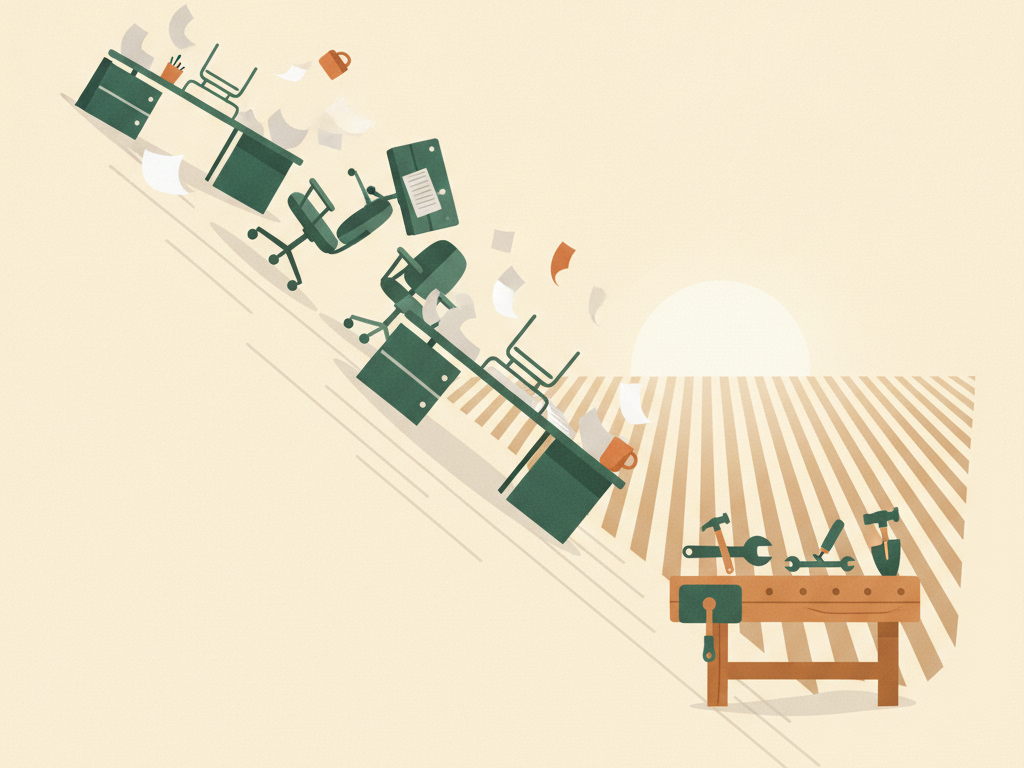
Skilled agricultural, forestry and fishery workers came to zero, elementary workers to 2,135, and service workers to 3,736. The pattern shows work done sitting at a desk shaking first.
Anthropic's "Labor Market Impact Report," released in March, pointed to a similar place. Seventy-five percent of computer programmers' tasks and 67 percent of data entry tasks fell within AI's reach. The average wage in occupations with high AI exposure came out 47 percent higher than in those without. The result runs counter to the long-standing assumption that automation sweeps upward from the bottom of the wage scale.
A counterargument came in the same week. On July 23, Google released a report analyzing millions of anonymized AI usage records collected worldwide, saying that AI today is being used as a tool that assists people from alongside rather than pushing them out. The evidence it cited was the nature of the conversations.
Among conversations dealing with cognitive work that has no set procedure, the share aiming at full automation was under 10 percent. Such non-routine cognitive analysis work accounts for 35 percent of all tasks by the standard of the O*NET job database, but made up 65 percent of Gemini usage. The areas where people call on AI most and the areas they hand over to AI wholesale are different.
The Google researchers did not say there was nothing to worry about. They added that as model performance rises, today's collaborative work could gradually be automated, and that if the productivity of experienced workers jumps sharply, the effect on the labor market could show up as cuts to entry-level hiring first. The fact that this study was carried out by a company that sells AI has to be read alongside it.
The size of the numbers themselves also varies by source. There is the International Monetary Fund's estimate that six in ten workers in advanced economies are within AI's reach, Goldman Sachs' analysis that 300 million full-time jobs are at risk of automation, and the World Economic Forum's forecast that by 2030, 170 million jobs will be created and 92 million lost, leaving 78 million. Their scope and definitions differ, so the figures cannot be placed on a single scale.
The deadlines set by those making forecasts are also far apart. Mustafa Suleyman, chief executive of Microsoft AI, said in May that most work handled on a computer would be automated within 12 to 18 months, and Professor Geoffrey Hinton said last year on the podcast "The Diary of a CEO" that AI would take all ordinary intellectual labor. Musk went as far as to say that saving retirement funds on a 10-20 year horizon could become meaningless.
His position is that while he acknowledges the chance of catastrophe is not zero, there is no way to stop development. Even if there were a stop button, he added, it should not be pressed.
Meanwhile, economists wrote a different document. The "Statement on AI's Economic Transition," released by the Stanford Digital Economy Lab on July 13, carried more than 200 signatures, including 16 Nobel laureates in economics. Names that do not usually stand on the same side, such as Paul Krugman, Niall Ferguson and Tyler Cowen, appeared together. Industry figures such as Reid Hoffman and Eric Schmidt, and policy veterans such as Jason Furman and Gita Gopinath, were also in the mix.
Ramp, which handles U.S. corporate spending data, said that the more a company spent on AI, the faster its overall employment and entry-level hiring grew. In material presented by the job platform Worksphere at a National Assembly forum, the number of postings itself had not fallen, and the word "AI" appeared more often in the postings. It reads as the opposite of Korea's youth employment figures, but the two sets of data measure different things in the first place. One is the number of workers in specific Korean industries, the other is the spending and job postings of U.S. companies.
Whether the sum of intelligence is overtaken five years from now is something to be learned then. What can be confirmed now is that 81,000 young people's jobs in IT and professional, scientific and technical services disappeared in a year, and that no comparison indicator was presented alongside it to sort out whether that decline was due to AI or to the business cycle. What a job seeker can check now is whether their own occupation falls into the four groups the KDI ranked at the top, and if it does, which tasks within it are hard to hand over to AI wholesale.