
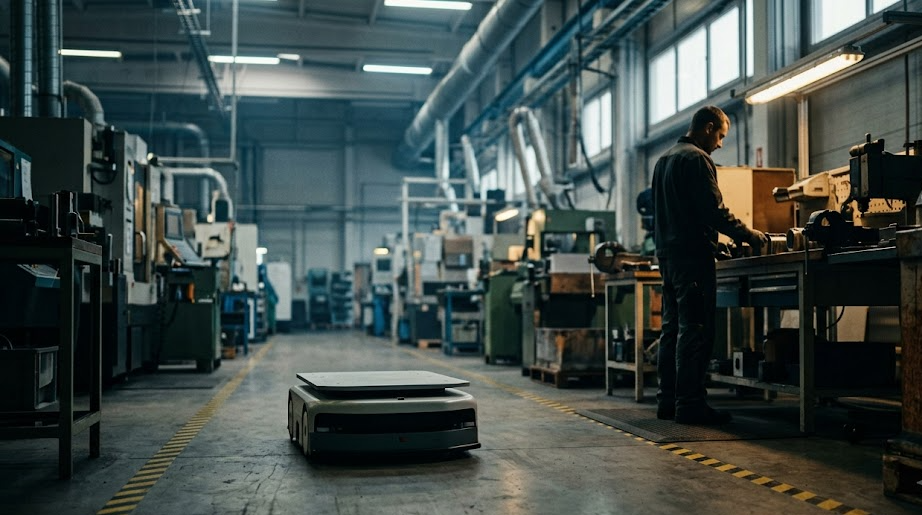
Of 100 manufacturers with 500 or more employees, 84 said they had brought physical AI into their plants or planned to. That is the result of the "Survey on Physical AI Adoption and Perceptions" released on Aug. 20 by the Korea Enterprises Federation (KEF). Companies now running it commercially or as a pilot project accounted for 47.0%, and those at the planning stage for 37.0%. Only 16 companies said they had neither adopted it nor planned to.
Just 4.0% had adopted it across all processes or all departments, while 43.0% had introduced it only in some processes and some departments. Cases where an entire plant was converted are rare.
Physical AI refers to technology in which artificial intelligence, once confined to software, is combined with robots or automated equipment to actually move and assemble goods. Humanoids, self-driving cars, drones, automated guided vehicles (AGV) and autonomous mobile robots (AMR) are included here. The survey was commissioned by the KEF to Southern Post and conducted over 15 days from May 27 to June 10.
Adoption diverged by company size. Among firms with 1,000 or more employees, 88.5% said they had adopted it or would, while those with 500 to fewer than 1,000 employees stood at 68.2%, a gap of 20.3 percentage points. The money to install new equipment can be seen as what separated the responses.
The equipment in use now and the equipment to be used later are of different types. The type cited by the most companies among current adopters was AGV and AMR at 63.8% (multiple responses), while companies preparing to adopt put the humanoid type first at 64.9%. Applications are concentrated in assembly and manufacturing processes at 66.0% and logistics, transport and warehouse management at 57.4%, while safety management is low at 10.6%.
Expectations lean toward production. Among the 84 companies that had adopted it or planned to, "higher productivity and performance" was cited most at 45.2%, followed by relief from workforce difficulties such as hiring shortages at 26.2% and prevention of industrial accidents at 22.6%. The average productivity gain they expected came to 31.9%. Because these are expectations the companies projected themselves, a gap may open up with the actual results.
In the same survey, the employment outlook pointed the other way. Companies expecting total jobs to fall as physical AI spreads accounted for 61.9%, responses of no major change for 34.5%, and responses of an increase for only 3.6%. The expectation of raising productivity by 31.9% and the forecast of using fewer people appeared together in one survey. It should be read together with the fact that all those who answered are employers.
As a barrier to adoption, risk from technical instability and system unreliability was highest at 34.5%. Uncertainty over returns relative to investment costs followed at 31.0%, and opposition to adoption from workers and unions at 27.4%. Opposition from workers and unions is a factor unrelated to equipment performance.
The macroeconomic outlook was viewed brightly. Responses that physical AI would work positively in solving national economic problems such as a shrinking workforce or falling productivity came to 79.8%, while responses that the impact would be small stood at 4.8%. Lee Seung-yong, head of the KEF's economic analysis team, pointed to uncertainty over returns relative to investment and concerns about labor-management conflict, and called for an overhaul of related regulations and support measures for companies.
The regulatory discussion has moved slightly ahead in another area. Son Mi-jung, director of the digital medical products support division at the Ministry of Food and Drug Safety, said at the Korea Hospital & Healthtech Fair (KHF 2026) held on Aug. 19 at COEX in Seoul that regulations framed on the premise of fixed, machine learning-based AI must be rewritten to fit AI that continuously learns and adapts. Because it was said with regard to medical devices, it does not transfer directly to the manufacturing line.
To a worker who carries parts all day on the assembly line, this survey says two things at once. The machine alongside will lift the heavy loads instead, and the number of colleagues working together may fall. The 61.9% response means that worry is also contained in the employers' own forecast. Before humanoids stand on the line, what needs fixing is less the robots' performance than how the work people will take on is to be divided again.