
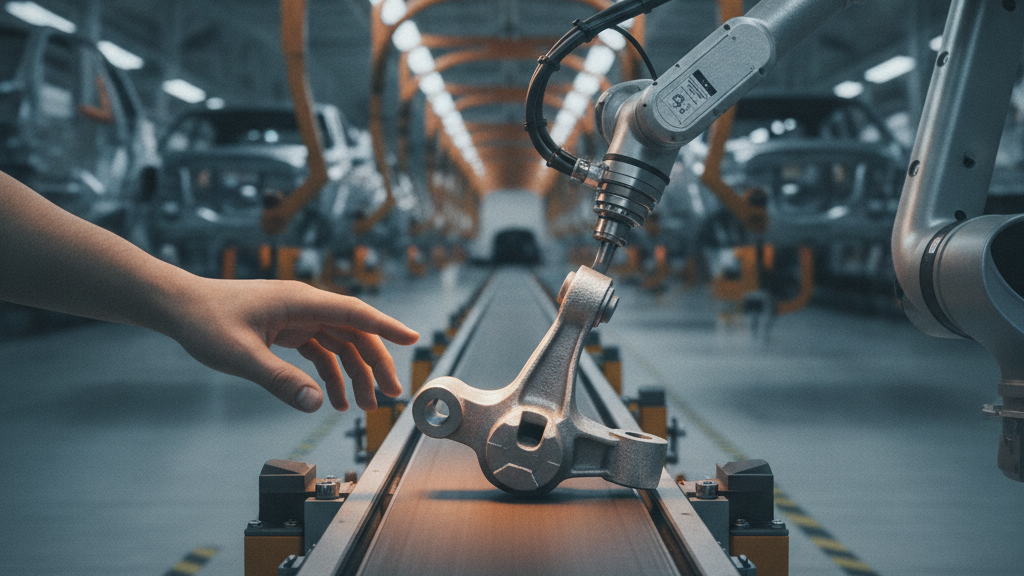
The Ulsan assembly line stopped for four hours a day. For three days from July 13 to 15, the ground the Hyundai Motor union gave for its partial strike was that the introduction of humanoid robots will cut jobs. A wage increase proposal is also on the bargaining table, but the direct reason for halting the line was the procedure by which machines take over processes where people had stood. The industry estimated that about 5,000 vehicles went unbuilt over the three days and that lost sales came to around 200 billion won.
The Wall Street Journal reported on the 15th, local time, that this was the world's first case of an automobile plant halting operations over humanoid robots.
The humanoid referred to here is a robot equipped with arms and legs like a person's, using workbenches and passageways designed for people just as they are. Where existing industrial robots repeated only set motions with a single arm fixed to the floor, this one aims to walk between lines and be put into several processes in turn. "Atlas," which Hyundai Motor unveiled at CES 2026 in January this year, is that machine. Boston Dynamics, its developer, is a company fully acquired by Hyundai Motor Group.
The next-generation Atlas that was unveiled came with the explanation that it has 56 joints and lifts parts weighing 50 kg. Hyundai Motor has set a schedule to begin deployment on the manufacturing floor from 2028. There is an account that narrows the deployment site to the U.S. plant, and an account that presents work stages instead of a site. According to the latter, in 2028 it will start with picking out parts and expand to assembly around 2030.
One Atlas is known to cost 130,000 dollars, or about 192 million won. The securities industry put the early mass-production cost at 130,000-140,000 dollars per unit and expects it to fall to 30,000 dollars, about 45 million won, once output reaches 50,000 units a year. If the price drops to that level, the standard for weighing whether to bring them in changes.
The union's demands take aim at that change. They call for requiring prior agreement with the union when robots are put on the line, for switching the hourly wage system, under which pay is cut along with working hours shortened by automation, to a monthly salary system, and for raising the retirement age. Some materials give the demanded retirement age as 65, and others state only "extension" without an age. On the wage system, labor and management agreed to commission a joint study.
By the Korean Statistical Information Service (국가통계포털), manufacturing employment fell for 24 straight months from July 2024 through June this year, and on a quarterly basis it is the eighth consecutive quarter of decline. In May this year, 140,000 jobs disappeared compared with a year earlier. There are no statistics separating out how much of that decline is due to robots.
The Bank of Korea, in its report "AI and the Korean Economy" last year, judged that about half of domestic jobs fall within the reach of AI adoption, and that 24 percent of them will gain from higher productivity while 27 percent will face a crisis in employment and income. The World Economic Forum projected that 92 million jobs will disappear worldwide and 170 million will be created by 2030.
Korea, with 1,220 industrial robots per 10,000 workers, ranks among the highest densities in the world. In the country with the highest robot density, the first strike over the procedures for bringing in robots has taken place. Hyundai Motor Group has newly created a software-centered factory and an organization dedicated to robot parts, and companies in the United States and China have also begun bringing humanoids into production sites.
Labor and management have not sat down at the table again since the 15th round of talks on July 8. With first-quarter operating profit this year down 30.8 percent from a year earlier, the company has little room either. GM Korea has also gone into a partial strike, and Kia, whose talks broke down, holds a vote on industrial action on the 23rd. The union has given notice of a second partial strike for three days from the 20th.
About two years remain until Atlas stands on the line. What labor and management have to settle in the meantime is what notice people receive when robots come in and what they can demand. The outcome of the Ulsan talks will not remain a standard that applies only to 40,000 union members.