
In an annual report released on the 22nd (local time), Oracle disclosed that it had 141,000 full-time employees worldwide at the end of fiscal 2026. That is down about 21,000, or 13%, from 162,000 a year earlier. The company wrote that its adoption and use of AI technology across its operations had caused the reduction in headcount and could continue to do so. It is a sentence the company itself put on paper as the reason for the cuts.
An annual report is a document submitted to investors with legal liability attached. Unlike the rhetoric of a press release, a sentence written here is hard to walk back. Oracle also cited changes in management and products, performance management, shifts in business strategy, and follow-up measures after mergers and acquisitions as background for the workforce adjustment. The company did not break out how much of the 21,000 was directly replaced by automation.
The costs were disclosed as well. The company spent $1.84 billion on severance and related expenses for this restructuring, about five times the $374 million of the previous year. The same company expects capital expenditures of about $70 billion this fiscal year. Nearly 40 times the money spent on cutting people is going to servers and electricity.
How that capital spending is being financed shows Oracle's position. The company is pursuing a total of $40 billion in debt and equity financing, including the $20 billion stock issuance it announced earlier. Unlike Amazon or Microsoft, which build data centers with the cash they earn, Oracle is faulted for relying relatively heavily on borrowing to build. Its contracts to supply large-scale data centers to OpenAI and Meta are the basis for taking on that burden.
Across the tech industry, more than 119,800 people have been laid off at 196 companies so far this year. Oracle alone accounts for about one-sixth of that.
In factories, the same thing shows up as added equipment. GM installed about 50 more Fanuc robot arms at Factory Zero, its electric vehicle plant in Detroit. They are machines that handle the work of attaching parts on the assembly line.
The installation went ahead while 1,300 workers laid off in March had yet to return, and James Cotton, president of UAW Local 22, said more than 1,000 members are on indefinite layoff. At this plant, 1,200 people were also permanently laid off in October 2025.
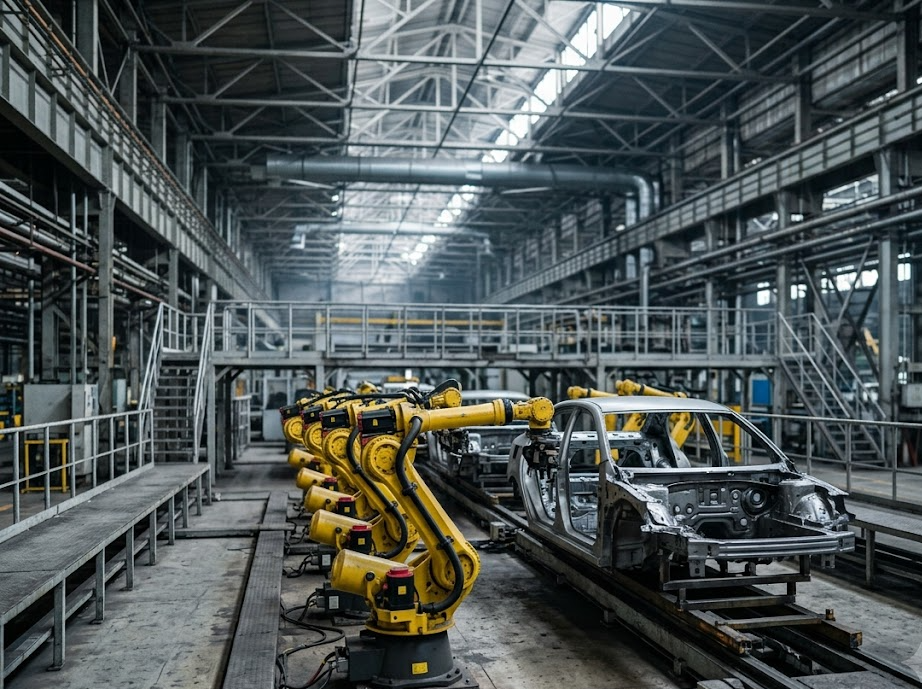
It is not GM's choice alone. Stellantis and Ford have also brought Fanuc robot arms into their U.S. plants, and Hyundai Motor plans to deploy Boston Dynamics' humanoid Atlas at its Georgia electric vehicle plant by 2028. Fanuc has operated so-called lights-out plants, which run with no people present, since 2001.
China's Jetour, Zeekr, and Xiaomi also run large-scale automated lines. At the UAW convention held in Detroit this month, President Shawn Fain warned that humanoids and large-scale automation could threaten jobs and wages.
Remarks by JD.com Chairman Richard Liu go a step further. At the APEC CEO Forum in Beijing, he said a day will come when robots deliver packages and delivery workers are basically no longer needed. He added that he worries about the jobs of the company's 700,000 delivery workers and stressed the need for retraining, but did not say when robot delivery would become common. JD.com has contracts with about 120 schools to teach its delivery workers robot repair and maintenance.
Domestic employment indicators worsened over the same period. Employment at the four largest business groups fell by more than 12,300 in a year, and at Samsung it dropped by 931, breaking a run of increases that had lasted seven straight years since 2017. In an analysis of employment changes in 2024-2025 by the Korea CXO Institute, the number of employees at domestic affiliates of the 102 large business groups designated by the Fair Trade Commission rose by only 8,170, and the growth rate fell from 1.8% to 0.4%. The two sets of statistics cover different subjects and periods, making it hard to subtract one from the other, but in both tallies the increase narrowed or turned into a decline.
The burden falls on those entering the labor market for the first time. The number of young people who are "just resting" has passed 400,000, and by the Korea Enterprises Federation's count the youth employment rate fell for 23 consecutive months starting last May. In the first quarter of this year, the number of people in their 20s and 30s who are unemployed, preparing for employment, or "just resting" was 1.71 million. In China, too, the unemployment rate for those aged 16-24 hit 16.3% in April, and about 12.7 million university graduates enter the market this summer.
The response is converging on retraining. The Ministry of Education is using 28.3 billion won from a supplementary budget to select 40 universities nationwide as operating institutions and provide advanced-industry education to about 4,000 people. The Korea Chamber of Commerce and Industry is pushing a K-New Deal Academy with Samsung, SK, LG, Hanwha, Lotte, and KT to train about 4,400 people through 39 specialized courses, fully covering the roughly 9 million won per person in tuition. Even combined, the two programs cover less than 0.5% of the 1.71 million people in their 20s and 30s.
At Shenzhen Airport, robots bring food to travelers, and a pilot program is running in which self-driving robots ride commuter trains to restock convenience stores. For a person who worked beside them to become a person who fixes the robots, arrangements such as contracts with 120 schools have to be in place. Now that AI has begun appearing in corporate filings as a reason for job cuts, what an individual needs to check is whether the company has a plan for where to move them. That plan can be checked in a meeting with the HR department.