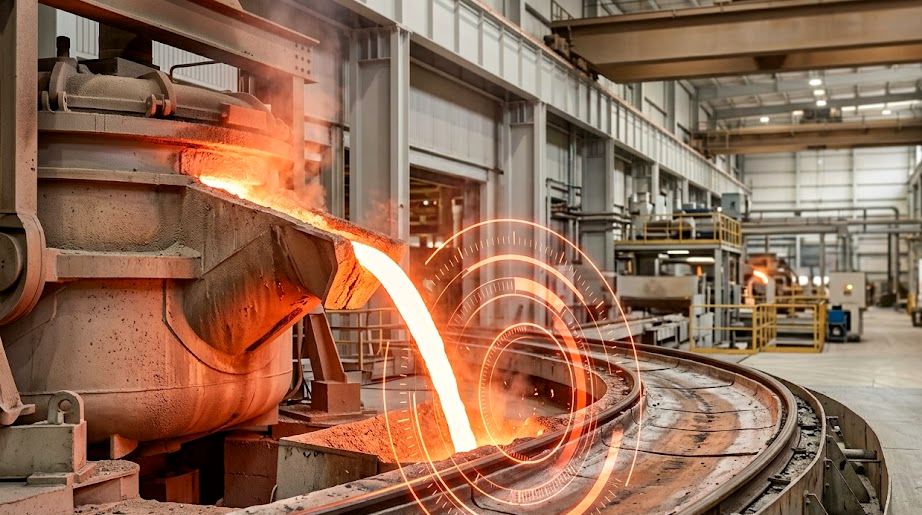
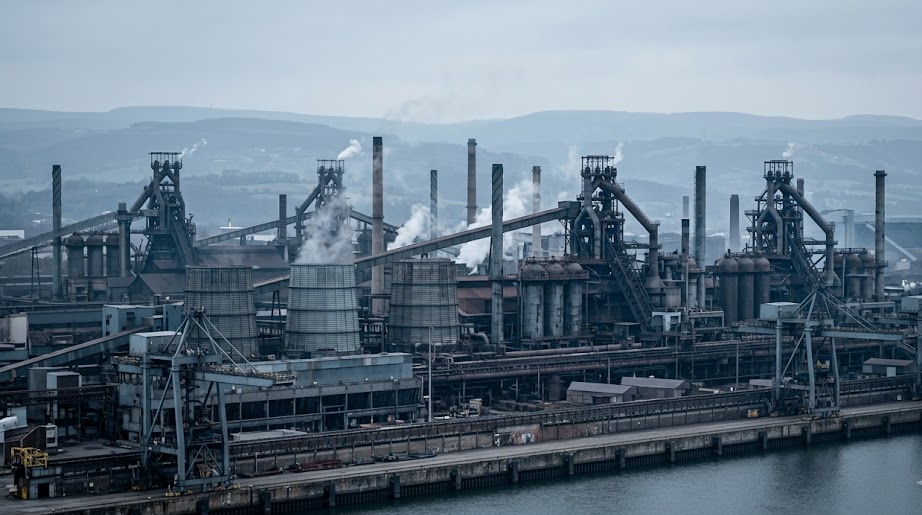
The Special Act on Strengthening the Competitiveness of the Steel Industry and the Transition to Carbon Neutrality (K-Steel Act) took effect on the 17th. It contains a low-carbon steel certification system, the designation of special districts, support for business restructuring and exceptions to the Fair Trade Act, and support measures for industrial electricity rates were not included in the provisions of the law. On the same day, POSCO held a completion ceremony at its Gwangyang Works for an electric arc furnace with an annual capacity of 2.5 million tons. It is the largest in the country for a single facility, and Prime Minister Kim Min-seok and POSCO Group Chairman Chang In-hwa were among those who attended.
The Gwangyang electric furnace is expected to cut carbon emissions by up to 75% compared with a blast furnace. POSCO also has a plan to secure commercial hydrogen reduction ironmaking (HyREX) technology by 2030. The facility has been built, but the cost of the power to run it and the burden of emissions allowances remain variables in the transition phase.
By the Korea Enterprises Federation's count, the average unit price of industrial electricity rose 75.8% over the three years from 2022 to 2025. Dongkuk Steel's power costs in 2025 came to 296 billion won, about five times its operating profit of 59.4 billion won that year, and its utilization rate that year was 74.9%. POSCO has covered about 85% of its total power consumption through in-house generation.
Conditions on the emissions allowance side are changing as well. In the national allowance allocation plan for the fourth planning period (2026-2030), the government set the total allowable greenhouse gas emissions at 2.5373 billion tons, 16.8% lower than before. The share of paid allocation in the power generation sector will rise from 10% to 50% by 2030. According to the emissions trading market information platform, the price of 2025 allowances (KAU25) rose from around 10,000 won per ton last December to the 20,000 won range.
Based on a Korea Energy Economics Institute report, expanding paid allocation to 50% would raise the manufacturing sector's electricity cost burden by about 2.5 trillion won a year, with additional costs of 309.4 billion won in the primary metals industry and 416 billion won in the chemicals industry. Energy-intensive industries such as steel, petrochemicals and cement receive free allocation that reflects trade intensity, but district energy, which supplies them with heat and power, is classified as power generation and takes the full impact of the expansion in paid allocation. Coal accounts for about 48% of the fuel used in industrial complex district energy, and the facilities amount to about 1.3GW. The won-dollar exchange rate also rose from the 1,380 won range in June 2025 to around 1,500 won, adding to the burden of installing facilities.
The supply picture is tight worldwide as well. The World Steel Association projected that, judging by the current project pipeline, green steel production will remain at about 70 million tons a year through the end of the 2020s. Compared with the projected global annual steel production of about 2 billion tons, that is 3.5%. About half of the planned green steel projects have fallen behind schedule.

The funding gap is wider. Governments have pledged 20 billion dollars (about 27.6 trillion won) in support for steel decarbonization, while the investment required is estimated at 1.5 trillion dollars (about 2,070 trillion won). Only 1.3% of the necessary funds has been secured, which stands against the steel industry's share of roughly 7-9% of global carbon emissions. Zhong Shaoliang, deputy director general of the World Steel Association, said emissions per ton of steel have barely changed over the past 10 years.
The trend in capacity expansion is running the other way as well. The OECD projects that new blast furnace capacity planned in India and Southeast Asia alone from 2024 through this year is similar in scale to all of the world's green steel projects combined. Once built, a blast furnace is used for up to 40 years. At the annual meeting of the steel industry in Singapore on the 19th (local time), project delays, a lack of government support and weak demand were cited as the core problems.
There are also voices calling for policies that create demand. Yeoh Choon Kui, vice president of the Malaysian Iron and Steel Industry Federation, said the green steel discussion has leaned only toward supply, and that governments should make the use of green steel mandatory in major infrastructure projects. Japan is putting 3 trillion yen (about 28.6 trillion won) into energy transition and steel decarbonization technology over the next 10 years, with a target of supplying 10 million tons of green steel in 2030. The EU included in its European Steel and Metals Action Plan the promotion of power purchase agreements, energy tax reductions, grid expansion and compensation for carbon costs within electricity prices under the emissions trading system, and India put forward a roadmap that includes green steel production and preferential public procurement.
Korea's crude steel production in 2025 was 62 million tons, sixth in the world. The downward trend has continued since the 70-million-ton production system broke down after 2022. At home, the industry is calling for support measures to ease the industrial electricity cost burden and for regional differentiation of electricity rates based on the Distributed Energy Act. The POSCO Research Institute recently released a report titled "Defend Steel Sovereignty!: The Changing Global Steel Policy Paradigm."
The EU's Carbon Border Adjustment Mechanism (CBAM) enters full operation this year. The expansion of paid allocation of emissions allowances will proceed in stages through 2030, and how much transition funding the K-Steel Act's certification system and special district designations are actually tied to will become clear in subordinate legislation and budget planning. The Gwangyang electric furnace is the largest in the country, but measured against the outlook for global green steel supply it amounts to one piece.