
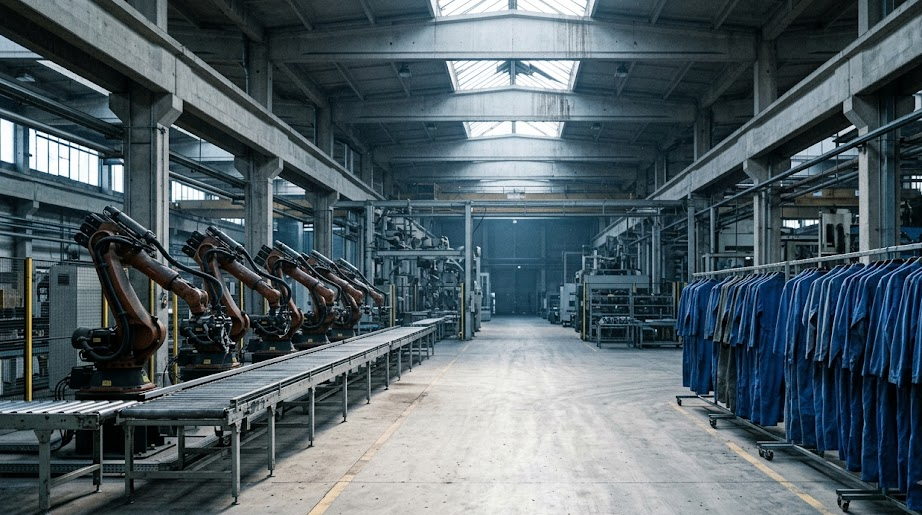
After more than 1,000 layoffs at Factory Zero, an electric vehicle production base in the United States, some 50 collaborative robots made by Japan's Fanuc were deployed in the same space. Collaborative robots are machines designed to work alongside people without safety fences, and they can be fitted into existing processes without rebuilding an entire line. GM spokesman Kevin Kelly said the deployment goes beyond a move to cut costs and is meant to ease the physical burden on workers and secure manufacturing competitiveness. James Cotton, president of United Auto Workers Local 22, voiced opposition to the situation in which machines have moved into processes that people have left.
A similar signal came from the office side the same week. Amazon has cut 30,000 jobs so far this year, citing AI investment. The company did not say whether the tally covers the world or the United States, or through what point it was compiled.
When this happens in factories and offices at the same time, the nature of what is going on in the labor market changes. Employment falling because of a downturn in a particular industry and work itself moving to machines do not follow the same path to recovery. In the former case hiring returns when demand returns, but in the latter people do not return even when output rises.
Other readings exist. Some experts assess that companies are using AI as a supplementary means to raise productivity rather than to remove people. The two accounts do not directly conflict. One is what actually happened at individual workplaces, and the other is a diagnosis of the overall trend.
South Korea's figures have also turned. In the May 2026 employment trends released by the National Data Office, the number of employed people fell by 40,000 from the same month a year earlier, the first decline in 17 months since December 2024. Manufacturing lost 140,000 and construction 43,000. The youth employment rate fell from 46.2% to 43.8%, and the youth unemployment rate rose from 6.6% to 7.2%.
Yet there are no statistics showing how much of that decline was taken over by robots or software. The U.S. workplace cases and the South Korean statistics have different bases and cannot be laid over one another directly. What the government pointed to as the background for the May figures was the prolonged war in the Middle East.
On June 17 at 8 a.m. at the Government Complex Seoul, the government held a joint interagency jobs task force meeting presided over by Lee Hyung-il, first vice minister of Finance and Economy, and Kwon Chang-jun, vice minister of Employment and Labor. The meeting assessed that young people are struggling with demographic and industrial change, hiring practices that have settled around experienced workers and rolling recruitment, and the war in the Middle East. A basic plan combining retraining, job transition support and a stronger employment safety net is also being prepared in response to changes in labor demand driven by the AI transition and the green industrial transition. The timing of its release was given only as "soon," and the plan's official name has yet to be fixed.
When Google chief executive Sundar Pichai took the stage as a speaker at Stanford University's commencement, students protesting AI policy walked out of the hall as a group. At the University of Arizona commencement a month earlier in May, former Google CEO Eric Schmidt was booed while speaking on AI.
Nvidia CEO Jensen Huang said that when a new technology appears, changes in social norms should be discussed along with regulation. Which tasks are handed to machines and which ones people keep, and who shares the returns from what is handed over and how, become the substance of those norms.
The jobs task force meets weekly, and response measures come out through the meeting of economy-related ministers. The next employment trends release covers June statistics, and those figures will determine whether May's decline is seen as a temporary wobble or a turn in the trend.